
Pulp Fiction, 1924 · page 32 of 172
Argosy All-Story Weekly, October 25, 1924 — page 32: what you’re looking at
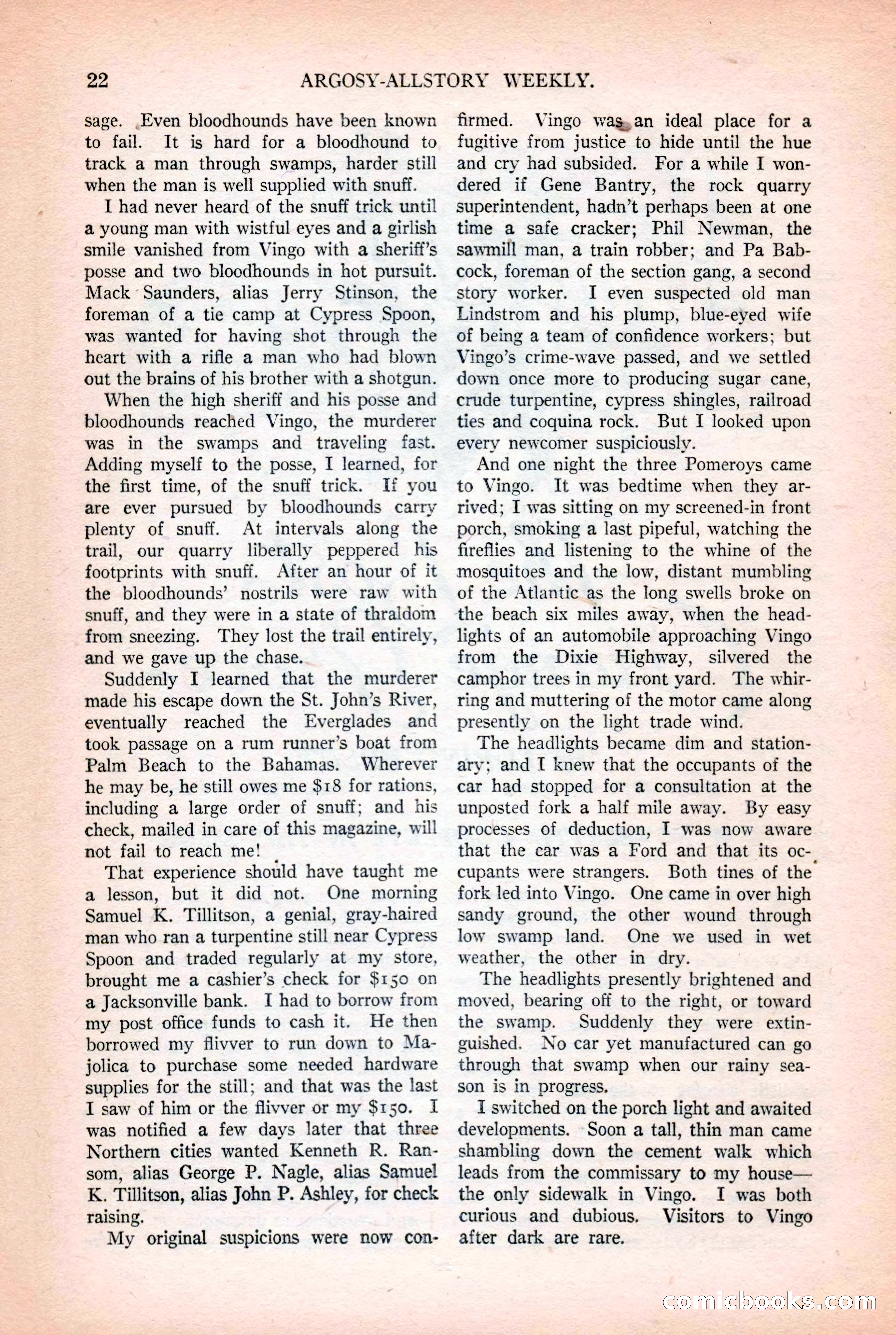
A restored page from Pulp Fiction, 1924. Page through the whole issue in the reader above.
📄 Transcribed text from this page (OCR, searchable)
Machine-transcribed from the original scan — historical spelling and the odd misread are preserved.
22 sage. .Even bloodhounds have been known to fail. It is hard for a bloodhound to track a man through swamps, harder still when the man is well supplied with snuff. I had never heard of the snuff trick until a young man with wistful eyes and a girlish smile vanished from Vingo with a sheriff’s posse and two bloodhounds in hot pursuit. Mack Saunders, alias Jerry Stinson, the foreman of a tie camp at Cypress Spoon, was wanted for having shot through the heart with a rifle a man who had blown out the brains of his brother with a shotgun. When the high sheriff and his posse and bloodhounds reached Vingo, the murderer was in the swamps and traveling fast. Adding myself to the posse, I learned, for the first time, of the snuff trick. If you are ever pursued by bloodhounds carry plenty of snuff. At intervals along the trail, our quarry liberally peppered his footprints with snuff. After an hour of it the bloodhounds’ nostrils were raw with snuff, and they were in a state of thraldom from sneezing. They lost the trail entirely, and we gave up the chase. Suddenly I learned that the murderer made his escape down the St. John’s River, eventually reached the Everglades and took passage on a rum runner’s boat from Palm Beach to the Bahamas. Wherever he may be, he still owes me $18 for rations, including a large order of snuff; and his check, mailed in care of this magazine, will not fail to reach me! | That experience should have taught me a lesson, but it did not. One morning Samuel K. Tillitson, a genial, gray-haired man who ran a turpentine still near Cypress Spoon and traded regularly at my store, brought me a cashier’s check for $150 on a Jacksonville bank. I had to borrow from my post office funds to cash it. He then borrowed my flivver to run down to Ma- jolica to purchase some needed hardware supplies for the still; and that was the last I saw of him or the flivver or my $150. I was notified a few days later that three Northern cities wanted Kenneth R. Ran- som, alias George P. Nagle, alias Samuel K. Tillitson, alias John P. Ashley, for check raising. My original suspicions were now con- ARGOSY-ALLSTORY WEEKLY. firmed. Vingo wag,an ideal place for a fugitive from justice to hide until the hue and cry had subsided. For a while I won- dered if Gene Bantry, the rock quarry superintendent, hadn’t perhaps been at one time a safe cracker; Phil Newman, the sawmill man, a train robber; and Pa Bab- cock, foreman of the section gang, a second story worker. I even suspected old man Lindstrom and his plump, blue-eyed wife of being a team of confidence workers; but Vingo’s crime-wave passed, and we settled down once more to producing sugar cane, crude turpentine, cypress shingles, railroad ties and coquina rock. But I looked upon every newcomer suspiciously. And one night the three Pomeroys came to Vingo. It was bedtime when they ar- rived; I was sitting on my screened-in front porch, smoking a last pipeful, watching the fireflies and listening to the whine of the mosquitoes and the low, distant mumbling of the Atlantic as the long swells broke on the beach six miles away, when the head- lights of an automobile approaching Vingo from the Dixie Highway, silvered the camphor trees in my front yard. The whir- ring and muttering of the motor came along presently on the light trade wind. The headlights became dim and station- ary; and I knew that the occupants of the car had stopped for a consultation at the unposted fork a half mile away. By easy processes of deduction, I was now aware that the car was a Ford and that its oc- cupants were strangers. fork led into Vingo. One came in over high sandy ground, the other wound through low swamp land. One we used in wet weather, the other in dry. The headlights presently brightened and moved, bearing off to the right, or toward the swamp. Suddenly they were extin- guished. No car yet manufactured can go through that swamp when our rainy sea- son is in progress. I switched on the porch light and awaited developments. Soon a tall, thin man came shambling down the cement walk which leads from the commissary to my house— the only sidewalk in Vingo. I was both curious and dubious. Visitors to Vingo after dark are rare. Gomichbooks Both tines of the (C@