
Pulp Fiction, 1924 · page 28 of 172
Argosy All-Story Weekly, October 25, 1924 — page 28: what you’re looking at
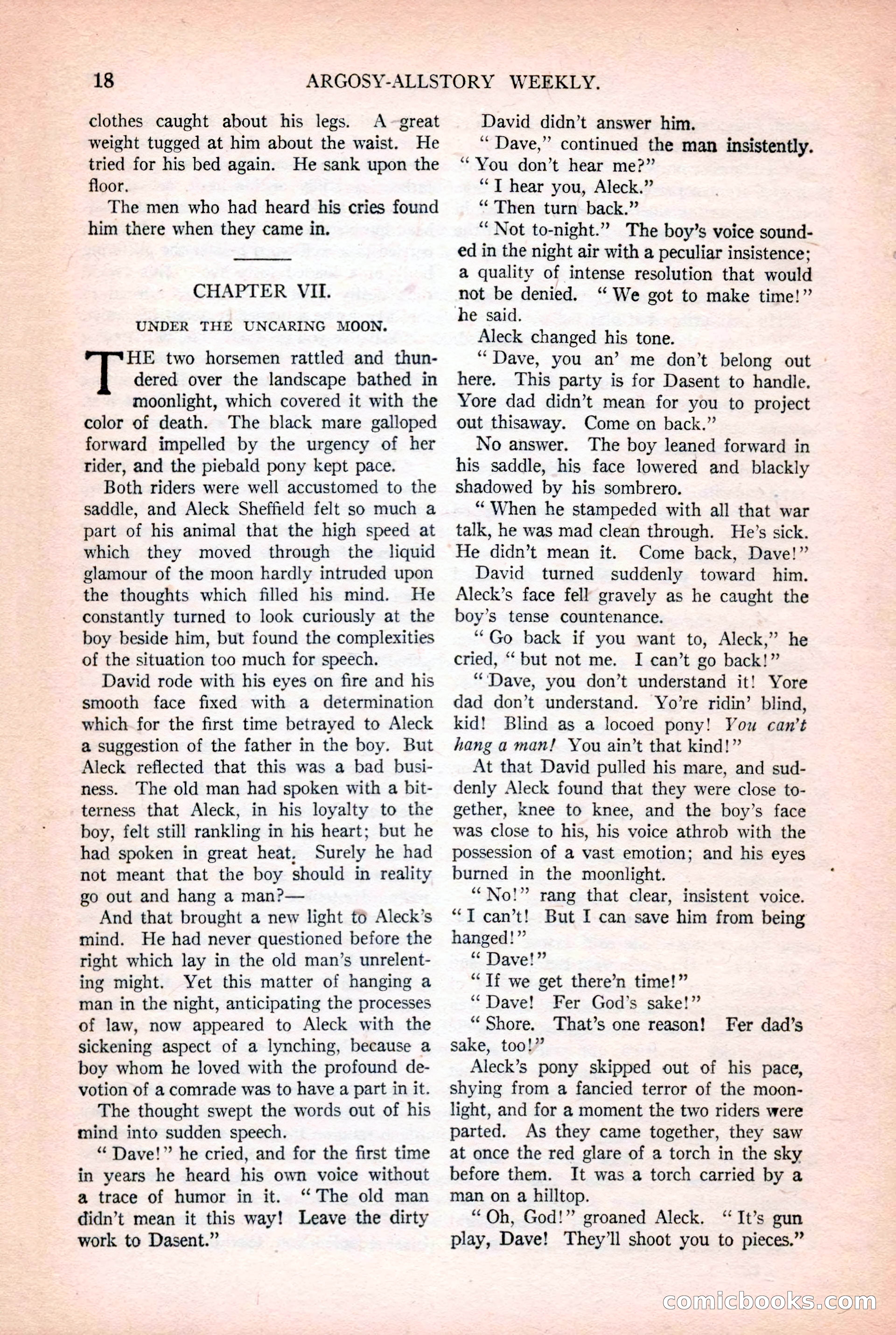
A restored page from Pulp Fiction, 1924. Page through the whole issue in the reader above.
📄 Transcribed text from this page (OCR, searchable)
Machine-transcribed from the original scan — historical spelling and the odd misread are preserved.
18 ARGOSY-ALLSTORY WEEKLY. clothes caught about his legs. A~great weight tugged at him about the waist. He tried for his bed again. He sank upon the floor. The men who had heard his cries found him there when they came in. CHAPTER VII. UNDER THE UNCARING MOON. HE two horsemen rattled and thun- dered over the landscape bathed in moonlight, which covered it with the color of death. The black mare galloped forward impelled by the urgency of her rider, and the piebald pony kept pace. Both riders were well accustomed to the saddle, and Aleck Sheffield felt so much a part of his animal that the high speed at which they moved through the _ liquid glamour of the moon hardly intruded upon the thoughts which filled his mind. He constantly turned to look curiously at the boy beside him, but found the complexities of the situation too much for speech. David rode with his eyes on fire and his smooth face fixed with a determination which for the first time betrayed to Aleck a suggestion of the father in the boy. But Aleck reflected that this was a bad busi- ness. The old man had spoken with a bit- terness that Aleck, in his loyalty to the boy, felt still rankling in his heart; but he had spoken in great heat, Surely he had not meant that the boy should in reality go out and hang a man?— And that brought a new light to Aleck’s mind. He had never questioned before the right which lay in the old man’s unrelent- ing might. Yet this matter of hanging a man in the night, anticipating the processes of law, now appeared to Aleck with the sickening aspect of a lynching, because a boy whom he loved with the profound de- votion of a comrade was to have a part in it. The thought swept the words out of his mind into sudden speech. “‘ Dave!” he cried, and for the first time in years he heard his own voice without a trace of humor in it. ‘The old man didn’t mean it this way! Leave the dirty work to Dasent.” David didn’t answer him. “ Dave,” continued the man insistently. “You don’t hear me?” ‘“T hear you, Aleck.” “Then turn back.” “Not to-night.” The boy’s voice sound- ed in the night air with a peculiar insistence; a quality of intense resolution that would not be denied. ‘“ We got to make time!” he said. Aleck changed his tone. ‘Dave, you an’ me don’t belong out here. This party is for Dasent to handle. Yore dad didn’t mean for you to project out thisaway. Come on back.” No answer. The boy leaned forward in his saddle, his face lowered and blackly shadowed by his sombrero. “When he stampeded with all that war talk, he was mad clean through. He’s sick. He didn’t mean it. Come back, Dave!” David turned suddenly toward him. Aleck’s face fell gravely as he caught the boy’s tense countenance. “Go back if you want to, Aleck,” he cried, “but not me. I can’t go back!” “Dave, you don’t understand it! Yore dad don’t understand. Yo’re ridin’ blind, kid! Blind as a locoed pony! You can’t hang aman! You ain’t that kind!” At that David pulled his mare, and sud- denly Aleck found that they were close to- gether, knee to knee, and the boy’s face was close to his, his voice athrob with the possession of a vast emotion; and his eyes burned in the moonlight. “No!” rang that clear, insistent voice. “T can’t! But I can save him from being hanged!” “* Dave!” “Tf we get there’n time!” ‘Dave! Fer God’s sake!” “Shore. That’s one reason! Fer dad’s sake, too!” Aleck’s pony skipped out of his pace, shying from a fancied terror of the moon- light, and for a moment the two riders were parted. As they came together, they saw at once the red glare of a torch in the sky before them. It was a torch carried by a man on a hilltop. “Oh, God!” groaned Aleck. “It’s gun play, Dave! They’ll shoot you to pieces.” Gomichbooks co