
Pulp Fiction, 1924 · page 166 of 172
Argosy All-Story Weekly, October 25, 1924 — page 166: what you’re looking at
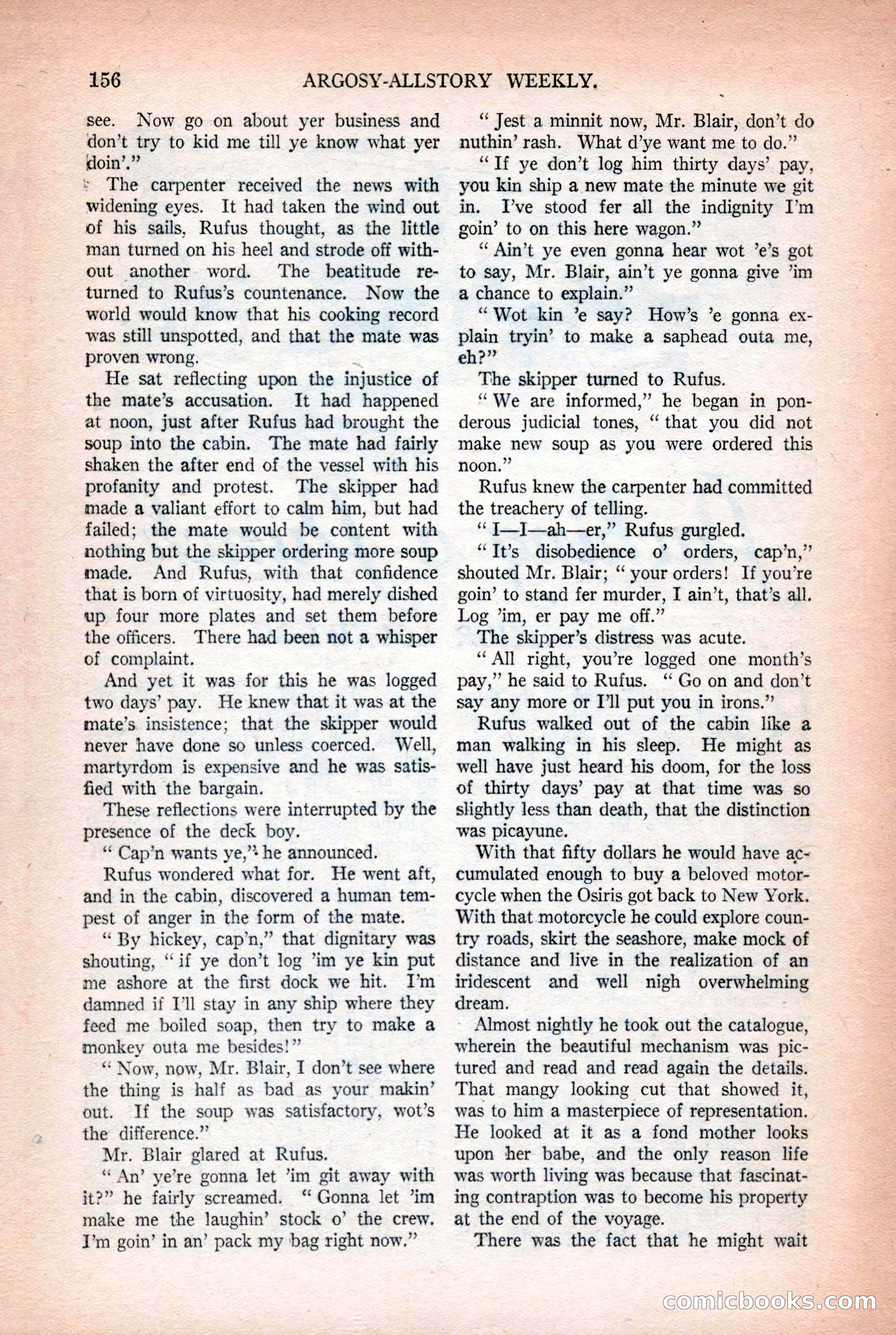
A restored page from Pulp Fiction, 1924. Page through the whole issue in the reader above.
📄 Transcribed text from this page (OCR, searchable)
Machine-transcribed from the original scan — historical spelling and the odd misread are preserved.
yiiis get, ¢ tng " dys 156 see. Now go on about yer business and don’t try to kid me till ye know what yer doin’.” The carpenter received the news with widening eyes. It had taken the wind out of his sails, Rufus thought, as the little man turned on his heel and strode off with- out another word. The beatitude re- turned to Rufus’s countenance. Now the world would know that his cooking record was still unspotted, and that the mate was proven wrong. He sat reflecting upon the injustice of the mate’s accusation. It had happened at noon, just after Rufus had brought the soup into the cabin. The mate had fairly shaken the after end of the vessel with his profanity and protest. The skipper had made a valiant effort to calm him, but had failed; the mate would be content with nothing but the skipper ordering more soup made. And Rufus, with that confidence that is born of virtuosity, had merely dished up four more plates and set them before the officers. There had been not a whisper of complaint. And yet it was for this he was logged two days’ pay. He knew that it was at the mate’s insistence; that the skipper would never have done so unless coerced. Well, martyrdom is expensive and he was satis- fied with the bargain. These reflections were interrupted by the presence of the deck boy. “ Cap’n wants ye,’* he announced. Rufus wondered what for. He went aft, and in the cabin, discovered a human tem- pest of anger in the form of the mate. “ By hickey, cap’n,” that dignitary was shouting, “if ye don’t log ‘im ye kin put me ashore at the first dock we hit. I’m damned if I’ll stay in any ship where they feed me boiled soap, then try to make a monkey outa me besides!” ** Now, now, Mr. Blair, I don’t see where the thing is half as bad as your makin’ out. If the soup was satisfactory, wot’s the difference.” Mr. Blair glared at Rufus. “ An’ ye’re gonna let ’im git away with it?” he fairly screamed. ‘ Gonna let ’im make me the laughin’ stock o’ the crew. I’m goin’ in an’ pack my bag right now.” ARGOSY-ALLSTORY WEEKLY, “ Jest a minnit now, Mr. Blair, don’t do nuthin’ rash. What d’ye want me to do.” “Tf ye don’t log him thirty days’ pay, you kin ship a new mate the minute we git in. I’ve stood fer all the indignity I’m goin’ to on this here wagon.” “‘ Ain’t ye even gonna hear wot ’e’s got to say, Mr. Blair, ain’t ye gonna give ‘im a chance to explain.” “Wot kin ’e say? How’s ’e gonna ex- plain tryin’ to make a saphead outa me, eh?” The skipper turned to Rufus. ‘We are informed,” he began in pon- derous judicial tones, “‘ that you did not make new soup as you were ordered this noon.” Rufus knew the carpenter had committed the treachery of telling. ‘* [—J—ah—er,” Rufus gurgled. “Tt’s disobedience o’ orders, cap’n,” shouted Mr. Blair; ‘‘ your orders! If you’re goin’ to stand fer murder, I ain’t, that’s all. Log ’im, er pay me off.” The skipper’s distress was acute. ‘“‘ All right, you’re logged one month’s pay,” he said to Rufus. ‘ Go on and don’t say any more or I'll put you in irons.” Rufus walked out of the cabin like a man walking in his sleep. He might as well have just heard his doom, for the loss of thirty days’ pay at that time was so slightly less than death, that the distinction was picayune. With that fifty dollars he would have ac- cumulated enough to buy a beloved motor- cycle when the Osiris got back to New York. With that motorcycle he could explore coun- try roads, skirt the seashore, make mock of distance and live in the realization of an iridescent and well nigh overwhelming dream. Almost nightly he took out the catalogue, wherein the beautiful mechanism was pic- tured and read and read again the details. That mangy looking cut that showed it, was to him a masterpiece of representation. He looked at it as a fond mother looks upon her babe, and the only reason life was worth living was because that fascinat- ing contraption was to become his property at the end of the voyage. There was the fact that he might wait COMMICLOOOKS (E@)