
Pulp Fiction, 1924 · page 153 of 172
Argosy All-Story Weekly, October 25, 1924 — page 153: what you’re looking at
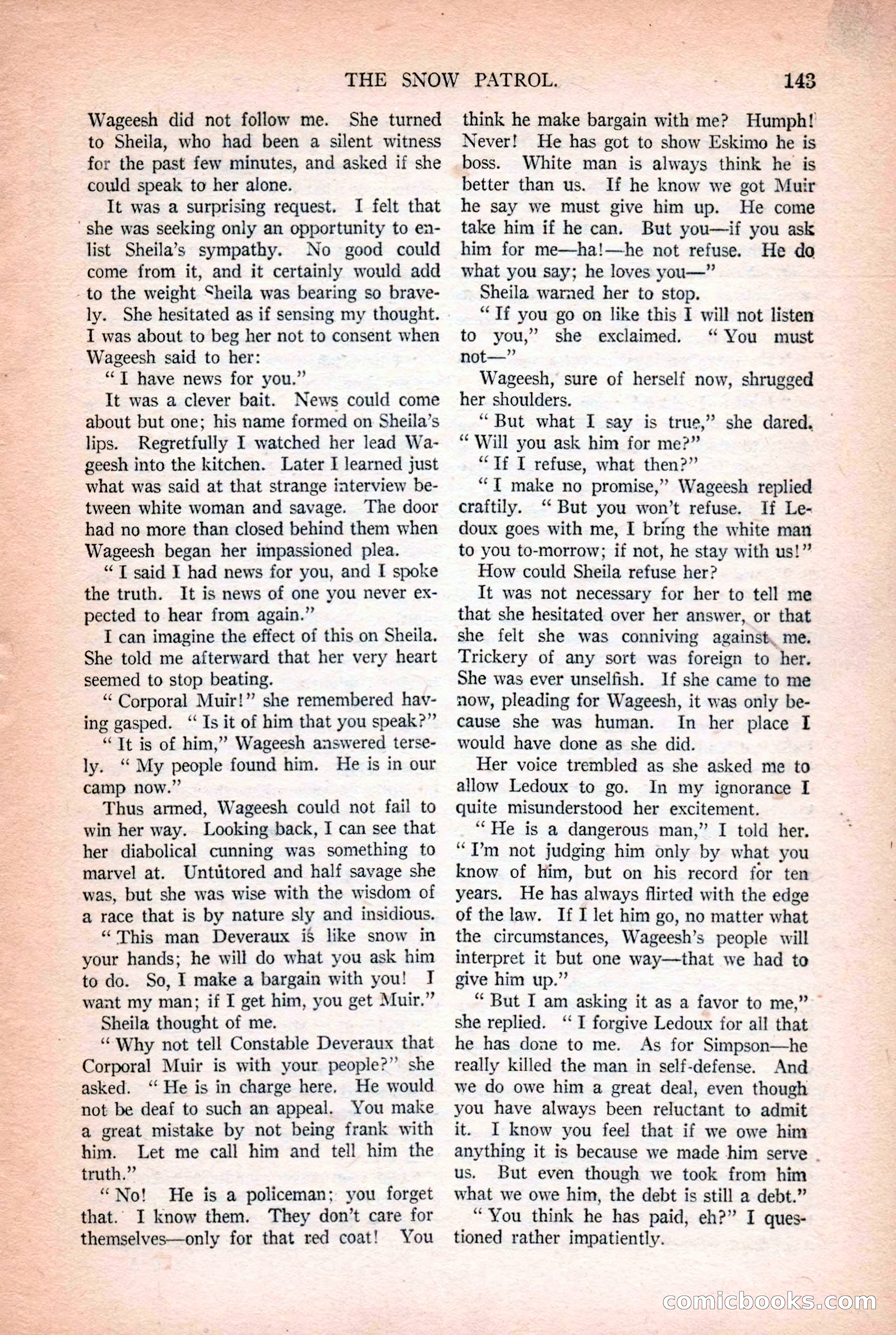
A restored page from Pulp Fiction, 1924. Page through the whole issue in the reader above.
📄 Transcribed text from this page (OCR, searchable)
Machine-transcribed from the original scan — historical spelling and the odd misread are preserved.
THE SNOW PATROL. Wageesh did not follow me. She turned to Sheila, who had been a silent witness for the past few minutes, and asked if she could speak to her alone. It was a surprising request. I felt that she was seeking only an opportunity to en- list Sheila’s sympathy. No good could come from it, and it certainly would add -to the weight Sheila was bearing so brave- ly. She hesitated as if sensing my thought. I was about to beg her not to consent when Wageesh said to her: ““T have news for you.” It was a clever bait. News could come about but one; his name formed on Sheila’s lips. Regretfully I watched her lead Wa- geesh into the kitchen. Later I learned just what was said at that strange interview be- tween white woman and savage. The door had no more than closed behind them when Wageesh began her impassioned plea. “ T said I had news for you, and I spoke the truth. It is news of one you never ex- pected to hear from again.” I can imagine the effect of this on Sheila. She told me afterward that her very heart seemed to stop beating. “Corporal Muir!” she remembered hav- ing gasped. “Is it of him that you speak?” “Tt is of him,” Wageesh answered terse- ly. “ My people found him. He is in our camp now.” Thus armed, Wageesh could not fail to win her way. Looking back, I can see that her diabolical cunning was something to marvel at. Untutored and half savage she was, but she was wise with the wisdom of a race that is by nature sly and insidious. “This man Deveraux i§ like snow in your hands; he will do what you ask him to do. So, I make a bargain with you! I want my man; if I get him, you get Muir.” Sheila thought of me. ‘““Why not tell Constable Deveraux that Corporal Muir is with your people?” she asked. ‘‘ He is in charge here. He would not be deaf to such an appeal. You make a great mistake by not being frank with him. Let me call him and tell him the truth.” “No! He is a policeman; you forget that. I know them. They don’t care for themselves—only for that red coat! You 145 think he make bargain with me? Humph! Never! He has got to show Eskimo he is boss. White man is always think he is better than us. If he know we got Muir he say we must give him up. He come take him if he can. But you—if you ask him for me—ha!—he not refuse. He do what you say; he loves you—” Sheila warned her to stop. “Tf you go on like this I will not listen to you,” she exclaimed. ‘“ You must not—” Wageesh, sure of herself now, shrugged her shoulders. “But what I say is true,” she dared. “ Will you ask him for me?” “Tf I refuse, what then?” ““{ make no promise,” Wageesh replied craftily. “ But you won’t refuse. If Le- doux goes with me, I bring the white man to you to-morrow; if not, he stay with us!” How could Sheila refuse her? It was not necessary for her to tell me that she hesitated over her answer, or that she felt she was conniving against, me. Trickery of any sort was foreign to her. She was ever unselfish. If she came to me now, pleading for Wageesh, it was only be- cause she was human. In her place I would have done as she did. Her voice trembled as she asked me to allow Ledoux to go. In my ignorance I quite misunderstood her excitement. ‘““He is a dangerous man,” I told her. “Tm not judging him only by what you know of him, but on his record for ten years. He has always flirted with the edge of the law. If I let him go, no matter what the circumstances, Wageesh’s people will interpret it but one way—that we had to give him up.” “ But I am asking it as a favor to me,” she replied. ‘ I forgive Ledoux for all that he has done to me. As for Simpson—he really killed the man in self-defense. And we do owe him a great deal, even though you have always been reluctant to admit it. I know you feel that if we owe him anything it is because we made him serve . us. But even though we took from him what we owe him, the debt is still a debt.” “You think he has paid, eh?” I ques- tioned rather impatiently. NOOK = A (C@ - “nd aA fe Ve ss sot me 4 ot ae yt he ngs At Mews tp on ght: Fx com