
Pulp Fiction, 1924 · page 123 of 172
Argosy All-Story Weekly, October 25, 1924 — page 123: what you’re looking at
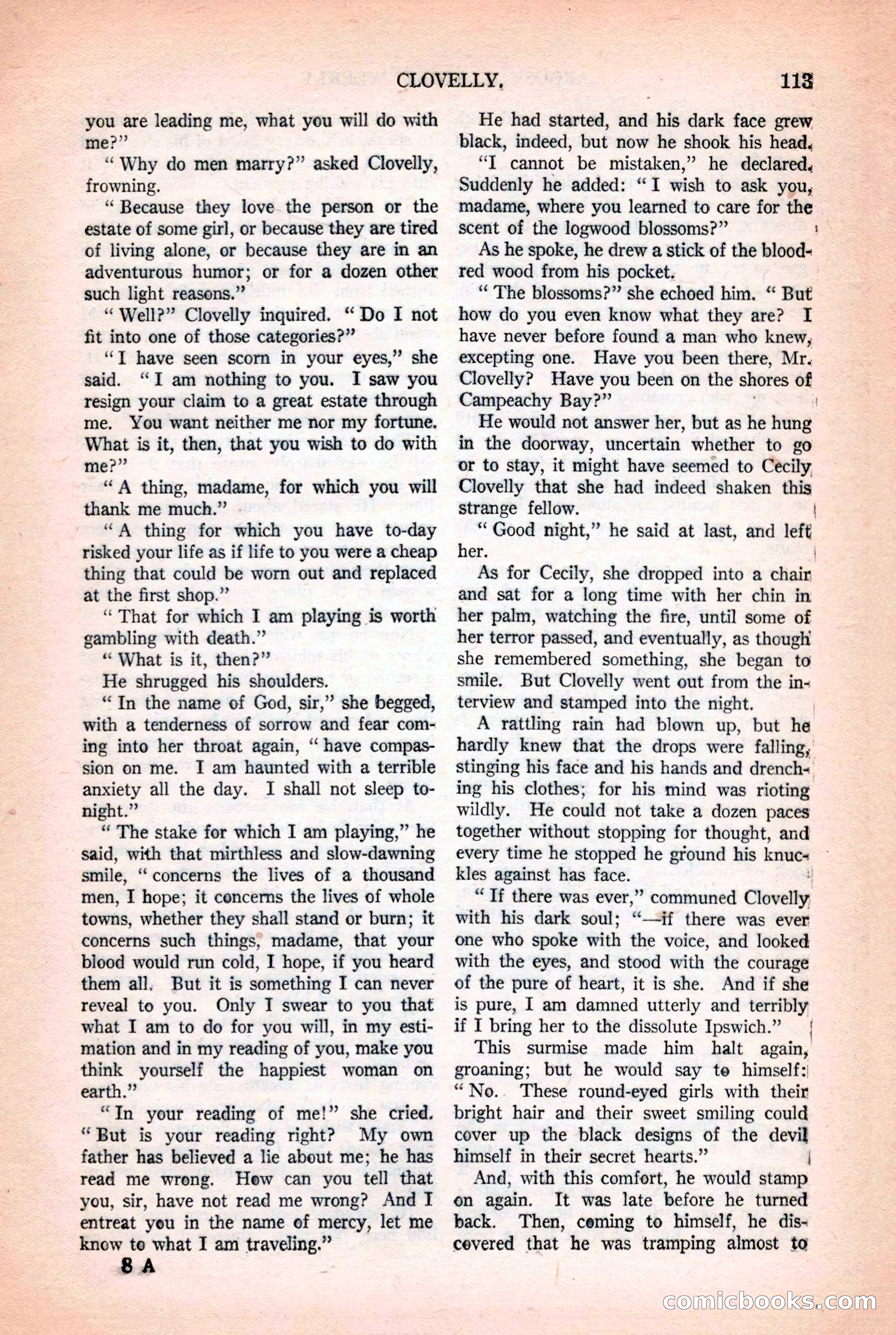
A restored page from Pulp Fiction, 1924. Page through the whole issue in the reader above.
📄 Transcribed text from this page (OCR, searchable)
Machine-transcribed from the original scan — historical spelling and the odd misread are preserved.
CLOVELLY, you are leading me, what you will do with me?” ‘““Why do men marry?” asked Clovelly, frowning. “ Because they love the person or the estate of some girl, or because they are tired of living alone, or because they are in an adventurous humor; or for a dozen other such light reasons.” “Well?” Clovelly inquired. “ Do I not fit into one of those categories?” ‘““T have seen scorn in your eyes,” she said. ‘I am nothing to you. I saw you resign your claim to a great estate through me. You want neither me nor my fortune. What is it, then, that you wish to do with me?” “ A thing, madame, for which you will thank me much.” “A thing for which you have to-day risked your life as if life to you were a cheap thing that could be worn out and replaced at the first shop.” “That for which I am playing is worth gambling with death.” “What is it, then?” He shrugged his shoulders. “In the name of God, sir,” she begged, with a tenderness of sorrow and fear com- ing into her throat again, “ have compas- sion on me. I am haunted with a terrible anxiety all the day. I shall not sleep to- night.” “ The stake for which I am playing,” he said, with that mirthless and slow-dawning smile, “concerns the lives of a thousand men, I hope; it concerns the lives of whole towns, whether they shall stand or burn; it concerns such things, madame, that your blood would run cold, I hope, if you heard them all, But it is something I can never reveal to you. Only I swear to you that what I am to do for you will, in my esti- mation and in my reading of you, make you think yourself the happiest woman on earth.” “In your reading of me!” she cried. “But is your reading right? My own father has believed a lie about me; he has read me wrong. Hew can you tell that you, sir, have not read me wrong? And I entreat you in the name of mercy, let me know te what I am traveling.” 8A 113 He had started, and his dark face grew black, indeed, but now he shook his head. “I cannot be mistaken,” he declared, Suddenly he added: “TI wish to ask you, madame, where you learned to care for the scent of the logwood blossoms?” As he spoke, he drew a stick of the blood- red wood from his pocket. “The blossoms?” she echoed him. “ But how do you even know what they are? I have never before found a man who knew, excepting one. Have you been there, Mr. Clovelly? Have you been on the shores of Campeachy Bay?” He would not answer her, but as he hung in the doorway, uncertain whether to go or to stay, it might have seemed to Cecily Clovelly that she had indeed shaken this strange fellow. “Good night,” he said at last, and left her. As for Cecily, she dropped into a chair and sat for a long time with her chin in her palm, watching the fire, until some of her terror passed, and eventually, as though she remembered something, she began to smile. But Clovelly went out from the in- terview and stamped into the night. ! j { A rattling rain had blown up, but he hardly knew that the drops were falling, stinging his face and his hands and drench< ing his clothes; for his mind was rioting wildly. He could not take a dozen paces together without stopping for thought, and every time he stopped he ground his knuc= kles against has face. “Tf there was ever,” communed Clovelly with his dark soul; “—if there was ever one who spoke with the voice, and looked with the eyes, and stood with the courage of the pure of heart, it is she. And if she is pure, I am damned utterly and terribly if I bring her to the dissolute Ipswich.” f { This surmise made him halt again, groaning; but he would say te himself; “No. These round-eyed girls with their bright hair and their sweet smiling could cover up the black designs of the sy himself in their secret hearts.” And, with this comfort, he would ilies on again. It was late before he turned back. Then, ceming to himself, he dis- cevered that he was tramping almost to CORMICLOO© Sa (E@