
Pulp Fiction, 1924 · page 93 of 172
Argosy All-Story Weekly, August 9, 1924 — page 93: what you’re looking at
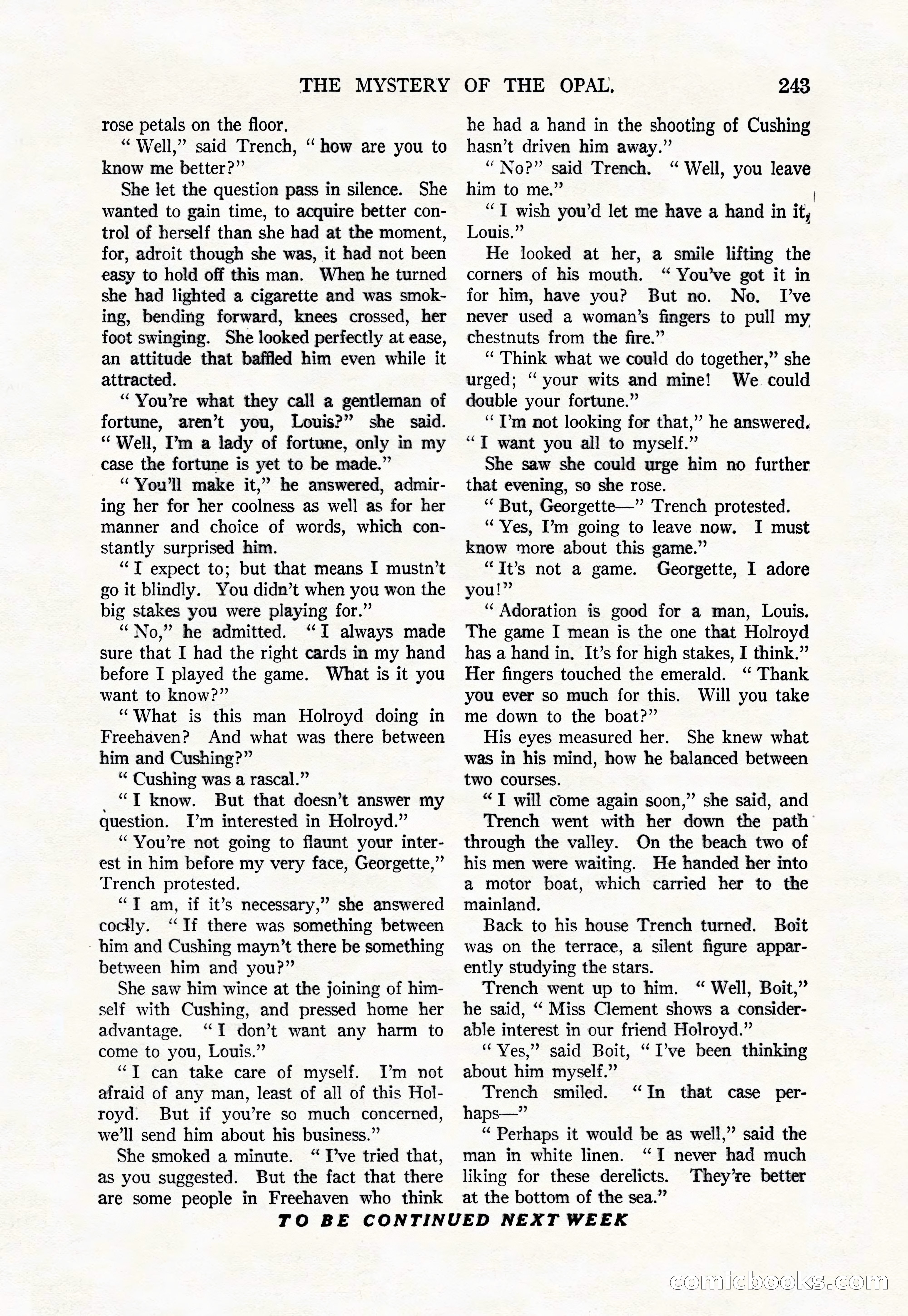
A restored page from Pulp Fiction, 1924. Page through the whole issue in the reader above.
📄 Transcribed text from this page (OCR, searchable)
Machine-transcribed from the original scan — historical spelling and the odd misread are preserved.
THE MYSTERY rose petals on the floor. “Well,” said Trench, “ how are you to know me better?”’ She let the question pass in silence. She wanted to gain time, to acquire better con- trol of herself than she had at the moment, for, adroit though she was, it had not been easy to hold off this man. When he turned she had lighted a cigarette and was smok- ing, bending forward, knees crossed, her foot swinging. She looked perfectly at ease, an attitude that baffled him even while it attracted. “You’re what they call a gentleman of fortune, aren’t you, Louis?” she said. “Well, I’m a lady of fortune, only in my case the fortune is yet to be made.” “You'll make it,” he answered, admir- ing her for her coolness as well as for her manner and choice of words, which con- stantly surprised him. ““T expect to; but that means I mustn’t go it blindly. You didn’t when you won the big stakes you were playing for.” “No,” he admitted. “I always made sure that I had the right cards in my hand before I played the game. What is it you want to know?” “What is this man Holroyd doing in Freehaven? And what was there between him and Cushing?” “ Cushing was a rascal.” _“T know. But that doesn’t answer my question. I’m interested in Holroyd.” “You're not going to flaunt your inter- est in him before my very face, Georgette,” Trench protested. “T am, if it’s necessary,” she answered coclly. “If there was something between him and Cushing mayn’t there be something between him and you?” She saw him wince at the joining of him- self with Cushing, and pressed home her advantage. “I don’t want any harm to come to you, Louis.” “I can take care of myself. I’m not afraid of any man, least of all of this Hol- royd. But if you’re so much concerned, we'll send him about his business.” She smoked a minute. “I’ve tried that, as you suggested. But the fact that there are some people in Freehaven who think OF THE OPAL. 243 he had a hand in the shooting of Cushing hasn’t driven him away.” “Noe” said Trench. “ Well, you leave him to me.” | “I wish you’d let me have a hand in it, Louis.” He looked at her, a smile lifting the corners of his mouth. “ You’ve got it in for him, have you? But no. No. I’ve never used a woman’s fingers to pull my chestnuts from the fire.” “Think what we could do together,” she urged; “ your wits and mine! We. could double your fortune.” ‘“‘T’m not looking for that,” he answered. “IT want you all to myself.” She saw she could urge him no further that evening, so she rose. ‘“‘ But, Georgette—” Trench protested. “Yes, I’m going to leave now. I must know more about this game.” “It’s not a game. Georgette, I adore you!” ‘“‘ Adoration is good for a man, Louis. The game I mean is the one that Holroyd has a hand in. It’s for high stakes, I think.” Her fingers touched the emerald. ‘“ Thank you ever so much for this. Will you take me down to the boat?” His eyes measured her. She knew what was in his mind, how he balanced between two courses. “T will come again soon,” she said, and Trench went with her down the path’ through the valley. On the beach two of his men were waiting. He handed her into a motor boat, which carried her to the mainland. Back to his house Trench turned. Boit was on the terrace, a silent figure appar- ently studying the stars. Trench went up to him. “ Well, Boit,” he said, “ Miss Clement shows a consider- able interest in our friend Holroyd.” “Yes,” said Boit, “ I’ve been thinking about him myself.” Trench smiled. haps—” “Perhaps it would be as well,” said the man in white linen. “I never had much liking for these derelicts. They’re better at the bottom of the sea.” “In that case per- TO BE CONTINUED NEXT WEEK MICLOO @) S GO)