
Pulp Fiction, 1924 · page 73 of 172
Argosy All-Story Weekly, August 9, 1924 — page 73: what you’re looking at
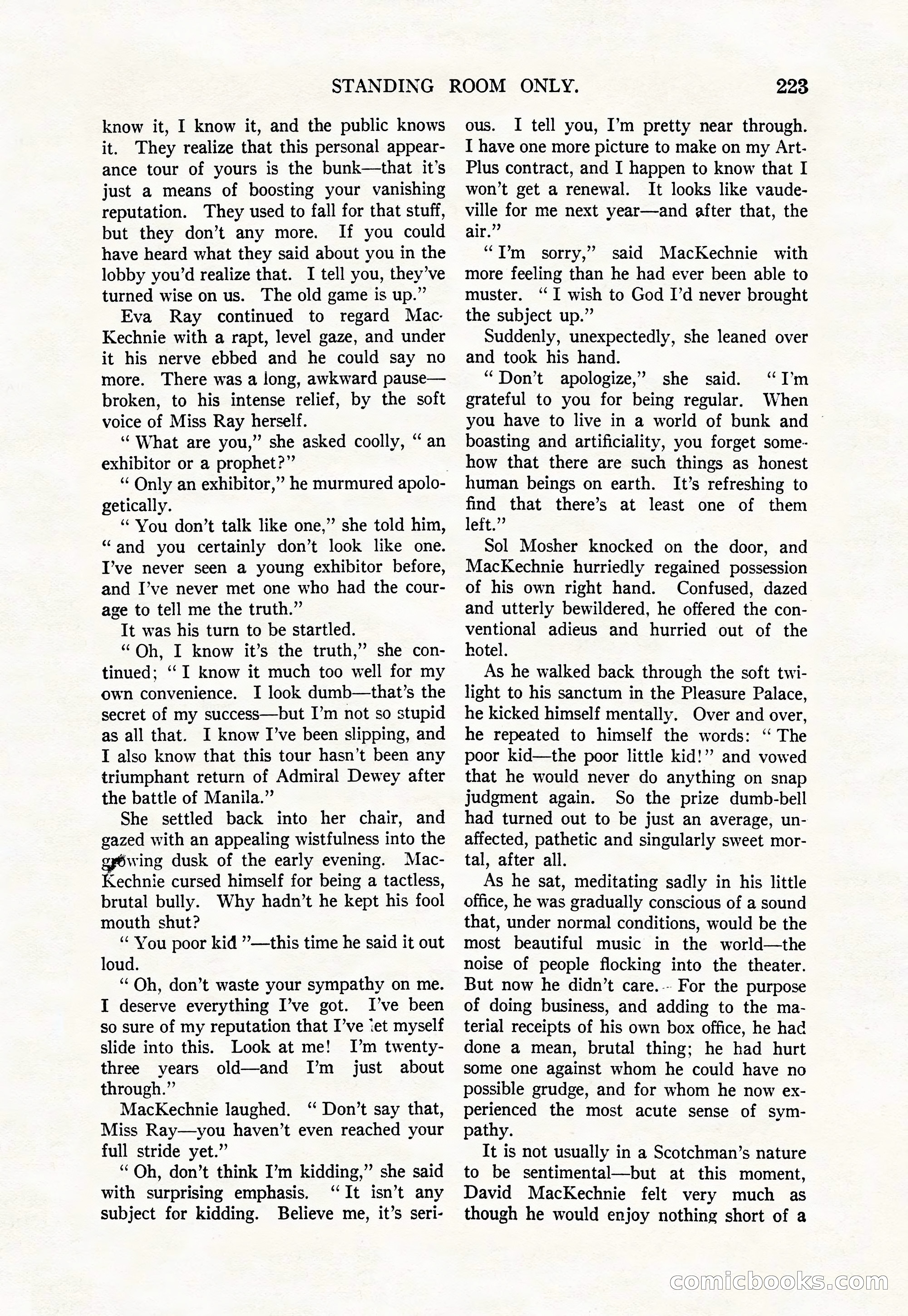
A restored page from Pulp Fiction, 1924. Page through the whole issue in the reader above.
📄 Transcribed text from this page (OCR, searchable)
Machine-transcribed from the original scan — historical spelling and the odd misread are preserved.
STANDING ROOM ONLY. 223 know it, I know it, and the public knows it. They realize that this personal appear- ance tour of yours is the bunk—that it’s just a means of boosting your vanishing reputation. They used to fall for that stuff, but they don’t any more. If you could have heard what they said about you in the lobby you’d realize that. I tell you, they’ve turned wise on us. The old game is up.” Eva Ray continued to regard Mac. Kechnie with a rapt, level gaze, and under it his nerve ebbed and he could say no more. There was a long, awkward pause— broken, to his intense relief, by the soft voice of Miss Ray herself. ‘What are you,” she asked coolly, “ an exhibitor or a prophet?” “ Only an exhibitor,” he murmured apolo- getically. “You don’t talk like one,” she told him, “and you certainly don’t look like one. I’ve never seen a young exhibitor before, and I’ve never met one who had the cour- age to tell me the truth.” It was his turn to be startled. “Oh, I know it’s the truth,” she con- tinued; ‘‘ I know it much too well for my own convenience. I look dumb—that’s the secret of my success—but I’m not so stupid as all that. I know I’ve been slipping, and I also know that this tour hasn’t been any triumphant return of Admiral Dewey after the battle of Manila.” She settled back into her chair, and gazed with an appealing wistfulness into the gy6wing dusk of the early evening. Mac- Kechnie cursed himself for being a tactless, brutal bully. Why hadn’t he kept his fool mouth shut? ‘“ You poor kid ”—this time he said it out loud. ‘Oh, don’t waste your sympathy on me. I deserve everything I’ve got. I’ve been so sure of my reputation that I’ve iet myself slide into this. Look at me! I’m twenty- three years old—and I’m just about through.” MacKechnie laughed. ‘‘ Don’t say that, Miss Ray—you haven’t even reached your full stride yet.” ‘Oh, don’t think I’m kidding,” she said with surprising emphasis. “It isn’t any subject for kidding. Believe me, it’s seri- ous. I tell you, I’m pretty near through. I have one more picture to make on my Art- Plus contract, and I happen to know that I won’t get a renewal. It looks like vaude- ville for me next year—and after that, the air.” “T’m_ sorry,” said MacKechnie with more feeling than he had ever been able to muster. ‘I wish to God I’d never brought the subject up.” Suddenly, unexpectedly, she leaned over and took his hand. “Don’t apologize,’ she said. “I’m grateful to you for being regular. When you have to live in a world of bunk and — boasting and artificiality, you forget some- how that there are such things as honest human beings on earth. It’s refreshing to find that there’s at least one of them left.” Sol Mosher knocked on the door, and MacKechnie hurriedly regained possession of his own right hand. Confused, dazed and utterly bewildered, he offered the con- ventional adieus and hurried out of the hotel. As he walked back through the soft twi- light to his sanctum in the Pleasure Palace, he kicked himself mentally. Over and over, he repeated to himself the words: ‘“ The poor kid—the poor little kid!” and vowed that he would never do anything on snap judgment again. So the prize dumb-bell had turned out to be just an average, un- affected, pathetic and singularly sweet mor- tal, after all. As he sat, meditating sadly in his little office, he was gradually conscious of a sound that, under normal conditions, would be the most beautiful music in the world—the noise of people flocking into the theater. But now he didn’t care... For the purpose of doing business, and adding to the ma- terial receipts of his own box office, he had done a mean, brutal thing; he had hurt some one against whom he could have no possible grudge, and for whom he now ex- perienced the most acute sense of sym- pathy. It is not usually in a Scotchman’s nature to be sentimental—but at this moment, David MacKechnie felt very much as though he would enjoy nothing short of a CoOMmicloookks CO