
Pulp Fiction, 1924 · page 71 of 172
Argosy All-Story Weekly, August 9, 1924 — page 71: what you’re looking at
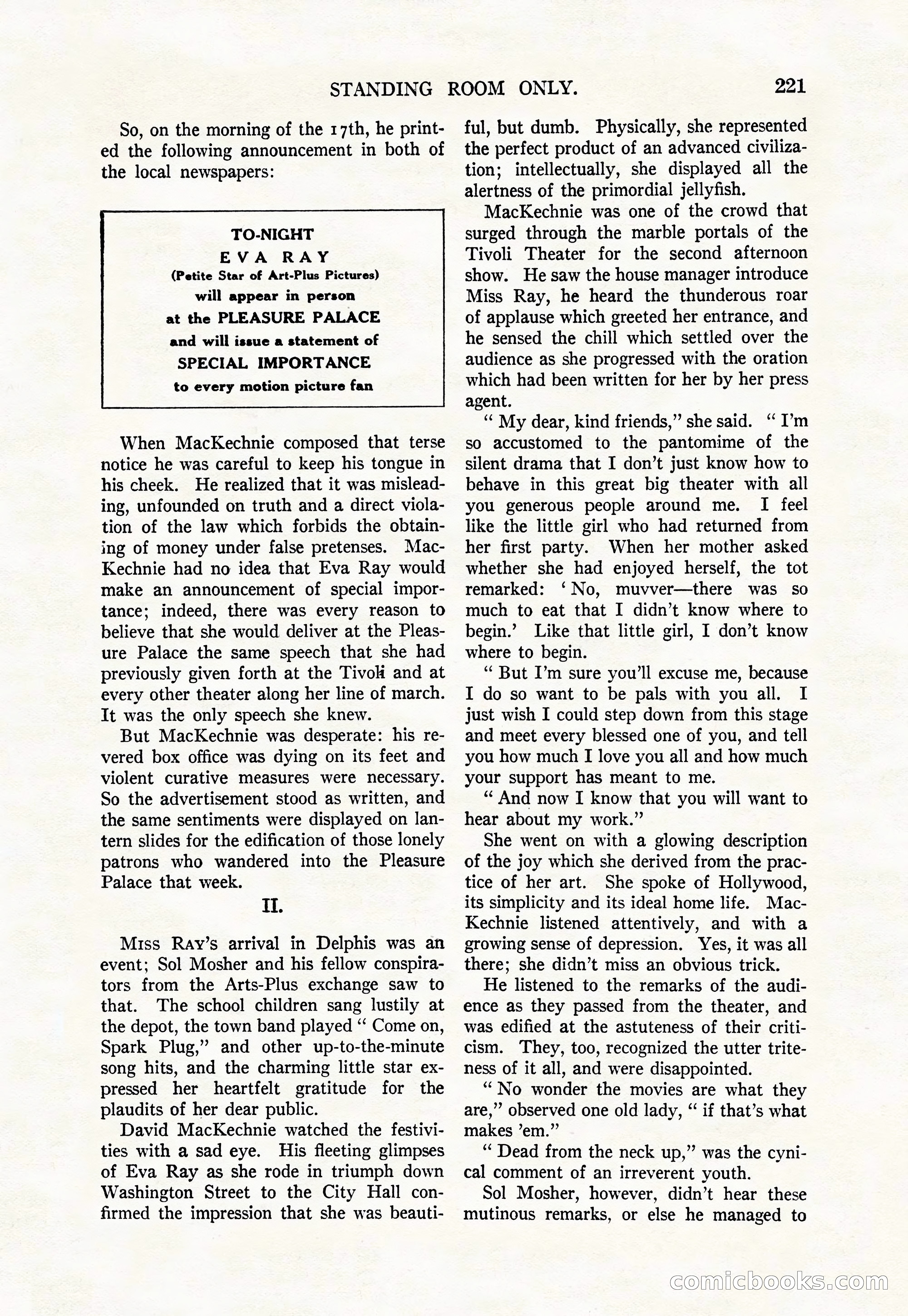
A restored page from Pulp Fiction, 1924. Page through the whole issue in the reader above.
📄 Transcribed text from this page (OCR, searchable)
Machine-transcribed from the original scan — historical spelling and the odd misread are preserved.
STANDING ROOM ONLY. So, on the morning of the 17th, he print- ed the following announcement in both of the local newspapers: TO-NIGHT EVA RAY (Petite Star of Art-Plus Pictures) will appear in person at the PLEASURE PALACE and will issue a statement of SPECIAL IMPORTANCE to every motion picture fan When MacKechnie composed that terse notice he was careful to keep his tongue in his cheek. He realized that it was mislead- ing, unfounded on truth and a direct viola- tion of the law which forbids the obtain- ing of money under false pretenses. Mac- Kechnie had no idea that Eva Ray would make an announcement of special impor- tance; indeed, there was every reason to believe that she would deliver at the Pleas- ure Palace the same speech that she had previously given forth at the Tivol and at every other theater along her line of march. It was the only speech she knew. But MacKechnie was desperate: his re- vered box office was dying on its feet and violent curative measures were necessary. So the advertisement stood as written, and the same sentiments were displayed on lan- tern slides for the edification of those lonely patrons who wandered into the Pleasure Palace that week. II. Miss Ray’s arrival in Delphis was an event; Sol Mosher and his fellow conspira- tors from the Arts-Plus exchange saw to that. The school children sang lustily at the depot, the town band played “‘ Come on, Spark Plug,” and other up-to-the-minute song hits, and the charming little star ex- pressed her heartfelt gratitude for the plaudits of her dear public. David MacKechnie watched the festivi- ties with a sad eye. His fleeting glimpses of Eva Ray as she rode in triumph down Washington Street to the City Hall con- firmed the impression that she was beauti- 221 ful, but dumb. Physically, she represented the perfect product of an advanced civiliza- tion; intellectually, she displayed all the alertness of the primordial jellyfish. MacKechnie was one of the crowd that surged through the marble portals of the Tivoli Theater for the second afternoon show. He saw the house manager introduce Miss Ray, he heard the thunderous roar of applause which greeted her entrance, and he sensed the chill which settled over the audience as she progressed with the oration which had been written for her by her press agent. ‘‘ My dear, kind friends,” she said. ‘“ I’m so accustomed to the pantomime of the silent drama that I don’t just know how to behave in this great big theater with all you generous people around me. I feel like the little girl who had returned from her first party. When her mother asked whether she had enjoyed herself, the tot remarked: ‘No, muvver—there was so much to eat that I didn’t know where to begin.’ Like that little girl, I don’t know where to begin. ‘“‘ But I’m sure you'll excuse me, because I do so want to be pals with you all. I just wish I could step down from this stage and meet every blessed one of you, and tell you how much I love you all and how much your support has meant to me. ““ And now I know that you will want to hear about my work.” She went on with a glowing description of the joy which she derived from the prac- tice of her art. She spoke of Hollywood, its simplicity and its ideal home life. Mac- Kechnie listened attentively, and with a growing sense of depression. Yes, it was all there; she didn’t miss an obvious trick. He listened to the remarks of the audi- ence as they passed from the theater, and was edified at the astuteness of their criti- cism. They, too, recognized the utter trite- ness of it all, and were disappointed. ‘No wonder the movies are what they are,’”’ observed one old lady, “ if that’s what makes ’em.”’ “Dead from the neck up,” was the cyni- cal comment of an irreverent youth. Sol Mosher, however, didn’t hear these mutinous remarks, or else he managed to GOMIIGIOO S (C@) nn