
Pulp Fiction, 1924 · page 58 of 172
Argosy All-Story Weekly, August 9, 1924 — page 58: what you’re looking at
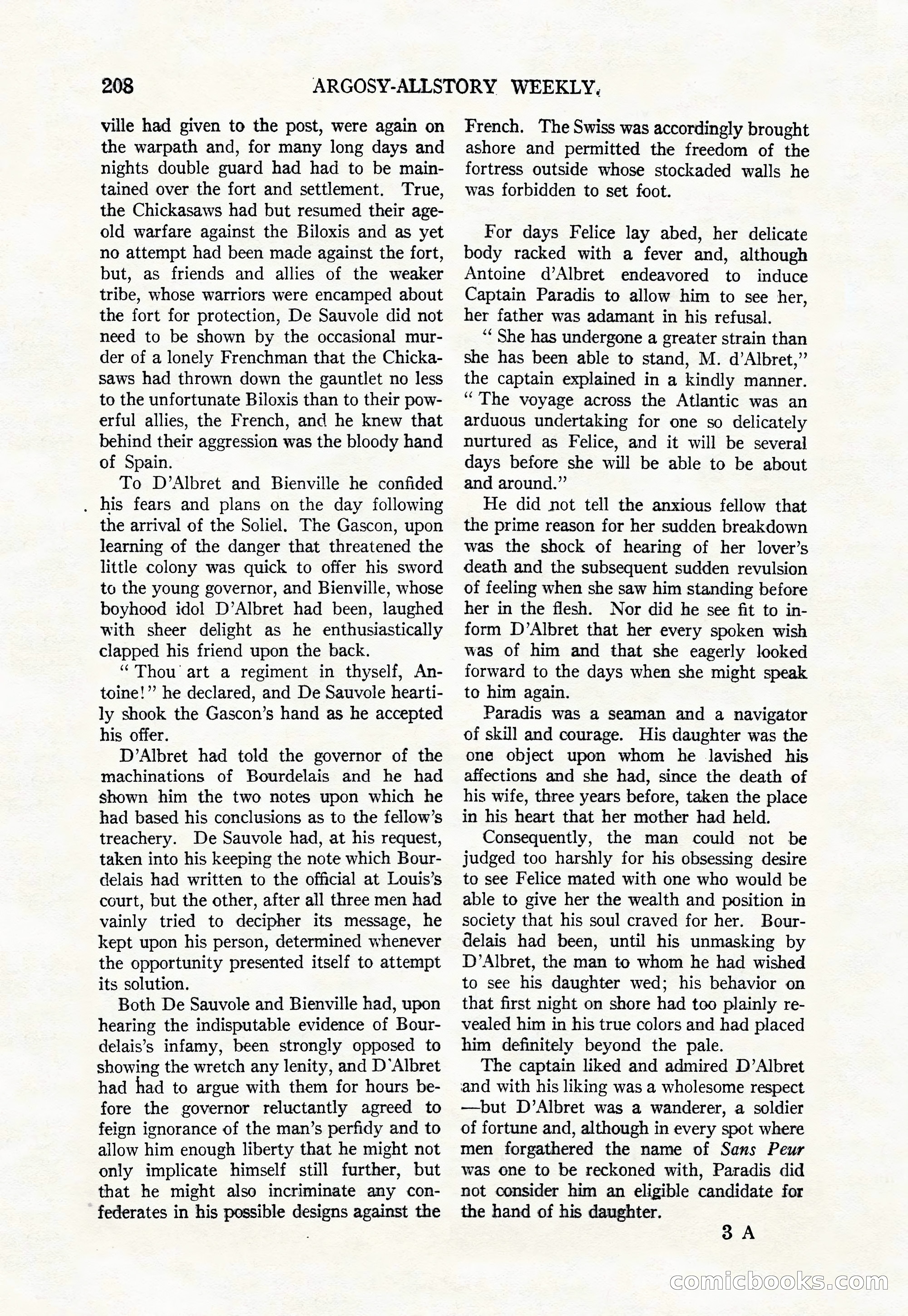
A restored page from Pulp Fiction, 1924. Page through the whole issue in the reader above.
📄 Transcribed text from this page (OCR, searchable)
Machine-transcribed from the original scan — historical spelling and the odd misread are preserved.
208 ville had given to the post, were again on the warpath and, for many long days and nights double guard had had to be main- tained over the fort and settlement. True, the Chickasaws had but resumed their age- old warfare against the Biloxis and as yet no attempt had been made against the fort, but, as friends and allies of the weaker tribe, whose warriors were encamped about the fort for protection, De Sauvole did not need to be shown by the occasional mur- der of a lonely Frenchman that the Chicka- saws had thrown down the gauntlet no less to the unfortunate Biloxis than to their pow- erful allies, the French, and he knew that behind their aggression was the bloody hand of Spain. To D’Albret and Bienville he confided . his fears and plans on the day following the arrival of the Soliel. The Gascon, upon learning of the danger that threatened the little colony was quick to offer his sword to the young governor, and Bienville, whose boyhood idol D’Albret had been, laughed with sheer delight as he enthusiastically clapped his friend upon the back. “Thou art a regiment in thyself, An- toine!” he declared, and De Sauvole hearti- ly shook the Gascon’s hand as he accepted his offer. D’Albret had told the governor of the machinations of Bourdelais and he had shown him the two notes upon which he had based his conclusions as to the fellow’s treachery. De Sauvole had, at his request, taken into his keeping the note which Bour- delais had written to the official at Louis’s court, but the other, after all three men had vainly tried to decipher its message, he kept upon his person, determined whenever the opportunity presented itself to attempt its solution. Both De Sauvole and Bienville had, upon hearing the indisputable evidence of Bour- delais’s infamy, been strongly opposed to showing the wretch any lenity, and D’Albret had had to argue with them for hours be- fore the governor reluctantly agreed to feign ignorance of the man’s perfidy and to allow him enough liberty that he might not only implicate himself still further, but that he might also incriminate any con- federates in his possible designs against the ARGOSY-ALLSTORY WEEKLY, French. The Swiss was accordingly brought ashore and permitted the freedom of the fortress outside whose stockaded walls he was forbidden to set foot. For days Felice lay abed, her delicate body racked with a fever and, although Antoine d’Albret endeavored to induce Captain Paradis to allow him to see her, her father was adamant in his refusal. ‘‘ She has undergone a greater strain than she has been able to stand, M. d’Albret,” the captain explained in a kindly manner. ‘The voyage across the Atlantic was an arduous undertaking for one so delicately nurtured as Felice, and it will be several days before she will be able to be about and around.”’ He did not tell the anxious fellow that the prime reason for her sudden breakdown was the shock of hearing of her lover’s death and the subsequent sudden revulsion of feeling when she saw him standing before her in the flesh. Nor did he see fit to in- form D’Albret that her every spoken wish was of him and that she eagerly looked forward to the days when she might speak to him again. Paradis was a seaman and a navigator of skill and courage. His daughter was the one object upon whom he lavished his affections and she had, since the death of his wife, three years before, taken the place in his heart that her mother had held. Consequently, the man could not be judged too harshly for his obsessing desire to see Felice mated with one who would be able to give her the wealth and position in society that his soul craved for her. Bour- delais had been, until his unmasking by D’Albret, the man to whom he had wished to see his daughter wed; his behavior on that first night on shore had too plainly re- vealed him in his true colors and had placed him definitely beyond the pale. The captain liked and admired D’Albret and with his liking was a wholesome respect —but D’Albret was a wanderer, a soldier of fortune and, although in every spot where men forgathered the name of Sans Peur was one to be reckoned with, Paradis did not consider him an eligible candidate for the hand of his daughter. 3A GoMmiilGeboo (”) S CO) nn