
Pulp Fiction, 1924 · page 17 of 172
Argosy All-Story Weekly, August 9, 1924 — page 17: what you’re looking at
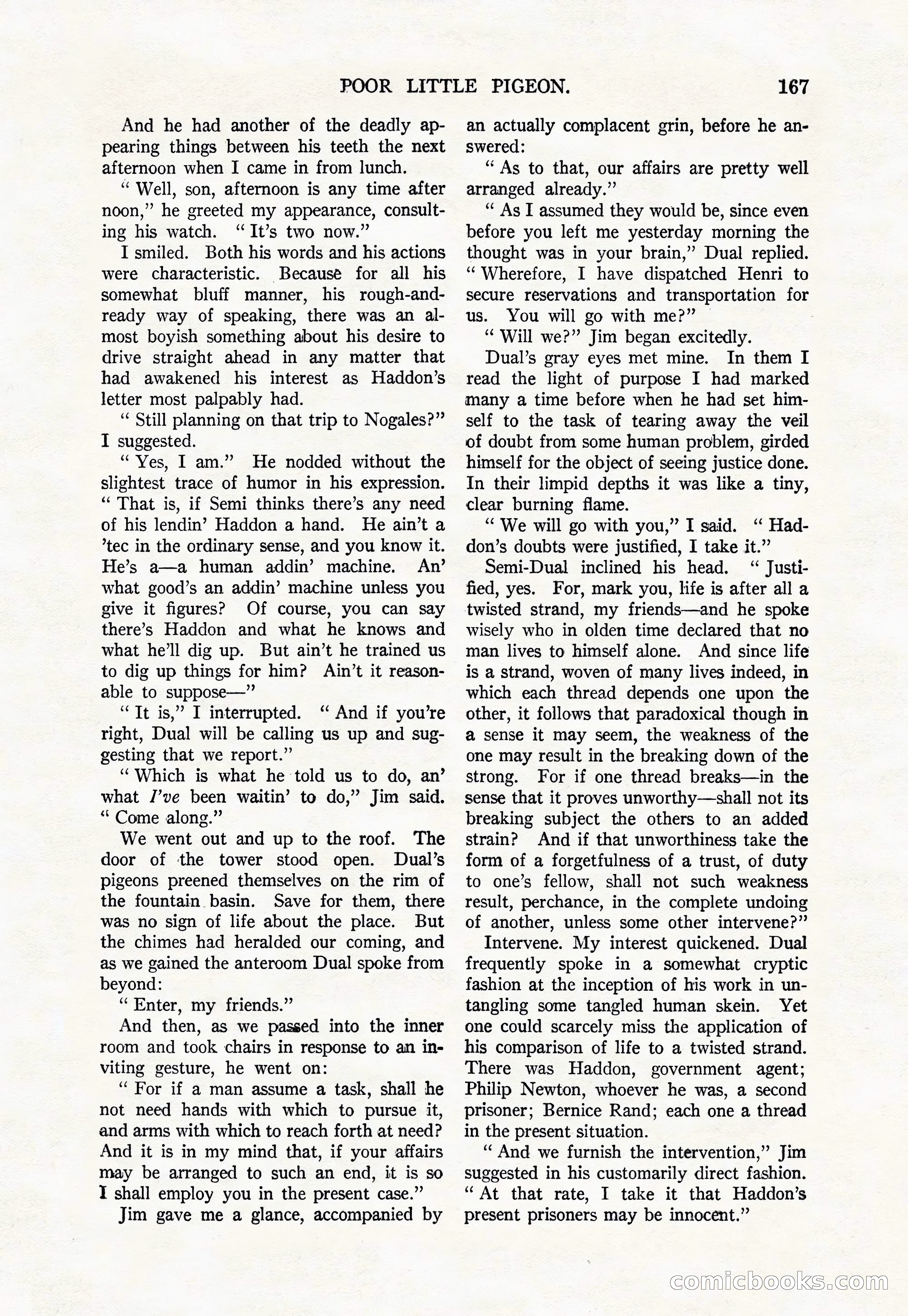
A restored page from Pulp Fiction, 1924. Page through the whole issue in the reader above.
📄 Transcribed text from this page (OCR, searchable)
Machine-transcribed from the original scan — historical spelling and the odd misread are preserved.
POOR LITTLE PIGEON. And he had another of the deadly ap- pearing things between his teeth the next afternoon when I came in from lunch. “ Well, son, afternoon is any time after noon,” he greeted my appearance, consult- ing his watch. ‘It’s two now.” I smiled. Both his words and his actions were characteristic. Becausé for all his somewhat bluff manner, his rough-and- ready way of speaking, there was an al- most boyish something about his desire to drive straight ahead in any matter that had awakened his interest as Haddon’s letter most palpably had. ‘* Still planning on that trip to Nogales?” I suggested. “Yes, I am.” He nodded without the slightest trace of humor in his expression. “That is, if Semi thinks there’s any need of his lendin’ Haddon a hand. He ain’t a ’tec in the ordinary sense, and you know it. He’s a—a human addin’ machine. An’ what good’s an addin’ machine unless you give it figures? Of course, you can say there’s Haddon and what he knows and what he’ll dig up. But ain’t he trained us to dig up things for him? Aijn’t it reason- able to suppose—”’ “It is,” I interrupted. ‘‘ And if you’re right, Dual will be calling us up and sug- gesting that we report.” ‘Which is what he told us to do, an’ what /’ve been waitin’ to do,” Jim said. “Come along.” We went out and up to the roof. The door of the tower stood open. Dual’s pigeons preened themselves on the rim of the fountain basin. Save for them, there was no sign of life about the place. But the chimes had heralded our coming, and as we gained the anteroom Dual spoke from beyond: “Enter, my friends.” And then, as we passed into the inner room and took chairs in response to an in- viting gesture, he went on: ‘For if a man assume a task, shall he not need hands with which to pursue it, and arms with which to reach forth at need? And it is in my mind that, if your affairs may be arranged to such an end, it is so I shall employ you in the present case.” Jim gave me a glance, accompanied by 167 an actually complacent grin, before he an- swered: “As to that, our affairs are pretty well arranged already.” ‘As I assumed they would be, since even before you left me yesterday morning the thought was in your brain,” Dual replied. ‘“‘ Wherefore, I have dispatched Henri to secure reservations and transportation for us. You will go with me?” ‘Will we?” Jim began excitedly. Dual’s gray eyes met mine. In them I read the light of purpose I had marked many a time before when he had set him- self to the task of tearing away the veil of doubt from some human problem, girded himself for the object of seeing justice done. In their limpid depths it was like a tiny, clear burning flame. “We will go with you,” I said. ‘ Had- don’s doubts were justified, I take it.” Semi-Dual inclined his head. “ Justi- fied, yes. For, mark you, life is after all a twisted strand, my friends—and he spoke wisely who in olden time declared that no man lives to himself alone. And since life is a strand, woven of many lives indeed, in which each thread depends one upon the other, it follows that paradoxical though in a@ sense it may seem, the weakness of the one may result in the breaking down of the strong. For if one thread breaks—in the sense that it proves unworthy—shall not its breaking subject the others to an added strain? And if that unworthiness take the form of a forgetfulness of a trust, of duty to one’s fellow, shall not such weakness result, perchance, in the complete undoing of another, unless some other intervene?” Intervene. My interest quickened. Dual frequently spoke in a somewhat cryptic fashion at the inception of his work in un- tangling some tangled human skein. Yet one could scarcely miss the application of his comparison of life to a twisted strand. There was Haddon, government agent; Philip Newton, whoever he was, a second prisoner; Bernice Rand; each one a thread in the present situation. ‘‘ And we furnish the intervention,” Jim suggested in his customarily direct fashion. “At that rate, I take it that Haddon’s present prisoners may be innocent.” COMmAICLO® O €) GO)