
Pulp Fiction, 1924 · page 166 of 172
Argosy All-Story Weekly, August 9, 1924 — page 166: what you’re looking at
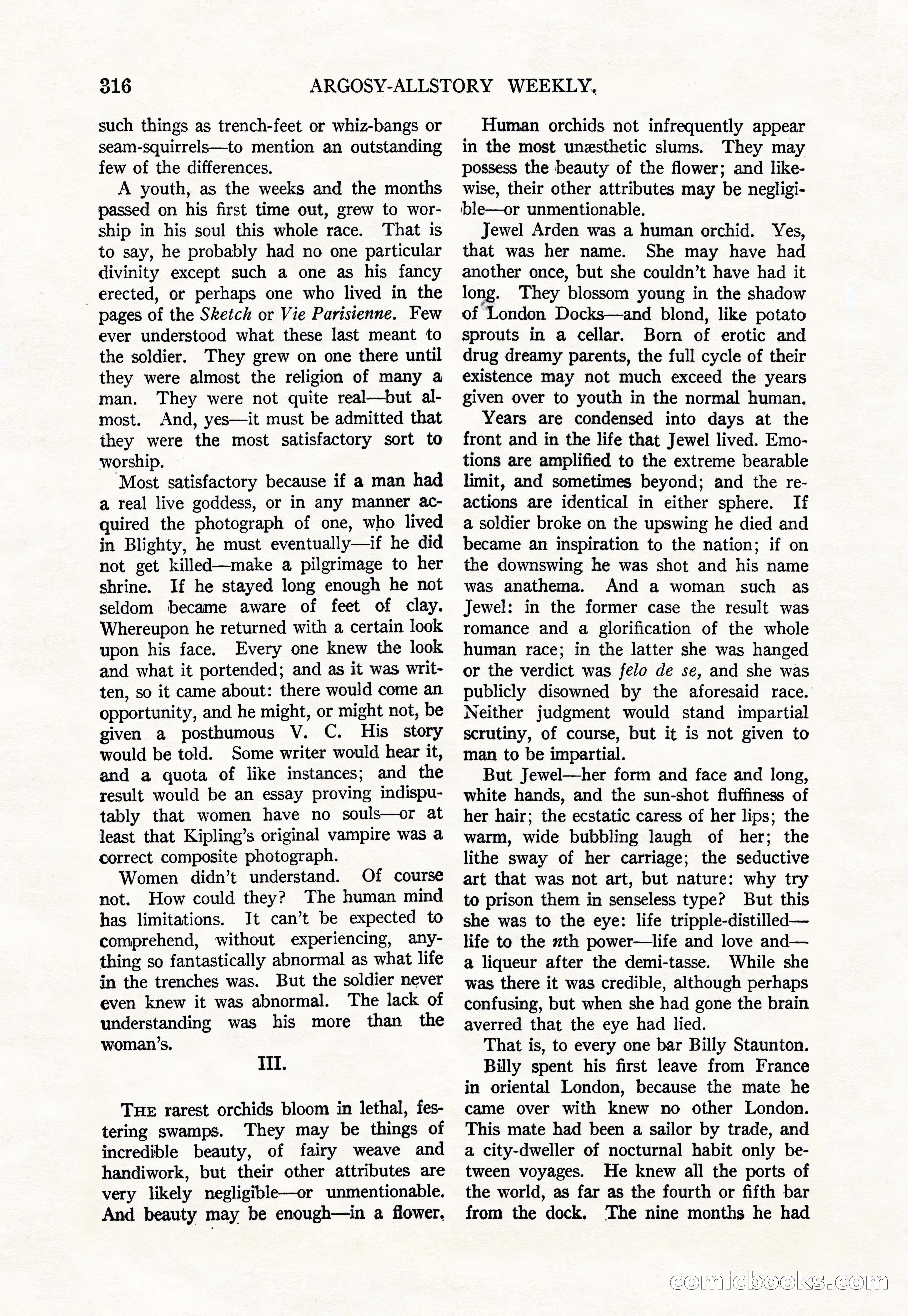
A restored page from Pulp Fiction, 1924. Page through the whole issue in the reader above.
📄 Transcribed text from this page (OCR, searchable)
Machine-transcribed from the original scan — historical spelling and the odd misread are preserved.
316 such things as trench-feet or whiz-bangs or seam-squirrels—to mention an outstanding few of the differences. A youth, as the weeks and the months passed on his first time out, grew to wor- ship in his soul this whole race. That is to say, he probably had no one particular divinity except such a one as his fancy erected, or perhaps one who lived in the pages of the Sketch or Vie Paristenne. Few ever understood what these last meant to the soldier. They grew on one there until they were almost the religion of many a man. ‘They were not quite real—but al- most. And, yes—it must be admitted that they were the most satisfactory sort to worship. Most satisfactory because if a man had a real live goddess, or in any manner ac- quired the photograph of one, who lived in Blighty, he must eventually—if he did not get killed—make a pilgrimage to her shrine. If he stayed long enough he not seldom became aware of feet of clay. Whereupon he returned with a certain look upon his face. Every one knew the look and what it portended; and as it was writ- ten, so it came about: there would come an opportunity, and he might, or might not, be given a posthumous V. C. His story would be told. Some writer would hear it, and a quota of like instances; and the result would be an essay proving indispu- tably that women have no souls—or at least that Kipling’s original vampire was a correct composite photograph. Women didn’t understand. Of course not. How could they? The human mind has limitations. It can’t be expected to comprehend, without experiencing, any- thing so fantastically abnormal as what life in the trenches was. But the soldier never even knew it was abnormal. The lack of understanding was his more than the woman’s. TIT. Tue rarest orchids bloom in lethal, fes- tering swamps. They may be things of incredible beauty, of fairy weave and handiwork, but their other attributes are very likely negligible—or unmentionable. And beauty may be enough—in a flower. ARGOSY-ALLSTORY WEEKLY. Human orchids not infrequently appear in the most unesthetic slums. They may possess the beauty of the flower; and like- wise, their other attributes may be negligi- ible—or unmentionable. Jewel Arden was a human orchid. Yes, that was her name. She may have had another once, but she couldn’t have had it long. They blossom young in the shadow of London Docks—and blond, like potato sprouts in a cellar. Born of erotic and drug dreamy parents, the full cycle of their existence may not much exceed the years given over to youth in the normal human. Years are condensed into days at the front and in the life that Jewel lived. Emo- tions are amplified to the extreme bearable limit, and sometimes beyond; and the re- actions are identical in either sphere. If a soldier broke on the upswing he died and became an inspiration to the nation; if on the downswing he was shot and his name was anathema. And a woman such as Jewel: in the former case the result was romance and a glorification of the whole human race; in the latter she was hanged or the verdict was felo de se, and she was publicly disowned by the aforesaid race. Neither judgment would stand impartial scrutiny, of course, but it is not given to man to be impartial. But Jewel—her form and face and long, white hands, and the sun-shot fluffiness of her hair; the ecstatic caress of her lips; the warm, wide bubbling laugh of her; the lithe sway of her carriage; the seductive art that was not art, but nature: why try to prison them in senseless type? But this she was to the eye: life tripple-distilled— life to the mth power—life and love and— a liqueur after the demi-tasse. While she was there it was credible, although perhaps confusing, but when she had gone the brain averred that the eye had lied. That is, to every one bar Billy Staunton. Billy spent his first leave from France in oriental London, because the mate he came over with knew no other London. This mate had been a sailor by trade, and a city-dweller of nocturnal habit only be- tween voyages. He knew all the ports of the world, as far as the fourth or fifth bar from the dock. The nine months he had GOMIIGooOO CGO) nn