
Pulp Fiction, 1924 · page 152 of 172
Argosy All-Story Weekly, August 9, 1924 — page 152: what you’re looking at
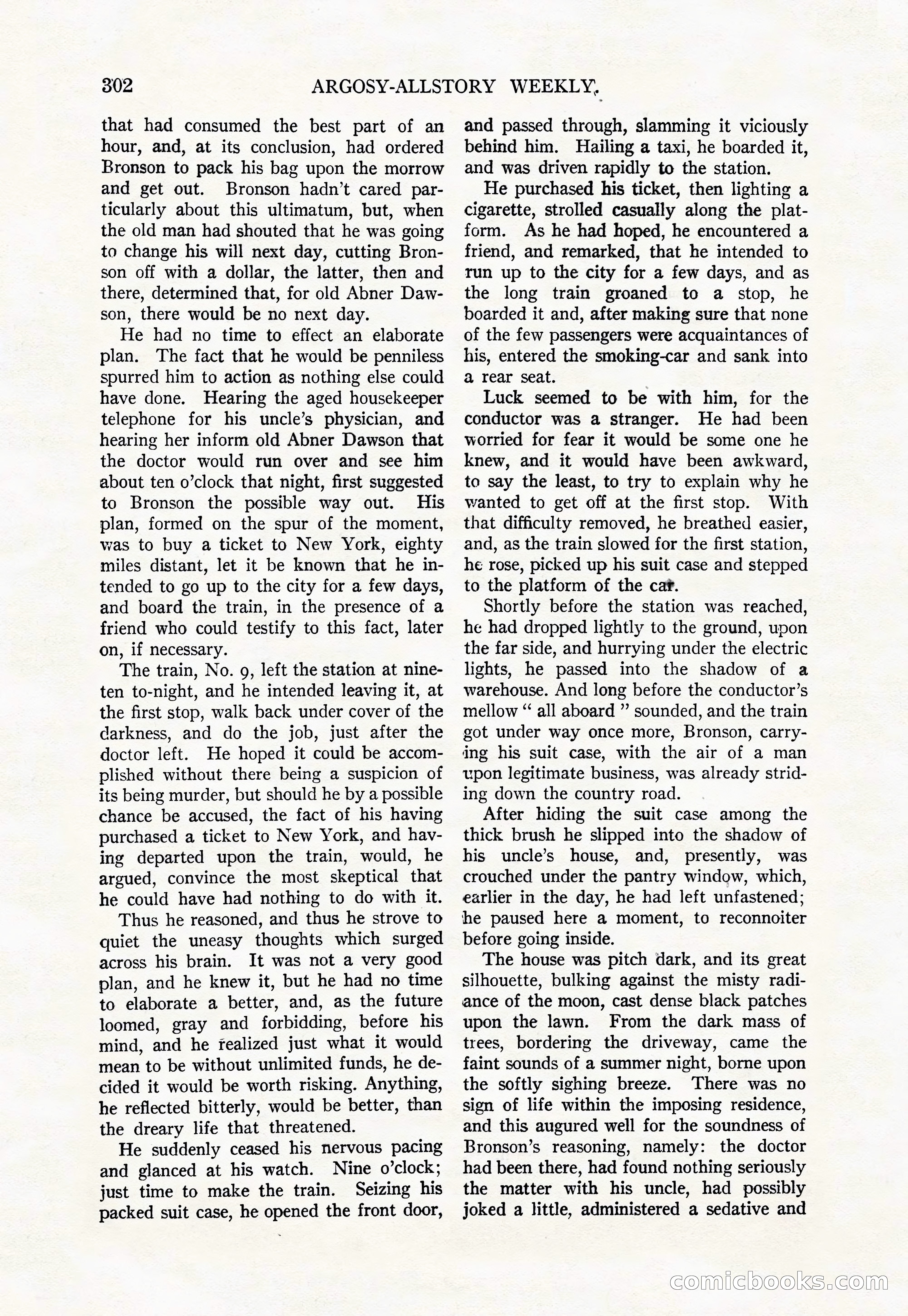
A restored page from Pulp Fiction, 1924. Page through the whole issue in the reader above.
📄 Transcribed text from this page (OCR, searchable)
Machine-transcribed from the original scan — historical spelling and the odd misread are preserved.
302 that had consumed the best part of an hour, and, at its conclusion, had ordered Bronson to pack his bag upon the morrow and get out. Bronson hadn’t cared par- ticularly about this ultimatum, but, when the old man had shouted that he was going to change his will next day, cutting Bron- son off with a dollar, the latter, then and there, determined that, for old Abner Daw- son, there would be no next day. He had no time to effect an elaborate plan. The fact that he would be penniless spurred him to action as nothing else could have done. Hearing the aged housekeeper telephone for his uncle’s physician, and hearing her inform old Abner Dawson that the doctor would run over and see him about ten o’clock that night, first suggested to Bronson the possible way out. His plan, formed on the spur of the moment, was to buy a ticket to New York, eighty miles distant, let it be known that he in- tended to go up to the city for a few days, and board the train, in the presence of a friend who could testify to this fact, later on, if necessary. The train, No. 9, left the station at nine- ten to-night, and he intended leaving it, at the first stop, walk back under cover of the darkness, and do the job, just after the doctor left. He hoped it could be accom- plished without there being a suspicion of its being murder, but should he by a possible chance be accused, the fact of his having purchased a ticket to New York, and hav- ing departed upon the train, would, he argued, convince the most skeptical that he could have had nothing to do with it. Thus he reasoned, and thus he strove to quiet the uneasy thoughts which surged across his brain. It was not a very good plan, and he knew it, but he had no time to elaborate a better, and, as the future loomed, gray and forbidding, before his mind, and he fealized just what it would mean to be without unlimited funds, he de- cided it would be worth risking. Anything, he reflected bitterly, would be better, than the dreary life that threatened. He suddenly ceased his nervous pacing and glanced at his watch. Nine o’clock; just time to make the train. Seizing his packed suit case, he opened the front door, ARGOSY-ALLSTORY WEEKLY, and passed through, slamming it viciously behind him. Hailing a taxi, he boarded it, and was driven rapidly to the station. He purchased his ticket, then lighting a cigarette, strolled casually along the plat- form. As he had hoped, he encountered a friend, and remarked, that he intended to run up to the city for a few days, and as the long train groaned to a stop, he boarded it and, after making sure that none of the few passengers were acquaintances of his, entered the smoking-car and sank into a rear seat. Luck seemed to be with him, for the conductor was a stranger. He had been worried for fear it would be some one he knew, and it would have been awkward, to say the least, to try to explain why he wanted to get off at the first stop. With that difficulty removed, he breathed easier, and, as the train slowed for the first station, he rose, picked up his suit case and stepped to the platform of the caf. Shortly before the station was reached, he had dropped lightly to the ground, upon the far side, and hurrying under the electric lights, he passed into the shadow of a warehouse. And long before the conductor’s mellow “ all aboard ” sounded, and the train got under way once more, Bronson, carry- ing his suit case, with the air of a man upon legitimate business, was already strid- ing down the country road. After hiding the suit case among the thick brush he slipped into the shadow of his uncle’s house, and, presently, was crouched under the pantry window, which, earlier in the day, he had left unfastened; he paused here a moment, to reconnoiter before going inside. The house was pitch dark, and its great silhouette, bulking against the misty radi- ance of the moon, cast dense black patches upon the lawn. From the dark mass of trees, bordering the driveway, came the faint sounds of a summer night, borne upon the softly sighing breeze. There was no sion of life within the imposing residence, and this augured well for the soundness of Bronson’s reasoning, namely: the doctor had been there, had found nothing seriously the matter with his uncle, had possibly joked a little, administered a sedative and GOMIIGIOO S CO) nn