
Pulp Fiction, 1924 · page 14 of 172
Argosy All-Story Weekly, August 9, 1924 — page 14: what you’re looking at
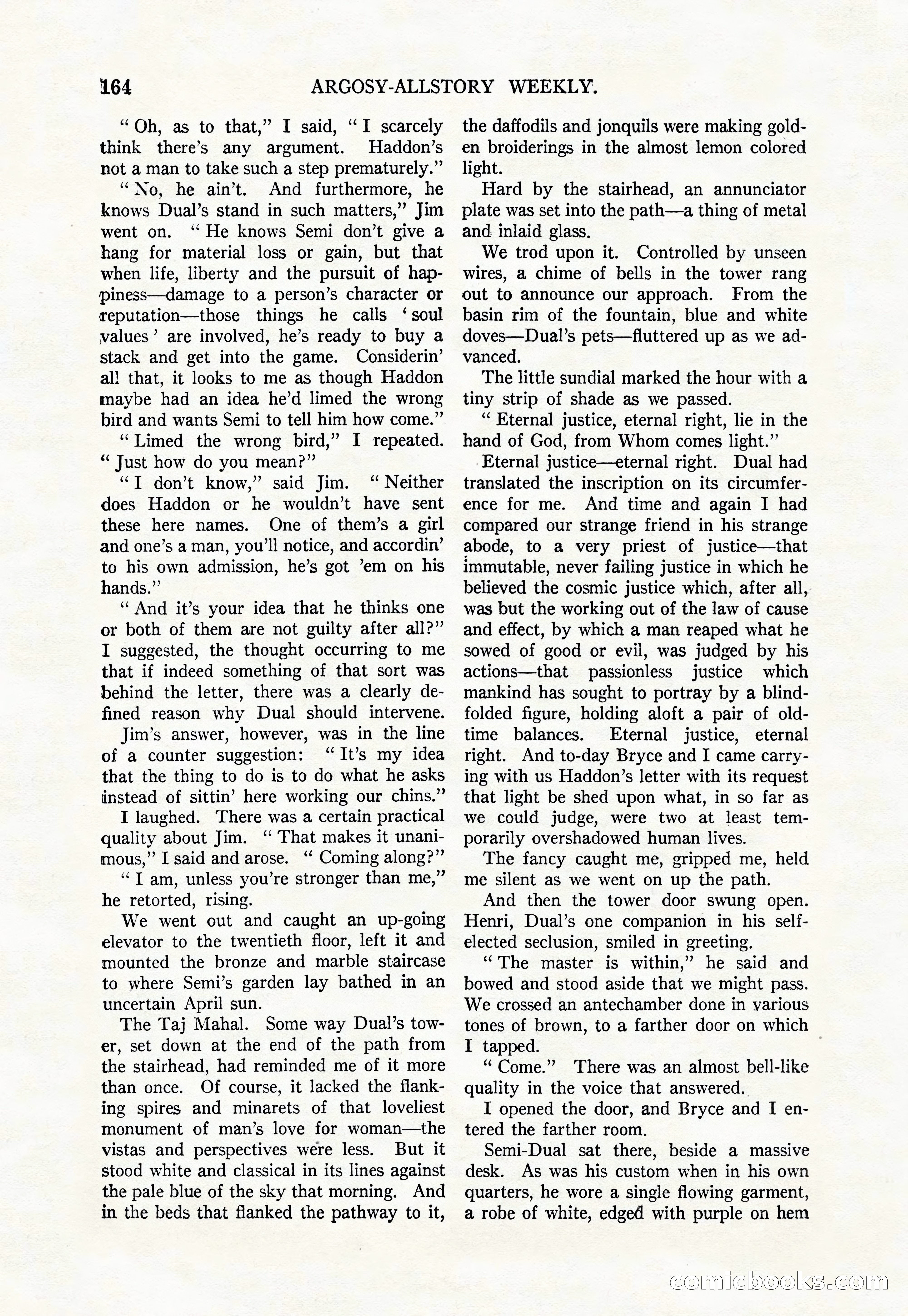
A restored page from Pulp Fiction, 1924. Page through the whole issue in the reader above.
📄 Transcribed text from this page (OCR, searchable)
Machine-transcribed from the original scan — historical spelling and the odd misread are preserved.
164 “Oh, as to that,” I said, “I scarcely think there’s any argument. Haddon’s not a man to take such a step prematurely.” “No, he ain’t. And furthermore, he knows Dual’s stand in such matters,” Jim went on. ‘‘ He knows Semi don’t give a hang for material loss or gain, but that when life, liberty and the pursuit of hap- piness—damage to a person’s character or reputation—those things he calls ‘soul values’ are involved, he’s ready to buy a stack and get into the game. Considerin’ al! that, it looks to me as though Haddon maybe had an idea he’d limed the wrong bird and wants Semi to tell him how come.” ‘“Limed the wrong bird,” I repeated. “‘ Just how do you mean?” “T don’t know,” said Jim. ‘“ Neither does Haddon or he wouldn’t have sent these here names. One of them’s a girl and one’s a man, you’ll notice, and accordin’ to his own admission, he’s got ’em on his hands.”’ ‘“ And it’s your idea that he thinks one or both of them are not guilty after all?” I suggested, the thought occurring to me that if indeed something of that sort was behind the letter, there was a clearly de- fined reason why Dual should intervene. Jim’s answer, however, was in the line of a counter suggestion: “It’s my idea that the thing to do is to do what he asks instead of sittin’ here working our chins.” I laughed. There was a certain practical quality about Jim. “ That makes it unani- mous,” I said and arose. ‘‘ Coming along?” “Tam, unless you’re stronger than me,” he retorted, rising. We went out and caught an up-going elevator to the twentieth floor, left it and mounted the bronze and marble staircase to where Semi’s garden lay bathed in an uncertain April sun. The Taj Mahal. Some way Dual’s tow- er, set down at the end of the path from the stairhead, had reminded me of it more than once. Of course, it lacked the flank- ing spires and minarets of that loveliest monument of man’s love for woman—the vistas and perspectives were less. But it stood white and classical in its lines against the pale blue of the sky that morning. And in the beds that flanked the pathway to it, ARGOSY-ALLSTORY WEEKLY. the daffodils and jonquils were making gold- en broiderings in the almost lemon colored light. Hard by the stairhead, an annunciator plate was set into the path—a thing of metal and. inlaid glass. We trod upon it. Controlled by unseen wires, a chime of bells in the tower rang out to announce our approach. From the basin rim of the fountain, blue and white doves—Dual’s pets—fluttered up as we ad- vanced. The little sundial marked the hour with a tiny strip of shade as we passed. ‘“‘ Eternal justice, eternal right, lie in the hand of God, from Whom comes light.”’ Eternal justice—eternal right. Dual had translated the inscription on its circumfer- ence for me. And time and again I had compared our strange friend in his strange abode, to a very priest of justice—that immutable, never failing justice in which he believed the cosmic justice which, after all, was but the working out of the law of cause and effect, by which a man reaped what he sowed of good or evil, was judged by his actions—that passionless justice which mankind has sought to portray by a blind- folded figure, holding aloft a pair of old- time balances. Eternal justice, eternal right. And to-day Bryce and I came carry- ing with us Haddon’s letter with its request that light be shed upon what, in so far as we could judge, were two at least tem- porarily overshadowed human lives. The fancy caught me, gripped me, held me silent as we went on up the path. And then the tower door swung open. Henri, Dual’s one companion in his self- elected seclusion, smiled in greeting. “The master is within,” he said and bowed and stood aside that we might pass. We crossed an antechamber done in yarious tones of brown, to a farther door on which I tapped. ‘““Come.” There was an almost bell-like quality in the voice that answered. I opened the door, and Bryce and I en- tered the farther room. Semi-Dual sat there, beside a massive desk. As was his custom when in his own quarters, he wore a single flowing garment, a robe of white, edged with purple on hem GOMIIGIOO S