
Pulp Fiction, 1924 · page 126 of 172
Argosy All-Story Weekly, August 9, 1924 — page 126: what you’re looking at
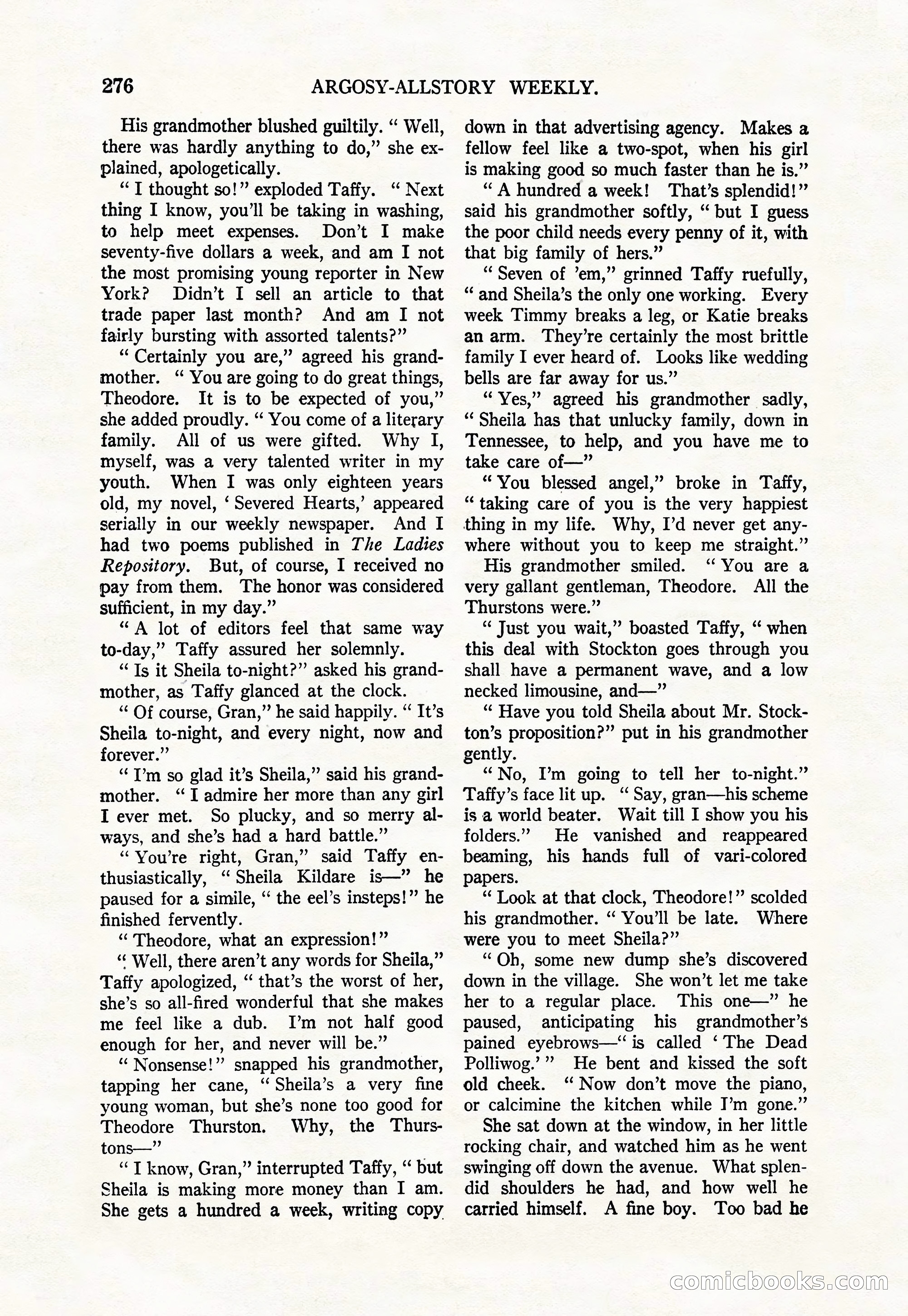
A restored page from Pulp Fiction, 1924. Page through the whole issue in the reader above.
📄 Transcribed text from this page (OCR, searchable)
Machine-transcribed from the original scan — historical spelling and the odd misread are preserved.
276 His grandmother blushed guiltily. ‘“ Well, there was hardly anything to do,” she ex- plained, apologetically. “I thought so!” exploded Taffy. “ Next thing I know, you'll be taking in washing, to help meet expenses. Don’t I make seventy-five dollars a week, and am I not the most promising young reporter in New York? Didn’t I sell an article to that trade paper last month? And am I not fairly bursting with assorted talents?” “‘ Certainly you are,” agreed his grand- mother. ‘ You are going to do great things, Theodore. It is to be expected of you,” she added proudly. “ You come of a literary family. All of us were gifted. Why I, myself, was a very talented writer in my youth. When I was only eighteen years old, my novel, ‘ Severed Hearts,’ appeared serially in our weekly newspaper. And I had two poems published in The Ladies Repository. But, of course, I received no pay from them. The honor was considered sufficient, in my day.” “A lot of editors feel that same way to-day,” Taffy assured her solemnly. “Ts it Sheila to-night?” asked his grand- mother, as Taffy glanced at the clock. ‘¢ Of course, Gran,” he said happily. “‘ It’s Sheila to-night, and every night, now and forever.” “I’m so glad it’s Sheila,” said his grand- mother. ‘I admire her more than any girl I ever met. So plucky, and so merry al- ways, and she’s had a hard battle.” “You're right, Gran,” said Taffy en- thusiastically, ‘Sheila Kildare is—” he paused for a simile, “‘ the eel’s insteps!” he finished fervently. “Theodore, what an expression “ Well, there aren’t any words for Sheila,” Taffy apologized, “ that’s the worst of her, she’s so all-fired wonderful that she makes me feel like a dub. I’m not half good enough for her, and never will be.” ‘“‘ Nonsense!” snapped his grandmother, tapping her cane, “ Sheila’s a very fine young woman, but she’s none too good for Theodore Thurston. Why, the Thurs- tons—”’ ‘“T know, Gran,” interrupted Taffy, ‘“ but Sheila is making more money than I am. She gets a hundred a week, writing copy 1» ARGOSY-ALLSTORY WEEKLY. down in that advertising agency. Makes a fellow feel like a two-spot, when his girl is making good so much faster than he is.” ‘“‘ A hundred a week! That’s splendid!” said his grandmother softly, “ but I guess the poor child needs every penny of it, with that big family of hers.” “Seven of ’em,” grinned Taffy ruefully, “and Sheila’s the only one working. Every week Timmy breaks a leg, or Katie breaks an arm. They’re certainly the most brittle family I ever heard of. Looks like wedding bells are far away for us.” “Yes,” agreed his grandmother sadly, “¢ Sheila has that unlucky family, down in Tennessee, to help, and you have me to take care of—” “You blessed angel,” broke in Taffy, “‘ taking care of you is the very happiest thing in my life. Why, I’d never get any- where without you to keep me straight.” His grandmother smiled. ‘“‘ You are a very gallant gentleman, Theodore. All the Thurstons were.” “ Just you wait,” boasted Taffy, “‘ when this deal with Stockton goes through you shall have a permanent wave, and a low necked limousine, and—”’ “ Have you told Sheila about Mr. Stock- ton’s proposition?” put in his grandmother gently. “No, I’m going to tell her to-night.” Taffy’s face lit up. ‘‘ Say, gran—his scheme is a world beater. Wait till I show you his folders.” He vanished and _ reappeared beaming, his hands full of vari-colored papers. “‘ Look at that clock, Theodore!” scolded his grandmother. “ You'll be late. Where were you to meet Sheila?” ‘“‘Oh, some new dump she’s discovered down in the village. She won’t let me take her to a regular place. This one—” he paused, anticipating his grandmother’s pained eyebrows—‘ is called ‘The Dead Polliwog.’’”’ He bent and kissed the soft old cheek. ‘‘ Now don’t move the piano, or calcimine the kitchen while I’m gone.” She sat down at the window, in her little rocking chair, and watched him as he went swinging off down the avenue. What splen- did shoulders he had, and how well he carried himself. A fine boy. Too bad he COMmMicloo (-) SH (C@) nn