
Pulp Fiction, 1924 · page 12 of 172
Argosy All-Story Weekly, August 9, 1924 — page 12: what you’re looking at
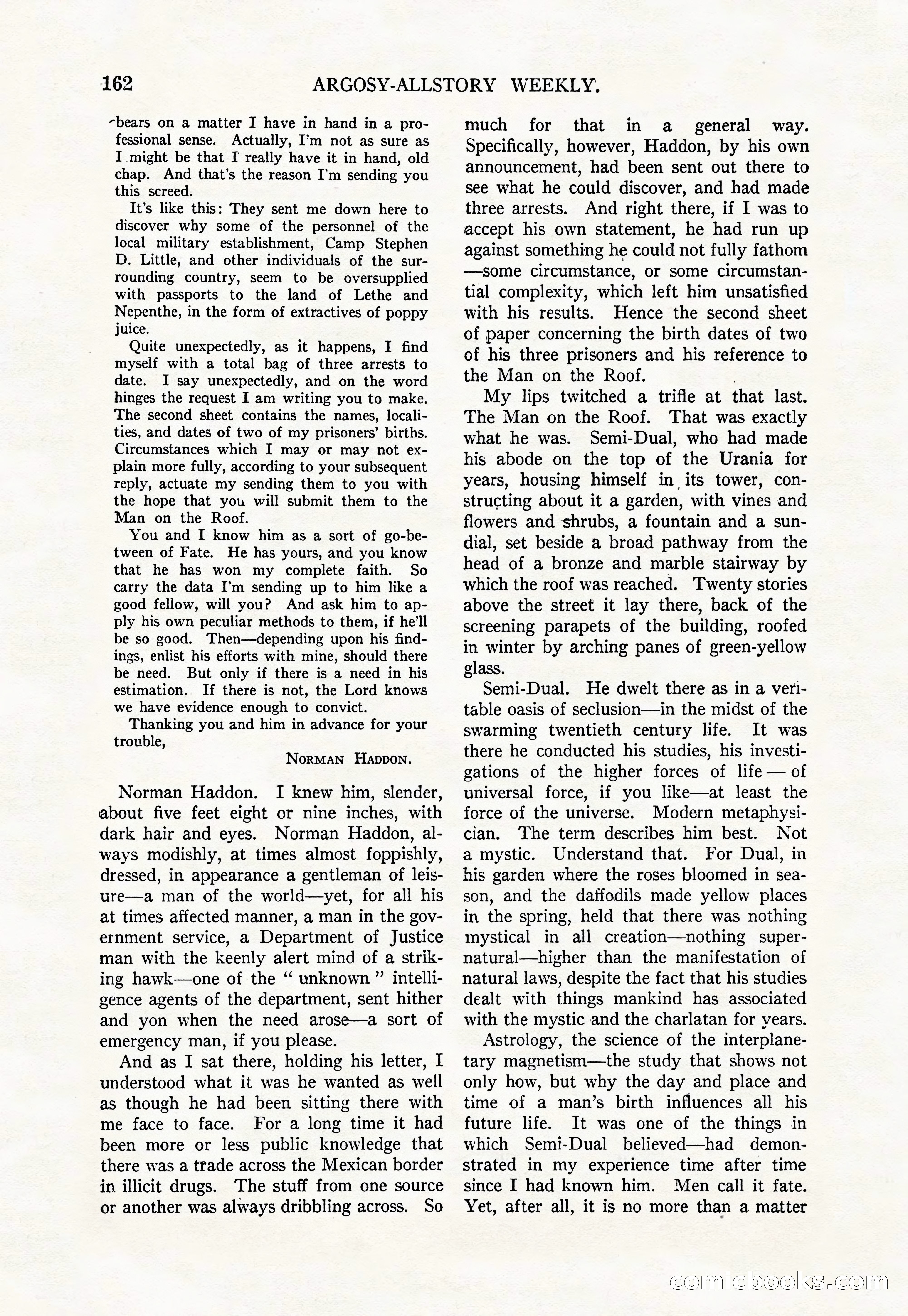
A restored page from Pulp Fiction, 1924. Page through the whole issue in the reader above.
📄 Transcribed text from this page (OCR, searchable)
Machine-transcribed from the original scan — historical spelling and the odd misread are preserved.
162 -bears on a matter IJ have in hand in a pro- fessional sense. Actually, I’m not as sure as I might be that I really have it in hand, old chap. And that’s the reason I'm sending you this screed. It’s like this: They sent me down here to discover why some of the personnel of the local military establishment, Camp Stephen D. Little, and other individuals of the sur- rounding country, seem to be oversupplied with passports to the land of Lethe and Nepenthe, in the form of extractives of poppy juice. Quite unexpectedly, as it happens, I find myself with a total bag of three arrests to date. I say unexpectedly, and on the word hinges the request I am writing you to make. The second sheet contains the names, locali- ties, and dates of two of my prisoners’ births. Circumstances which I may or may not ex- plain more fully, according to your subsequent reply, actuate my sending them to you with the hope that you will submit them to the Man on the Roof. You and I know him as a sort of go-be- tween of Fate. He has yours, and you know that he has won my complete faith. So carry the data I’m sending up to him like a good fellow, will youe And ask him to ap- ply his own peculiar methods to them, if he’ll be so good. Then—depending upon his find- ings, enlist his efforts with mine, should there be need. But only if there is a need in his estimation. If there is not, the Lord knows we have evidence enough to convict. Thanking you and him in advance for your trouble, Norman Happon. Norman Haddon. I knew him, slender, about five feet eight or nine inches, with dark hair and eyes. Norman Haddon, al- ways modishly, at times almost foppishly, dressed, in appearance a gentleman of leis- ure—a man of the world—yet, for all his at times affected manner, a man in the gov- ernment service, a Department of Justice man with the keenly alert mind of a strik- ing hawk—one of the “ unknown ”’ intelli- gence agents of the department, sent hither and yon when the need arose—a sort of emergency man, if you please. And as I sat there, holding his letter, I understood what it was he wanted as well as though he had been sitting there with me face to face. For a long time it had been more or less public knowledge that there was a trade across the Mexican border in illicit drugs. The stuff from one source or another was always dribbling across. So ARGOSY-ALLSTORY WEEKLY. much for that in a_ general way. Specifically, however, Haddon, by his own announcement, had been sent out there to see what he could discover, and had made three arrests. And right there, if I was to accept his own statement, he had run up against something he could not fully fathom —some circumstance, or some circumstan- tial complexity, which left him unsatisfied with his results. Hence the second sheet of paper concerning the birth dates of two of his three prisoners and his reference to the Man on the Roof. | My lips twitched a trifle at that last. The Man on the Roof. That was exactly what he was. Semi-Dual, who had made his abode on the top of the Urania for years, housing himself in its tower, con- structing about it a garden, with vines and flowers and shrubs, a fountain and a sun- dial, set beside a broad pathway from the head of a bronze and marble stairway by which the roof was reached. Twenty stories above the street it lay there, back of the screening parapets of the building, roofed in winter by arching panes of green-yellow glass. Semi-Dual. He dwelt there as in a veri- table oasis of seclusion—in the midst of the swarming twentieth century life. It was there he conducted his studies, his investi- gations of the higher forces of life — of universal force, if you like—at least the force of the universe. Modern metaphysi- cian. The term describes him best. Not a mystic. Understand that. For Dual, in his garden where the roses bloomed in sea- son, and the daffodils made yellow places in the spring, held that there was nothing mystical in all creation—nothing super- natural—higher than the manifestation of natural laws, despite the fact that his studies dealt with things mankind has associated with the mystic and the charlatan for vears. Astrology, the science of the interplane- tary magnetism—the study that shows not only how, but why the day and place and time of a man’s birth influences all his future life. It was one of the things in which Semi-Dual believed—had demon- strated in my experience time after time since I had known him. Men call it fate. Yet, after all, it is no more than a matter LOO = a CO S (Cc (0)