
Pulp Fiction, 1924 · page 113 of 172
Argosy All-Story Weekly, August 9, 1924 — page 113: what you’re looking at
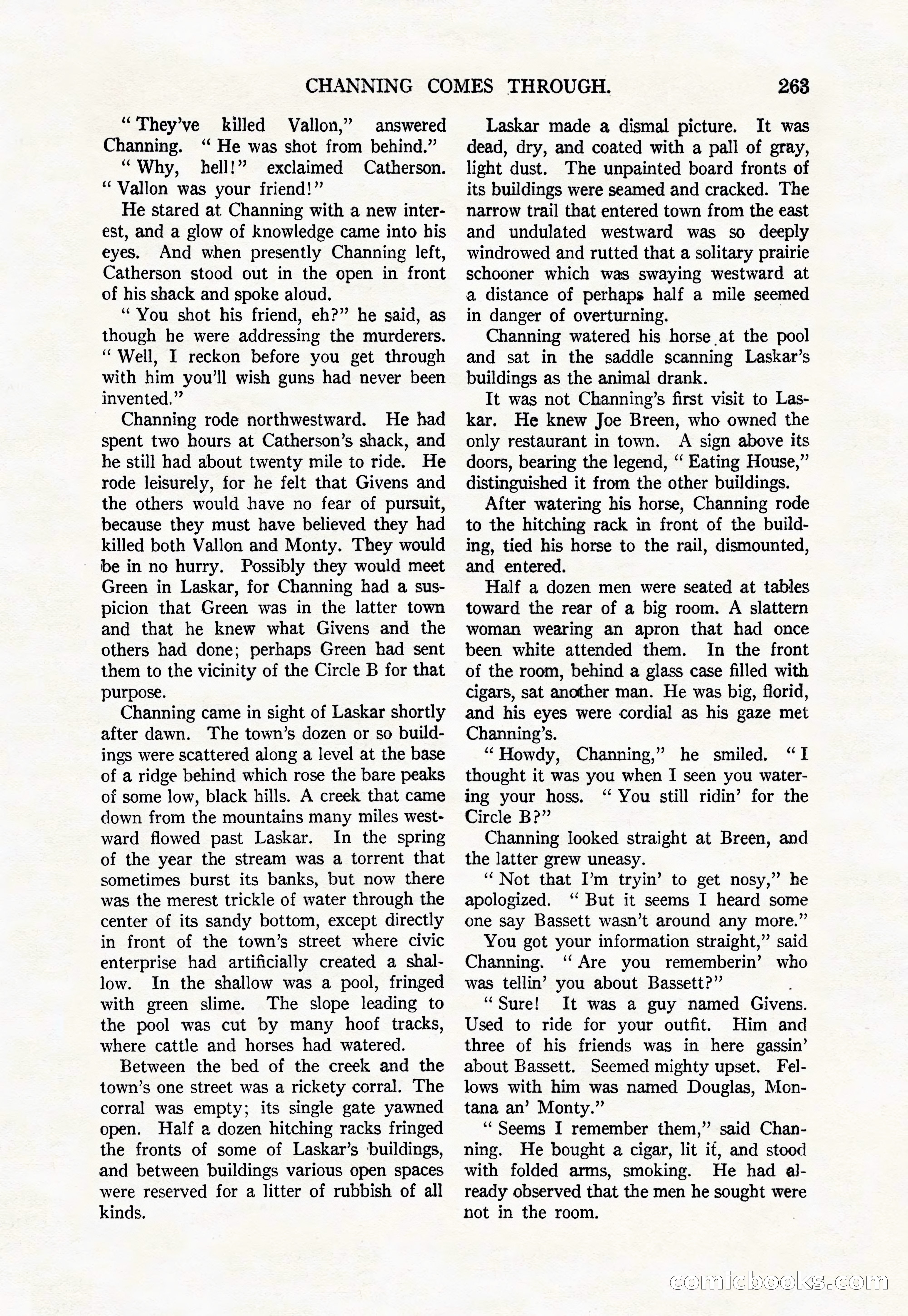
A restored page from Pulp Fiction, 1924. Page through the whole issue in the reader above.
📄 Transcribed text from this page (OCR, searchable)
Machine-transcribed from the original scan — historical spelling and the odd misread are preserved.
CHANNING COMES THROUGH. killed Vallon,” answered Channing. “‘“ He was shot from behind.” “Why, hell!” exclaimed Catherson. ‘“Vallon was your friend!” He stared at Channing with a new inter- est, and a glow of knowledge came into his eyes. And when presently Channing left, Catherson stood out in the open in front of his shack and spoke aloud. “You shot his friend, eh?” he said, as though he were addressing the murderers. “Well, I reckon before you get through with him you'll wish guns had never been invented.” Channing rode northwestward. He had spent two hours at Catherson’s shack, and he still had about twenty mile to ride. He rode leisurely, for he felt that Givens and the others would have no fear of pursuit, because they must have believed they had killed both Vallon and Monty. They would be in no hurry. Possibly they would meet Green in Laskar, for Channing had a sus- picion that Green was in the latter town and that he knew what Givens and the others had done; perhaps Green had sent them to the vicinity of the Circle B for that purpose. Channing came in sight of Laskar shortly after dawn. The town’s dozen or so build- ings were scattered along a level at the base of a ridge behind which rose the bare peaks of some low, black hills. A creek that came down from the mountains many miles west- ward flowed past Laskar. In the spring of the year the stream was a torrent that sometimes burst its banks, but now there was the merest trickle of water through the center of its sandy bottom, except directly in front of the town’s street where civic enterprise had artificially created a shal- low. In the shallow was a pool, fringed with green slime. The slope leading to the pool was cut by many hoof tracks, where cattle and horses had watered. Between the bed of the creek and the town’s one street was a rickety corral. The corral was empty; its single gate yawned open. Half a dozen hitching racks fringed the fronts of some of Laskar’s ‘buildings, and between buildings various open spaces were reserved for a litter of rubbish of all kinds. “ They’ve 263 Laskar made a dismal picture. It was dead, dry, and coated with a pall of gray, light dust. The unpainted board fronts of its buildings were seamed and cracked. The narrow trail that entered town from the east and undulated westward was so deeply windrowed and rutted that a solitary prairie schooner which was swaying westward at a distance of perhaps half a mile seemed in danger of overturning. Channing watered his horse at the pool and sat in the saddle scanning Laskar’s buildings as the animal drank. It was not Channing’s first visit to Las- kar. He knew Joe Breen, who owned the only restaurant in town. A sign above its doors, bearing the legend, “‘ Eating House,” distinguished it from the other buildings. After watering his horse, Channing rode to the hitching rack in front of the build- ing, tied his horse to the rail, dismounted, and entered. Half a dozen men were seated at tables toward the rear of a big room. A slattern woman wearing an apron that had once been white attended them. In the front of the room, behind a glass case filled with cigars, sat another man. He was big, florid, and his eyes were cordial as his gaze met Channing’s. “Howdy, Channing,” he smiled. “I thought it was you when I seen you water- ing your hoss. “ You still ridin’ for the Circle BP” Channing looked straight at Breen, and the latter grew uneasy. ‘““ Not that I’m tryin’ to get nosy,” he apologized. ‘“ But it seems I heard some one say Bassett wasn’t around any more.” You got your information straight,” said Channing. ‘“‘ Are you rememberin’ who was tellin’ you about Bassett?” “Sure! It was a guy named Givens. Used to ride for your outfit. Him and three of his friends was in here gassin’ about Bassett. Seemed mighty upset. Fel- lows with him was named Douglas, Mon- tana an’ Monty.” ‘‘ Seems I remember them,” said Chan- ning. He bought a cigar, lit it, and stood with folded arms, smoking. He had al- ready observed that the men he sought were not in the room. GOMIIGIOO S (C@)