
Pulp Fiction, 1924 · page 107 of 172
Argosy All-Story Weekly, August 9, 1924 — page 107: what you’re looking at
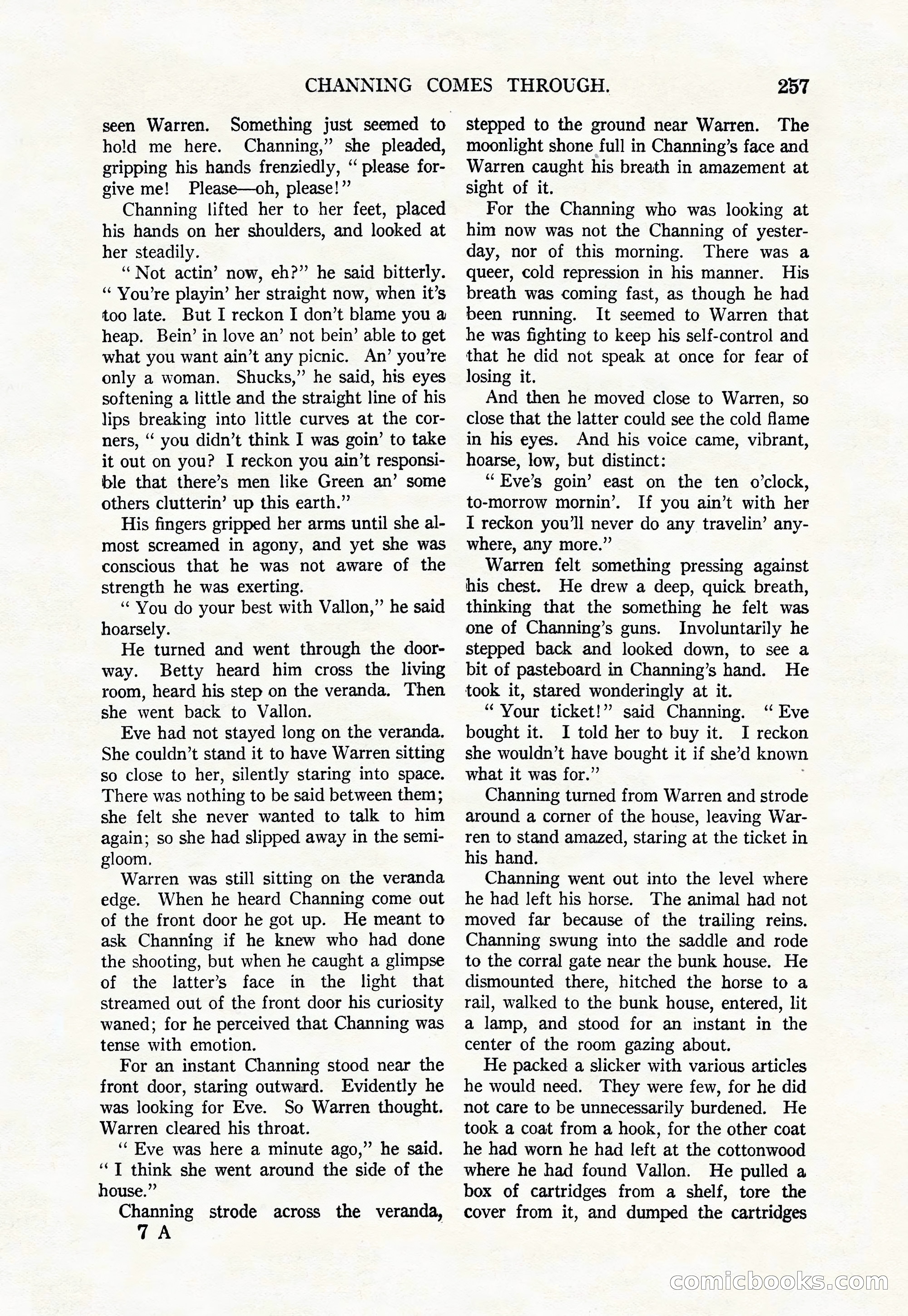
A restored page from Pulp Fiction, 1924. Page through the whole issue in the reader above.
📄 Transcribed text from this page (OCR, searchable)
Machine-transcribed from the original scan — historical spelling and the odd misread are preserved.
CHANNING COMES THROUGH. seen Warren. Something just seemed to hold me here. Channing,” she pleaded, gripping his hands frenziedly, “ please for- give me! Please—oh, please!” Channing lifted her to her feet, placed his hands on her shoulders, and looked at her steadily. “Not actin’ now, eh?” he said bitterly. ‘“ You’re playin’ her straight now, when it’s too late. But I reckon I don’t blame you a heap. Bein’ in love an’ not bein’ able to get what you want ain’t any picnic. An’ you’re only a woman. Shucks,” he said, his eyes softening a little and the straight line of his lips breaking into little curves at the cor- ners, “‘ you didn’t think I was goin’ to take it out on you? I reckon you ain’t responsi- ble that there’s men like Green an’ some others clutterin’ up this earth.” His fingers gripped her arms until she al- most screamed in agony, and yet she was conscious that he was not aware of the strength he was exerting. “You do your best with Vallon,” he said hoarsely. He turned and went through the door- way. Betty heard him cross the living room, heard his step on the veranda. Then she went back to Vallon. Eve had not stayed long on the veranda. She couldn’t stand it to have Warren sitting so close to her, silently staring into space. There was nothing to be said between them; she felt she never wanted to talk to him again; so she had slipped away in the semi- gloom, Warren was still sitting on the veranda edge. When he heard Channing come out of the front door he got up. He meant to ask Channing if he knew who had done the shooting, but when he caught a glimpse of the latter’s face in the light that streamed out of the front door his curiosity waned; for he perceived that Channing was tense with emotion. For an instant Channing stood near the front door, staring outward. Evidently he was looking for Eve. So Warren thought. Warren cleared his throat. ‘‘ Eve was here a minute ago,” he said. ‘‘T think she went around the side of the house.” Channing strode across the veranda, TA 257 stepped to the ground near Warren. The moonlight shone full in Channing’s face and Warren caught his breath in amazement at sight of it. For the Channing who was looking at him now was not the Channing of yester- day, nor of this morning. There was a queer, cold repression in his manner. His breath was coming fast, as though he had been running. It seemed to Warren that he was fighting to keep his self-control and that he did not speak at once for fear of losing it. And then he moved close to Warren, so close that the latter could see the cold flame in his eyes. And his voice came, vibrant, hoarse, low, but distinct: ““Eve’s goin’ east on the ten o’clock, to-morrow mornin’. If you ain’t with her I reckon you’ll never do any travelin’ any- where, any more.” Warren felt something pressing against his chest. He drew a deep, quick breath, thinking that the something he felt was one of Channing’s guns. Involuntarily he stepped back and looked down, to see a bit of pasteboard in Channing’s hand. He took it, stared wonderingly at it. “Your ticket!” said Channing. “ Eve bought it. I told her to buy it. I reckon she wouldn’t have bought it if she’d known what it was for.” Channing turned from Warren and strode around a corner of the house, leaving War- ren to stand amazed, staring at the ticket in his hand. Channing went out into the level where he had left his horse. The animal had not moved far because of the trailing reins. Channing swung into the saddle and rode to the corral gate near the bunk house. He dismounted there, hitched the horse to a rail, walked to the bunk house, entered, lit a lamp, and stood for an instant in the center of the room gazing about. He packed a slicker with various articles he would need. They were few, for he did not care to be unnecessarily burdened. He took a coat from a hook, for the other coat he had worn he had left at the cottonwood where he had found Vallon. He pulled a box of cartridges from a shelf, tore the cover from it, and dumped the cartridges GomnilGpaoo O S (C(O)