
Pulp Fiction, 1924 · page 99 of 172
Argosy All-Story Weekly, May 17, 1924 — page 99: what you’re looking at
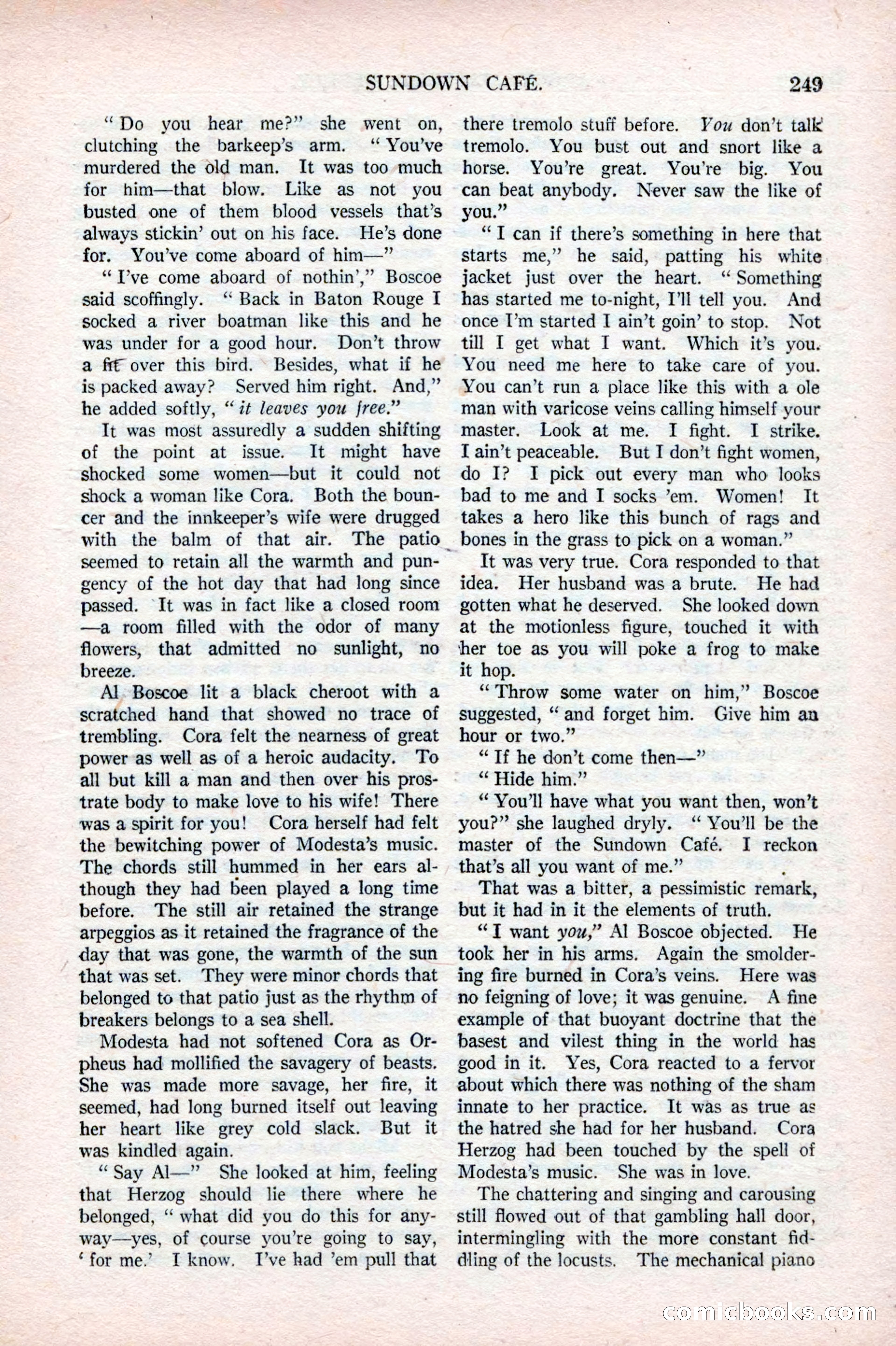
A restored page from Pulp Fiction, 1924. Page through the whole issue in the reader above.
📄 Transcribed text from this page (OCR, searchable)
Machine-transcribed from the original scan — historical spelling and the odd misread are preserved.
SUNDOWN CAFE. “Do you hear me?” she went on, clutching the barkeep’s arm. ‘“ You’ve murdered the old man. It was too much for him—that blow. Like as not you busted one of them blood vessels that’s always stickin’ out on his face. He’s done for. You’ve come aboard of him—” “T’ve come aboard of nothin’,”’ Boscoe said scoffingly. ‘“ Back in Baton Rouge I socked a river boatman like this and he was under for a good hour. Don’t throw a frt over this bird. Besides, what if he is packed away? Served him right. And,” he added softly, “it leaves you free.” It was most assuredly a sudden shifting of the point at issue. It might have shocked some women—but it could not shock a woman like Cora. Both the boun- cer and the innkeeper’s wife were drugged with the balm of that air. seemed to retain all the warmth and pun- gency of the hot day that had long since passed. It was in fact like a closed room —a room filled with the odor of many flowers, that admitted no sunlight, no breeze. Al. Boscoe lit a black cheroot with a scratched hand that showed no trace of trembling. Cora felt the nearness of great power as well as of a heroic audacity. To all but kill a man and then over his pros- trate body to make love to his wife! There was a spirit for you! Cora herself had felt the bewitching power of Modesta’s music. The chords still hummed in her ears al- though they had been played a long time before. The still air retained the strange arpeggios as it retained the fragrance of the day that was gone, the warmth of the sun that was set. They were minor chords that belonged to that patio just as the rhythm of breakers belongs to a sea shell. Modesta had not softened Cora as Or- pheus had mollified the savagery of beasts. She was made more savage, her fire, it seemed, had long burned itself out leaving her heart like grey cold slack. But it was kindled again. “Say Al—” She looked at him, feeling that Herzog should lie there where he belonged, “ what did you do this for any- way—yes, of course you’re going to say, ‘for me.’ I know. I’ve had ’em pull that The patio— 249 there tremolo stuff before. You don’t talk tremolo. You bust out and snort like a horse. You’re great. You're big. You can beat anybody. Never saw the like of you.” “TI can if there’s something in here that starts me,” he said, patting his white jacket just over the heart. ‘“ Something has started me to-night, I’ll tell you. And once I’m started I ain’t goin’ to stop. Not till I get what I want. Which it’s you. You need me here to take care of you. You can’t run a place like this with a ole man with varicose veins calling himself your master. Look at me. I fight. I strike. [ ain’t peaceable. But I don’t fight women, do I? I pick out every man who looks bad to me and I socks ’em. Women! It takes a hero like this bunch of rags and bones in the grass to pick on a woman.” It was very true. Cora responded to that idea. Her husband was a brute. He had gotten what he deserved. She looked down at the motionless figure, touched it with ther toe as you will poke a frog to make it hop. “Throw some water on him,” Boscoe suggested, “and forget him. Give him an hour or two.” “Tf he don’t come then—” “ Hide him.” “ You'll have what you want then, won’t you?” she laughed dryly. ‘ You’ll be the master of the Sundown Café. I reckon that’s all you want of me.” That was a bitter, a pessimistic remark, but it had in it the elements of truth. “T want you,’ Al Boscoe objected. He took her in his arms. Again the smolder- ing fire burned in Cora’s veins. Here was no feigning of love; it was genuine. A fine example of that buoyant doctrine that the basest and vilest thing in the world has good in it. Yes, Cora reacted to a fervor about which there was nothing of the sham innate to her practice. It was as true as the hatred she had for her husband. Cora Herzog had been touched by the spell of Modesta’s music. She was in love. The chattering and singing and carousing still flowed out of that gambling hall door, intermingling with the more constant fid- dling of the locusts. The mechanical piano COmicloooks (C@