
Pulp Fiction, 1924 · page 96 of 172
Argosy All-Story Weekly, May 17, 1924 — page 96: what you’re looking at
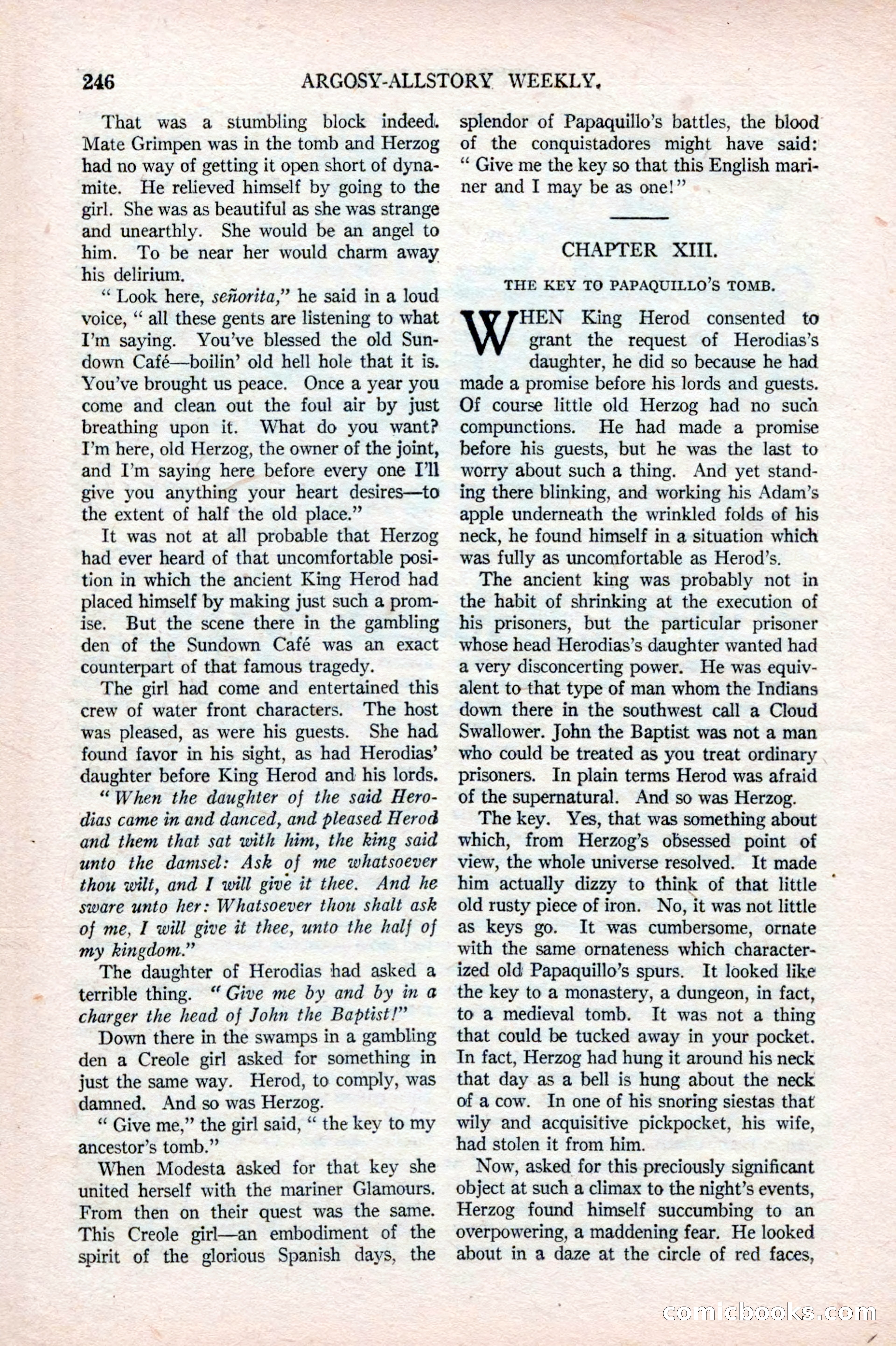
A restored page from Pulp Fiction, 1924. Page through the whole issue in the reader above.
📄 Transcribed text from this page (OCR, searchable)
Machine-transcribed from the original scan — historical spelling and the odd misread are preserved.
246 That was a stumbling block indeed. Mate Grimpen was in the tomb and Herzog had no way of getting it open short of dyna- mite. He relieved himself by going to the girl. She was as beautiful as she was strange and unearthly. She would be an angel to him. To be near her would charm away his delirium. “ Look here, seorita,” he said in a loud voice, “ all these gents are listening to what I’m saying. You’ve blessed the old Sun- down Café—boilin’ old hell hole that it is. You’ve brought us peace. Once a year you come and clean out the foul air by just breathing upon it. What do you want? I’m here, old Herzog, the owner of the joint, and I’m saying here before every one [ll give you anything your heart desires—to the extent of half the old place.” It was not at all probable that Herzog had ever heard of that uncomfortable posi- tion in which the ancient King Herod had placed himself by making just such a prom- ise. But the scene there in the gambling den of the Sundown Café was an exact counterpart of that famous tragedy. The girl had come and entertained this crew of water front characters. The host was pleased, as were his guests. She had found favor in his sight, as had Herodias’ daughter before King Herod and his lords. “When the daughter of the said Hero- dias came in and danced, and pleased Herod and them that sat with him, the king said unio the damsel: Ask of me whatsoever thou wilt, and I will give it thee. And he sware unto her: Whatsoever thou shalt ask of me, I will give it thee, unto the half of my kingdom.” The daughter of Herodias had asked a terrible thing. ‘“ Give me by and by ina charger the head of John the Baptist!” Down there in the swamps in a gambling den a Creole girl asked for something in just the same way. Herod, to comply, was damned. And so was Herzog. “ Give me,” the girl said, “ the key to my ancestor’s tomb.” When Modesta asked for that key she united herself with the mariner Glamours. From then on their quest was the same. This Creole girl—an embodiment of the spirit of the glorious Spanish days, the ARGOSY-ALLSTORY WEEKLY, splendor of Papaquillo’s battles, the blood of the conquistadores might have said: ““ Give me the key so that this English mari- ner and I may be as one!” CHAPTER XIII. THE KEY TO PAPAQUILLO’S TOMB. HEN King Herod consented to grant the request of Herodias’s daughter, he did so because he had made a promise before his lords and guests. Of course little old Herzog had no such compunctions. He had made a promise before his guests, but he was the last to worry about such a thing. And yet stand- ing there blinking, and working his Adam’s apple underneath the wrinkled folds of his neck, he found himself in a situation which was fully as uncomfortable as Herod’s. The ancient king was probably not in the habit of shrinking at the execution of his prisoners, but the particular prisoner whose head Herodias’s daughter wanted had a very disconcerting power. He was equiv- alent to that type of man whom the Indians down there in the southwest call a Cloud Swallower. John the Baptist was not a man who could be treated as you treat ordinary prisoners. In plain terms Herod was afraid of the supernatural. And so was Herzog. The key. Yes, that was something about which, from Herzog’s obsessed point of view, the whole universe resolved. It made him actually dizzy to think of that little ~ old rusty piece of iron. No, it was not little as keys go. It was cumbersome, ornate with the same ornateness which character- ized old Papaquillo’s spurs. It looked like the key to a monastery, a dungeon, in fact, to a medieval tomb. It was not a thing that could be tucked away in your pocket. In fact, Herzog had hung it around his neck that day as a bell is hung about the neck of a cow. In one of his snoring siestas that wily and acquisitive pickpocket, his wife, had stolen it from him. Now, asked for this preciously significant object at such a climax to the night’s events, Herzog found himself succumbing to an overpowering, a maddening fear. He looked about in a daze at the circle of red faces, CORmMICLOokKs (C©@)