
Pulp Fiction, 1924 · page 74 of 172
Argosy All-Story Weekly, May 17, 1924 — page 74: what you’re looking at
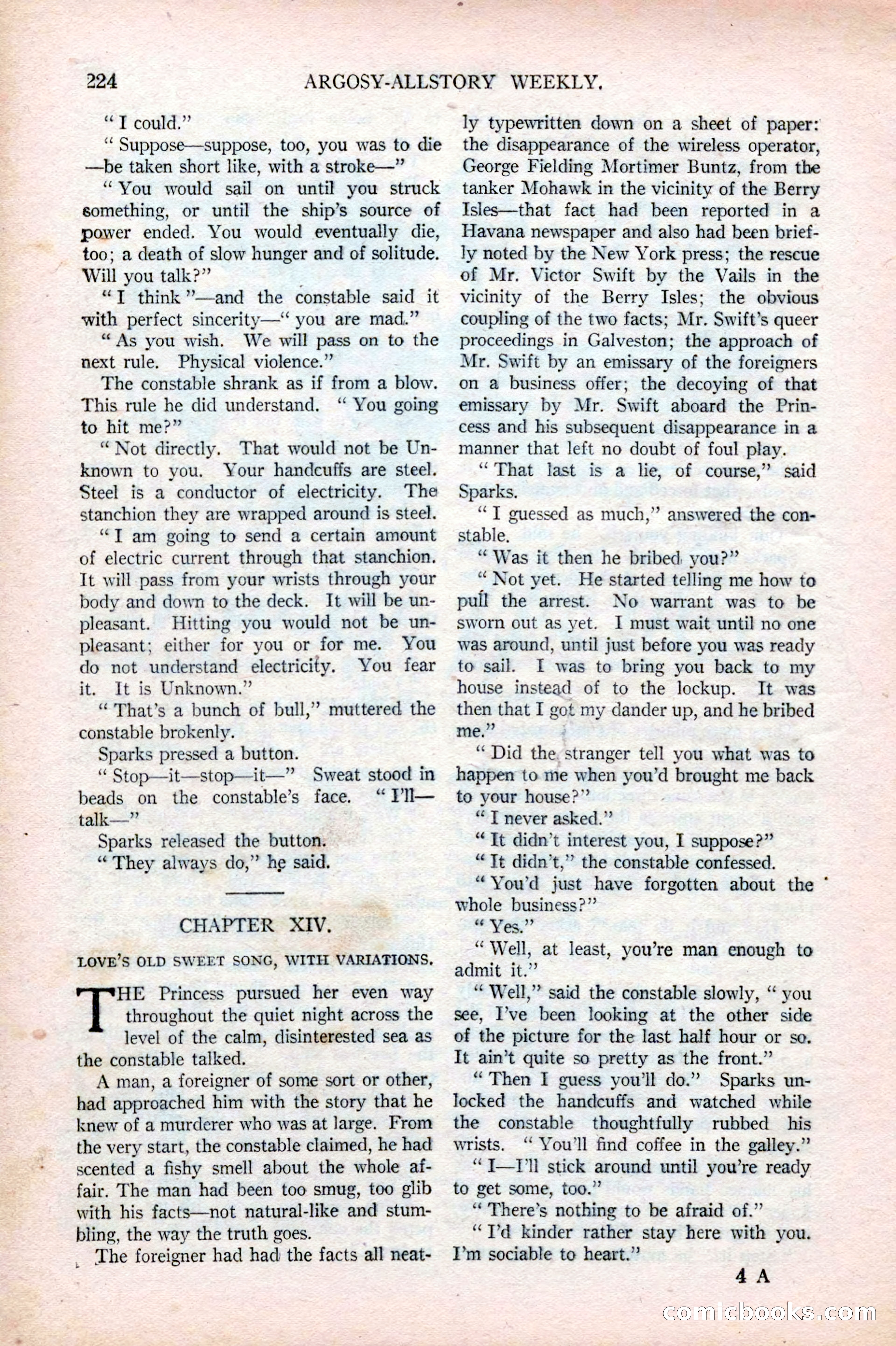
A restored page from Pulp Fiction, 1924. Page through the whole issue in the reader above.
📄 Transcribed text from this page (OCR, searchable)
Machine-transcribed from the original scan — historical spelling and the odd misread are preserved.
224 “T could.” ‘‘ Suppose—suppose, too, you was to die —be taken short like, with a stroke—” “You would sail on until you struck something, or until the ship’s source of power ended. You would eventually die, too; a death of slow hunger and of solitude. Will you talk?” “TI think ’—and the constable said it with perfect sincerity—‘‘ you are mad.” “ As you wish. We will pass on to the next rule. Physical violence.” The constable shrank as if from a blow. This rule he did understand. ‘“ You going to hit me?” “Not directly. That would not be Un- known to you. Your handcuffs are steel. Steel is a conductor of electricity. The stanchion they are wrapped around is steel. “T am going to send a certain amount of electric current through that stanchion. It will pass from your wrists through your body and down to the deck. It will be un- pleasant. Hitting you would not be un- pleasant; either for you or for me. You do not understand electricity. You fear it. It is Unknown.” “That’s a bunch of bull,” muttered the constable brokenly. Sparks pressed a button. “ Stop—it—stop—it—” Sweat stood in beads on the constable’s face. “ PU— talk—”’ Sparks released the button. “They always do,” he said. CHAPTER XIV, LOVE’S OLD SWEET SONG, WITH VARIATIONS, HE Princess pursued her even way throughout the quiet night across the level of the calm, disinterested sea as the constable talked. A man, a foreigner of some sort or other, had approached him with the story that he knew of a murderer who was at large. From the very start, the constable claimed, he had scented a fishy smell about the whole af- fair. The man had been too smug, too glib with his facts—not natural-like and stum- bling, the way the truth goes. The foreigner had had the facts all neat- ‘ ARGOSY-ALLSTORY WEEKLY. ly typewritten down on a sheet of paper: the disappearance of the wireless operator, George Fielding Mortimer Buntz, from the tanker Mohawk in the vicinity of the Berry Isles—that fact had been reported in a Havana newspaper and also had been brief- ly noted by the New York press; the rescue of Mr. Victor Swift by the Vails in the vicinity of the Berry Isles; the obvious coupling of the two facts; Mr. Swift’s queer proceedings in Galveston; the approach of Mr. Swift by an emissary of the foreigners on a business offer; the decoying of that emissary by Mr. Swift aboard the Prin- cess and his subsequent disappearance in a manner that left no doubt of foul play. “That last is a lie, of course,” said Sparks. ‘““T guessed as much,” stable. “Was it then he bribed. you?” “Not yet. He started telling me how to pull the arrest. No warrant was to be sworn out as yet. I must wait until no one was around, until just before you was ready to sail. I was to bring you back to my house instead of to the lockup. It was then that I got my dander up, and he bribed me. 9 “ Did the: stranger tell you what was to happen to me whens ee brought me back to your house?” “ T never asked.” “Tt didn’t interest you, I suppose?” “Tt didn’t,” the constable confessed. answered the con- “You'd just have forgotten about the * whole business?” e Yes,’’ “Well, at least, you’re man enough to admit it.” “Well,” said the constable slowly, “ you see, I’ve been looking at the other side of the picture for the last half hour or se. It ain’t quite so pretty as the front.” “Then I guess you'll do.” Sparks un- locked the handcuffs and watched while the constable thoughtfully rubbed his wrists. ‘“ You'll find coffee in the galley.” ‘“I—T'll stick around until you’re ready to get some, too.” “’'There’s nothing to be afraid of.” ‘““T’d kinder rather stay here with you. I’m sociable to heart.” 4A COmmicloool< (C@