
Pulp Fiction, 1924 · page 169 of 172
Argosy All-Story Weekly, May 17, 1924 — page 169: what you’re looking at
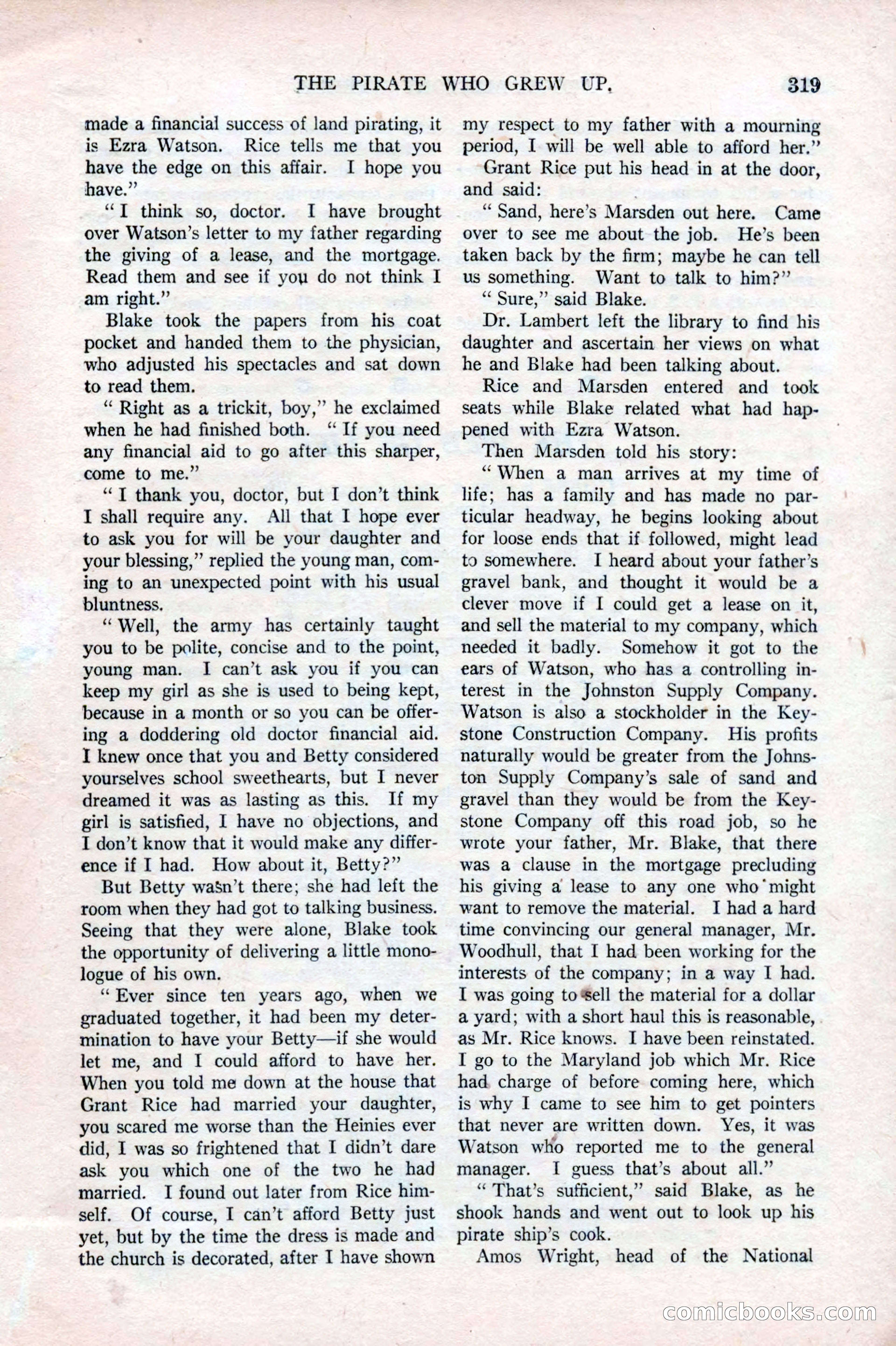
A restored page from Pulp Fiction, 1924. Page through the whole issue in the reader above.
📄 Transcribed text from this page (OCR, searchable)
Machine-transcribed from the original scan — historical spelling and the odd misread are preserved.
THE PIRATE WHO GREW UP. made a financial success of land pirating, it is Ezra Watson. Rice tells me that you have the edge on this affair. I hope you have.” “TI think so, doctor. I have brought over Watson’s letter to my father regarding the giving of a lease, and the mortgage. Read them and see if you do not think I am right.” Blake took the papers from his coat pocket and handed them to the physician, who adjusted his spectacles and sat down to read them. “ Right as a trickit, boy,” he exclaimed when he had finished both. “If you need any financial aid to go after this sharper, come to me.” “T thank you, doctor, but I don’t think I shall require any. All that I hope ever to ask you for will be your daughter and your blessing,” replied the young man, com- ing to an unexpected point with his usual bluntness. “Well, the army has certainly taught you to be polite, concise and to the point, young man. I can’t ask you if you can keep my girl as she is used to being kept, because in a month or so you can be offer- ing a doddering old doctor financial aid. I knew once that you and Betty considered yourselves school sweethearts, but I never dreamed it was as lasting as this. If my girl is satisfied, I have no objections, and I don’t know that it would make any differ- ence if I had. How about it, Betty?” But Betty waSn’t there; she had left the room when they had got to talking business. Seeing that they were alone, Blake took the opportunity of delivering a little mono- logue of his own. “Ever since ten years ago, when we graduated together, it had been my deter- mination to have your Betty—if she would let me, and I could afford to have her. When you told me down at the house that Grant Rice had married your daughter, you scared me worse than the Heinies ever did, I was so frightened that I didn’t dare ask you which one of the two he had married. I found out later from Rice him- self. Of course, I can’t afford Betty just yet, but by the time the dress is made and the church is decorated, after I have shown ol9 my respect to my father with a mourning period, I will be well able to afford her.” Grant Rice put his head in at the door, and said: ) ‘Sand, here’s Marsden out here. Came over to see me about the job. He’s been taken back by the firm; maybe he can tell us something. Want to talk to him?” “ Sure,” said Blake. Dr. Lambert left the library to find his daughter and ascertain her views on what he and Blake had been talking about. Rice and Marsden entered and took seats while Blake related what had hap- pened with Ezra Watson. Then Marsden told his story: “When a man arrives at my time of life; has a family and has made no par- ticular headway, he begins looking about for loose ends that if followed, might lead to somewhere. I heard about your father’s gravel bank, and thought it would be a clever move if I could get a lease on it, and sell the material to my company, which needed it badly. Somehow it got to the ears of Watson, who has a controlling in- terest in the Johnston Supply Company. Watson is also a stockholder in the Key- stone Construction Company. His profits naturally would be greater from the Johns- ton Supply Company’s sale of sand and gravel than they would be from the Key- stone Company off this road job, so he wrote your father, Mr. Blake, that there was a clause in the mortgage precluding his giving a lease to any one who’ might want to remove the material. I had a hard time convincing our general manager, Mr. Woodhull, that [ had been working for the interests of the company; in a way I had. I was going to%ell the material for a dollar a yard; with a short haul this is reasonable, as Mr. Rice knows. I have been reinstated. I go to the Maryland job which Mr. Rice had. charge of before coming here, which is why I came to see him to get pointers that never are written down. Yes, it was Watson who reported me to the general manager. I guess that’s about all.” ‘“That’s sufficient,’ said Blake, as he shook hands and went out to look up his pirate ship’s cook. Amos Wright, head of the National COmiclbooks (C@