
Pulp Fiction, 1924 · page 152 of 172
Argosy All-Story Weekly, May 17, 1924 — page 152: what you’re looking at
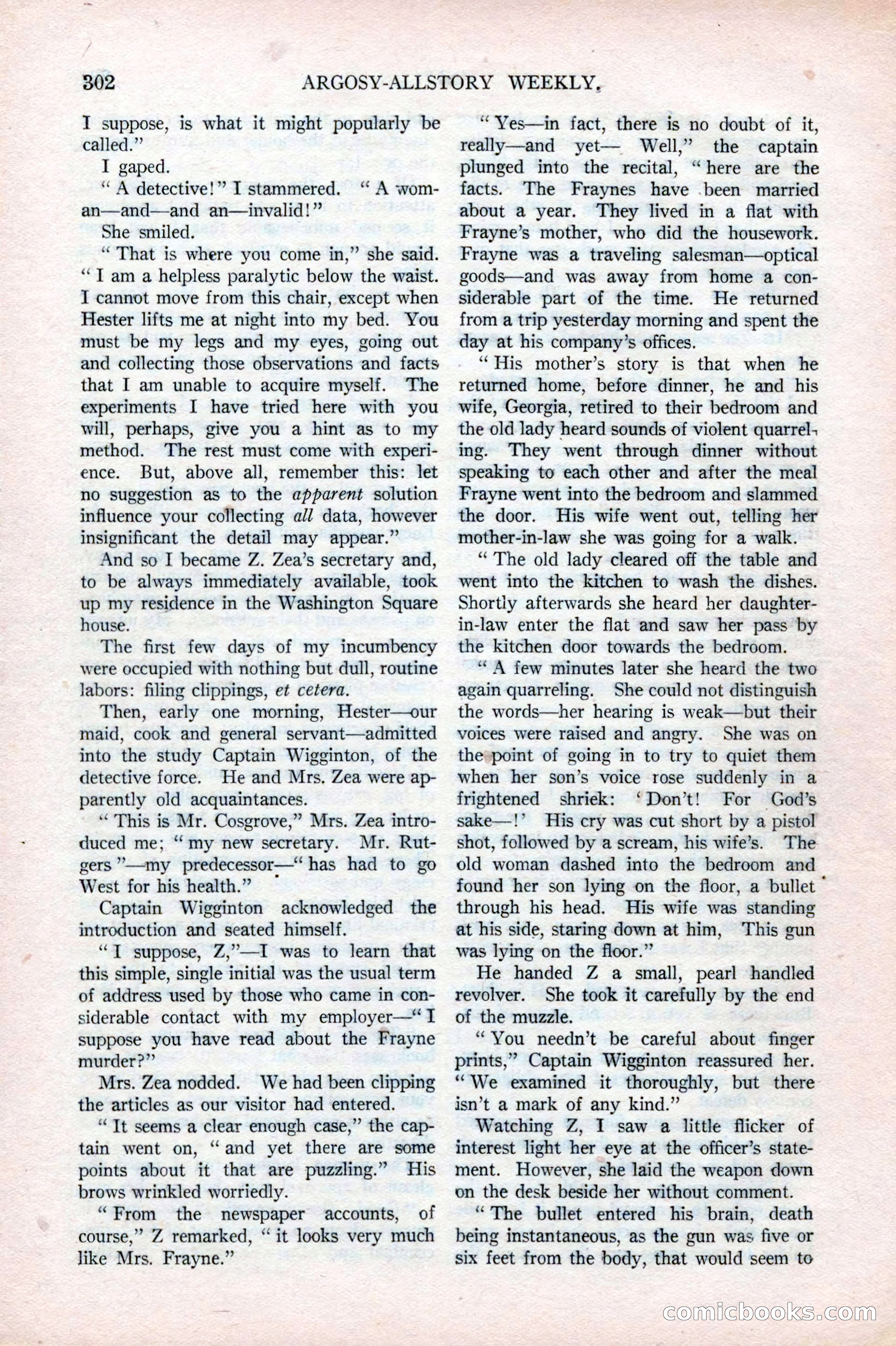
A restored page from Pulp Fiction, 1924. Page through the whole issue in the reader above.
📄 Transcribed text from this page (OCR, searchable)
Machine-transcribed from the original scan — historical spelling and the odd misread are preserved.
302 T suppose, is what it might popularly be called.” I gaped. ‘A detective!” I stammered. an—and—and an—invalid!” She smiled. “That is where you come in,” she said. “Tt am a helpless paralytic below the waist. I cannot move from this chair, except when Hester lifts me at night into my bed. You must be my legs and my eyes, going out and collecting those observations and facts that I am unable to acquire myself. The experiments I have tried here with you will, perhaps, give you a hint as to my method. The rest must come with experi- ence. But, above all, remember this: let no suggestion as to the apparent solution influence your collecting all data, however insignificant the detail may appear.” And so I became Z. Zea’s secretary and, to be always immediately available, took up my residence in the Washington Square house. The first few days of my incumbency were occupied with nothing but dull, routine Jabors: filing clippings, et cetera. Then, early one morning, Hester—our maid, cook and general servant—admitted into the study Captain Wigginton, of the detective force. He and Mrs. Zea were ap- parently old acquaintances. “This is Mr. Cosgrove,” Mrs. Zea intro- duced me; “ my new secretary. Mr. Rut- gers "—my predecessor—‘ has had to go West for his health.” Captain Wigginton acknowledged the introduction and seated himself. “T suppose, Z,”—I was to learn that this simple, single initial was the usual term of address used by those who came in con- siderable contact with my employer—* I suppose you have read about the Frayne murder?” Mrs. Zea nodded. We had been clipping the articles as our visitor had entered. “Tt seems a clear enough case,” the cap- tain went on, “and yet there are some “ A wom- points about it that are puzzling.” His brows wrinkled worriedly. “From the newspaper accounts, of course,” Z remarked, “it looks very much like Mrs. Frayne.” ARGOSY-ALLSTORY WEEKLY, “"Yes—in fact, there is no doubt of it, really—and yet— Well,” the captain plunged into the recital, “here are the facts. The Fraynes have .been married about a year. They lived in a flat with Frayne’s mother, who did the housework. Frayne was a traveling salesman—optical goods—and was away from home a con- siderable part of the time. He returned from a trip yesterday morning and spent the day at his company’s offices. ‘““His mother’s story is that when he returned home, before dinner, he and his wife, Georgia, retired to their bedroom and the old lady heard sounds of violent quarrel. ing. They went through dinner without speaking to each other and after the meal Frayne went into the bedroom and slammed the door. His wife went out, telling her mother-in-law she was going for a walk. “The old lady cleared off the table and went into the kitchen to wash the dishes. Shortly afterwards she heard her daughter- in-law enter the flat and saw her pass by the kitchen door towards the bedroom. “A few minutes later she heard the two again quarreling. She could not distinguish the words—her hearing is weak—but their voices were raised and angry. She was on the»point of going in to try to quiet them when her son’s voice rose suddenly in a frightened shriek: ‘Don’t! For God’s sake—!’ His cry was cut short by a pistol shot, followed by a scream, his wife’s. The old woman dashed into the bedroom and found her son lying on the floor, a bullet © through his head. His wife was standing at his side, staring down at him, This gun was lying on the floor.” He handed Z a small, pearl handled revolver. She took it carefully by the end of the muzzle. “You needn’t be careful about finger prints,” Captain Wigginton reassured her. “We examined it thoroughly, but there isn’t a mark of any kind.” Watching Z, I saw a little flicker of interest light her eye at the officer’s state- ment. However, she laid the weapon down on the desk beside her without comment. “The bullet entered his brain, death being instantaneous, as the gun was five or six feet from the body, that would seem to COMMICLOoOolkKks (C@