
Pulp Fiction, 1924 · page 150 of 172
Argosy All-Story Weekly, May 17, 1924 — page 150: what you’re looking at
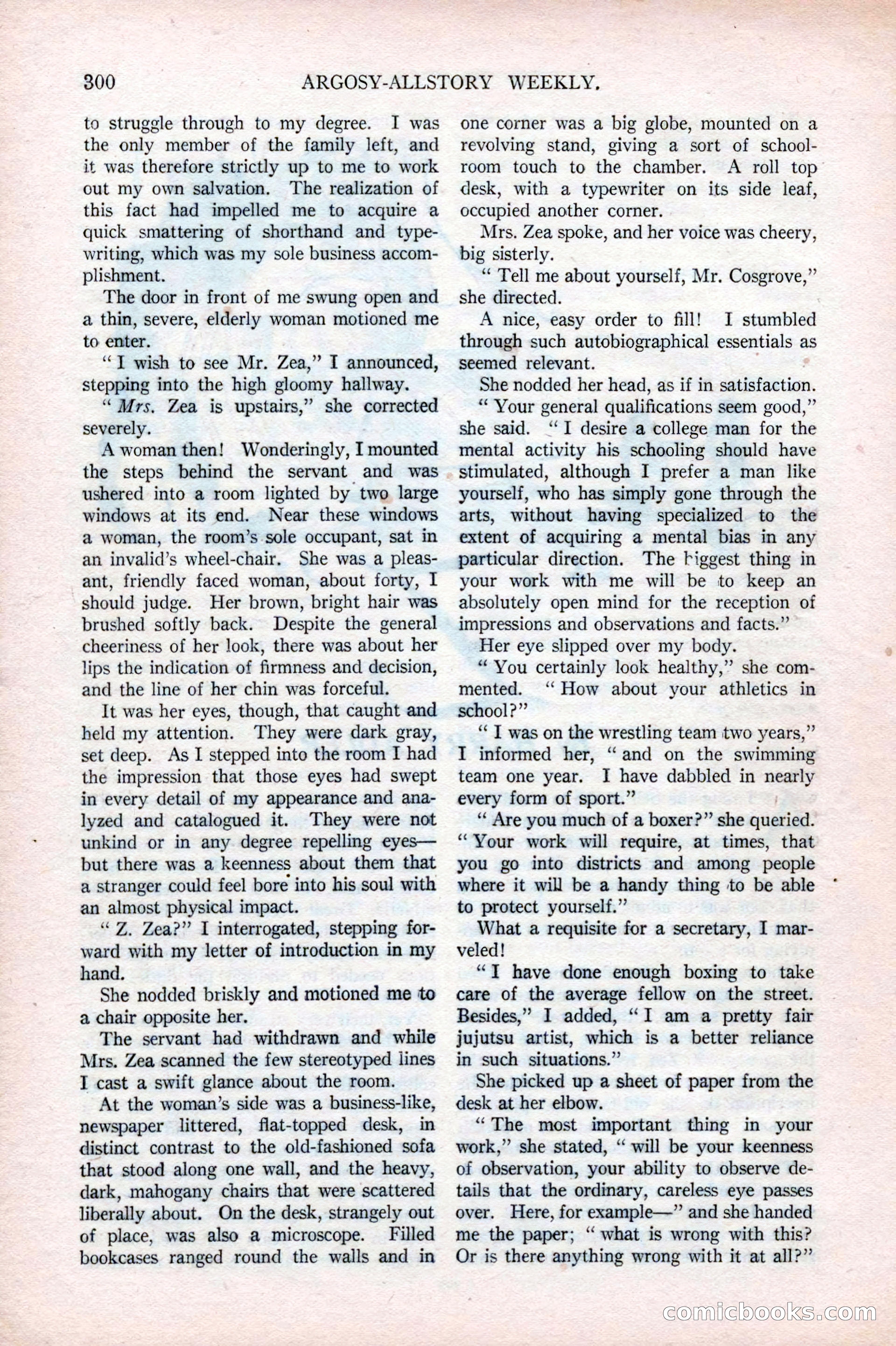
A restored page from Pulp Fiction, 1924. Page through the whole issue in the reader above.
📄 Transcribed text from this page (OCR, searchable)
Machine-transcribed from the original scan — historical spelling and the odd misread are preserved.
300 to struggle through to my degree. I was the only member of the family left, and it was therefore strictly up to me to work out my own salvation. The realization of this fact had impelled me to acquire a quick smattering of shorthand and type- writing, which was my sole business accom- plishment. The door in front of me swung open and a thin, severe, elderly woman motioned me to enter. “YT wish to see Mr. Zea,” I announced, stepping into the high gloomy hallway. “Mrs. Zea is upstairs,” she corrected severely. A woman then! Wonderingly, I mounted the steps behind the servant and was ushered into a room lighted by two large windows at its end. Near these windows a woman, the room’s sole occupant, sat in an invalid’s wheel-chair. She was a pleas- ant, friendly faced woman, about forty, I should judge. Her brown, bright hair was brushed softly back. Despite the general cheeriness of her look, there was about her lips the indication of firmness and decision, and the line of her chin was forceful. It was her eyes, though, that caught and held my attention. They were dark gray, set deep. As I stepped into the room I had the impression that those eyes had swept in every detail of my appearance and ana- lyzed and catalogued it. They were not unkind or in any degree repelling eyes— but there was a keenness about them that a stranger could feel bore into his soul with an almost physical impact. “7. Zea?’ I interrogated, stepping for- ward with my letter of introduction in my hand. She nodded briskly and motioned me to a chair opposite her. The servant had withdrawn and while Mrs. Zea scanned the few stereotyped lines I cast a swift glance about the room. At the woman’s side was a business-like, newspaper littered, flat-topped desk, in distinct contrast to the old-fashioned sofa that stood along one wall, and the heavy, dark, mahogany chairs that were scattered liberally about. On the desk, strangely out of place, was also a microscope. Filled bookcases ranged round the walls and in ARGOSY-ALLSTORY WEEKLY. one corner was a big globe, mounted on a revolving stand, giving a sort of school- room touch to the chamber. A roll top desk, with a typewriter on its side leaf, occupied another corner. Mrs. Zea spoke, and her voice was cheery, big sisterly. “Tell me about yourself, Mr. Cosgrove,” she directed. A nice, easy order to fill! I stumbled through such autobiographical essentials as seemed relevant. She nodded her head, as if in satisfaction. “Your general qualifications seem good,” she said. “I desire a college man for the mental activity his schooling should have stimulated, although I prefer a man like yourself, who has simply gone through the arts, without having specialized to the extent of acquiring a mental bias in any particular direction. The biggest thing in your work with me will be to keep an absolutely open mind for the reception of impressions and observations and facts.” Her eye slipped over my body. “You certainly look healthy,” she com- mented. ‘“‘ How about your athletics in school?” ‘“‘ T was on the wrestling team two years,” I informed her, “and on the swimming team one year. I have dabbled in nearly every form of sport.” ‘“* Are you much of a boxer?” she queda’ “Your work will require, at times, that you go into districts and among people where it will be a handy thing to be able to protect yourself.” What a requisite for a secretary, I mar- veled! “JT have done enough boxing to take care of the average fellow on the street. Besides,” I added, “I am a pretty fair jujutsu artist, which is a better reliance in such situations.” She picked up a sheet of paper from the desk at her elbow. “The most important thing in your work,” she stated, “ will be your keenness of observation, your ability to observe de- tails that the ordinary, careless eye passes over. Here, for example—” and she handed me the paper; “ what is wrong with this? Or is there anything wrong with it at all?” COMmMicloooks (C@