
Pulp Fiction, 1924 · page 102 of 172
Argosy All-Story Weekly, May 17, 1924 — page 102: what you’re looking at
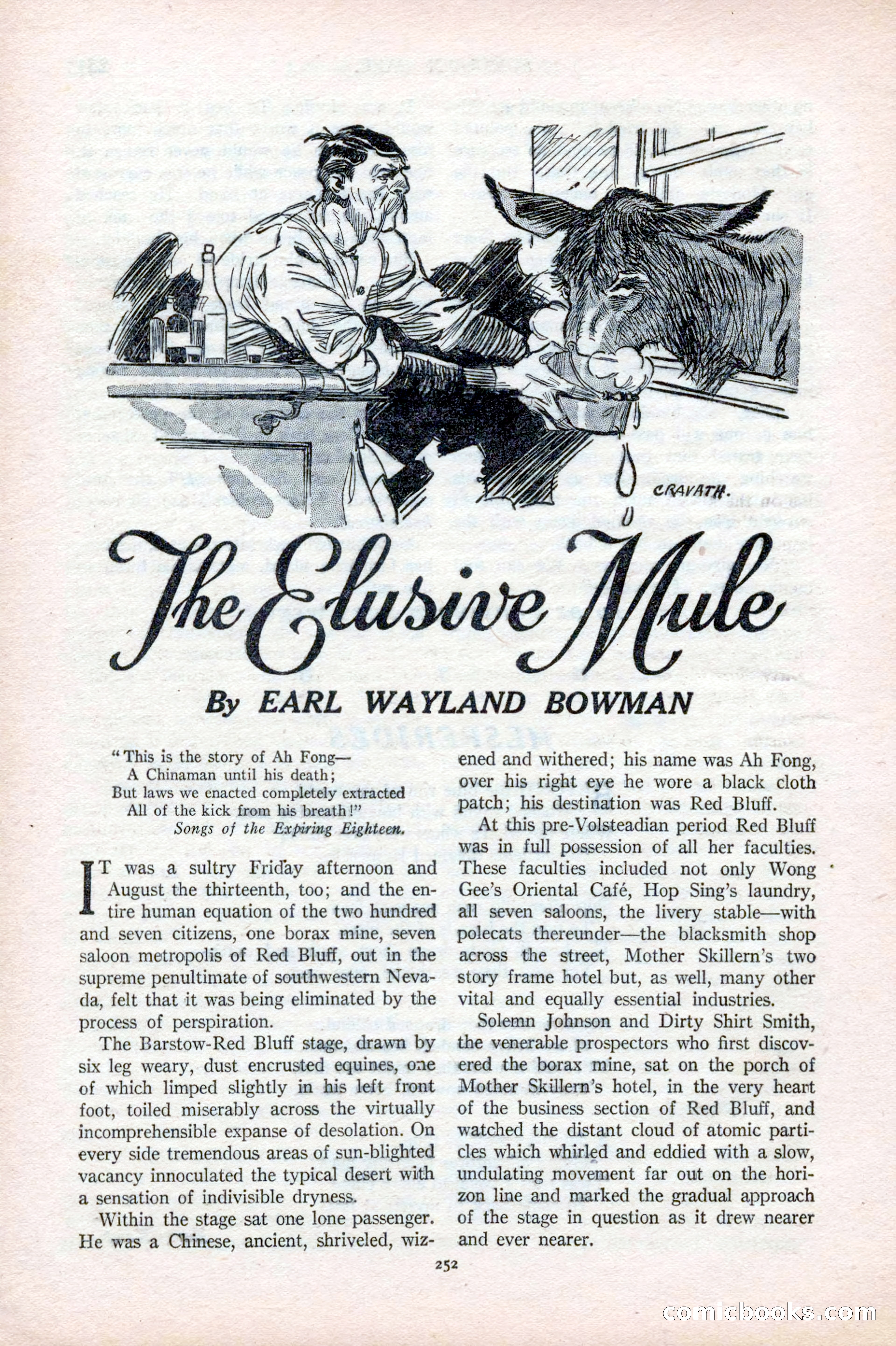
A restored page from Pulp Fiction, 1924. Page through the whole issue in the reader above.
📄 Transcribed text from this page (OCR, searchable)
Machine-transcribed from the original scan — historical spelling and the odd misread are preserved.
By EARL WAYLAND BOWMAN “This is the story of Ah Fong— A Chinaman until his death; But laws we enacted completely extracted All of the kick from his breath!” Songs of the Expiring Eighteen. T was a sultry Friday afternoon and August the thirteenth, too; and the en- tire human equation of the two hundred and seven citizens, one borax mine, seven saloon metropolis of Red Bluff, out in the supreme penultimate of southwestern Neva- da, felt that it was being eliminated by the process of perspiration. The Barstow-Red Bluff stage, drawn by six leg weary, dust encrusted equines, one of which limped slightly in his left front foot, toiled miserably across the virtually incomprehensible expanse of desolation. On every side tremendous areas of sun-blighted vacancy innoculated the typical desert with a sensation of indivisible dryness. Within the stage sat one lone passenger. He was a Chinese, ancient, shriveled, wiz- ened and withered; his name was Ah Fong, over his right eye he wore a black cloth patch; his destination was Red Bluff. At this pre-Volsteadian period Red Bluff was in full possession of all her faculties. These faculties included not only Wong Gee’s Oriental Café, Hop Sing’s laundry, all seven saloons, the livery stable—with polecats thereunder—the blacksmith shop across the street, Mother Skillern’s two story frame hotel but, as well, many other vital and equally essential industries. Solemn Johnson and Dirty Shirt Smith, the venerable prospectors who first discov- ered the borax mine, sat on the porch of Mother Skillern’s hotel, in the very heart of the business section of Red Bluff, and watched the distant cloud of atomic parti- cles which whirled and eddied with a slow, undulating movement far out on the hori- zon line and marked the gradual approach of the stage in question as it drew nearer and ever nearer. 252 COmiclboool< (C@