
Pulp Fiction, 1924 · page 99 of 186
Argosy All-Story Weekly, May 3, 1924 — page 99: what you’re looking at
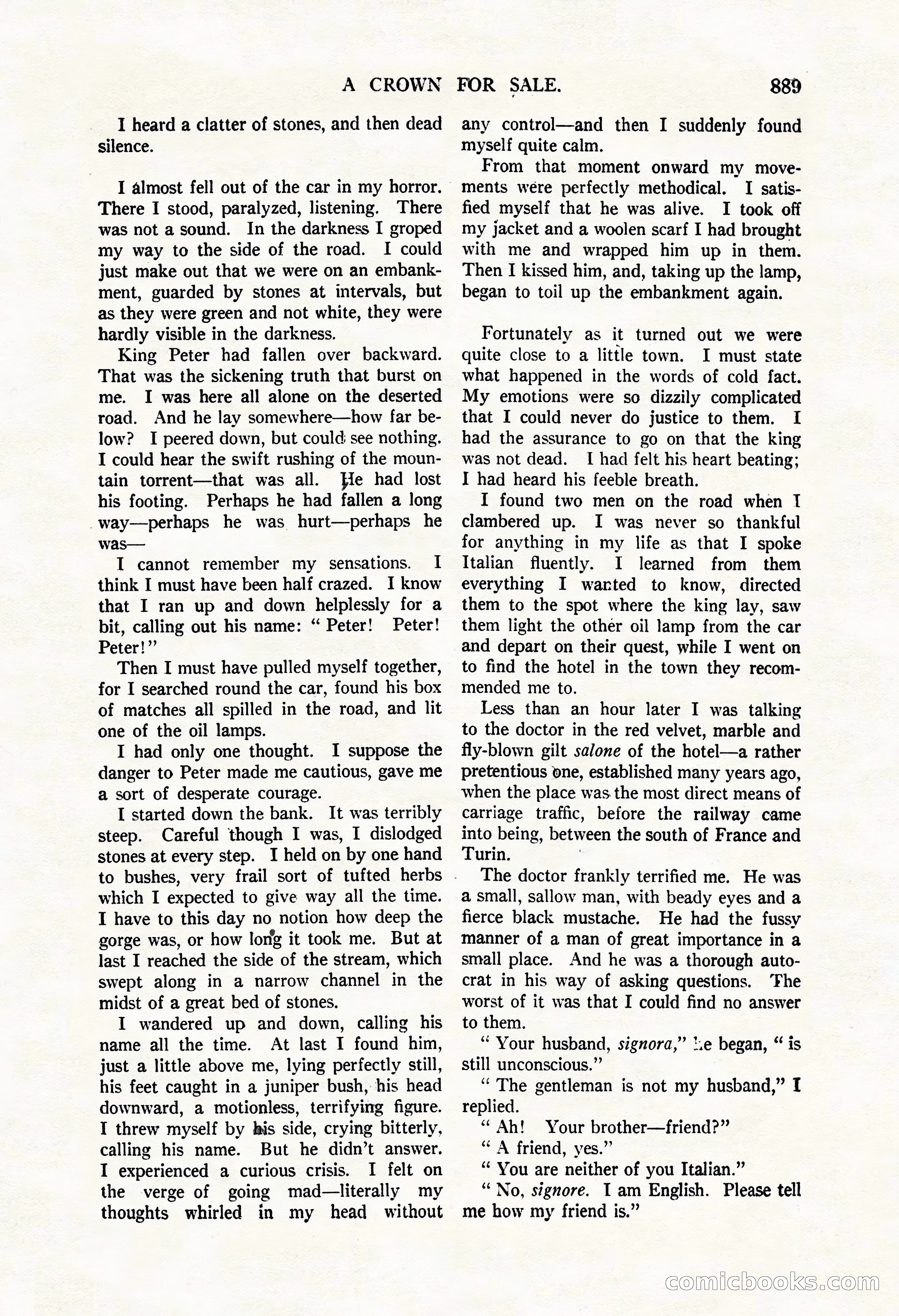
A restored page from Pulp Fiction, 1924. Page through the whole issue in the reader above.
📄 Transcribed text from this page (OCR, searchable)
Machine-transcribed from the original scan — historical spelling and the odd misread are preserved.
A CROWN I heard a clatter of stones, and then dead silence. I almost fell out of the car in my horror. There I stood, paralyzed, listening. There was not a sound. In the darkness I groped my way to the side of the road. I could just make out that we were on an embank- ment, guarded by stones at intervals, but as they were green and not white, they were hardly visible in the darkness. King Peter had fallen over backward. That was the sickening truth that burst on me. I was here all alone on the deserted road. And he lay somewhere—how far be- low? I peered down, but could see nothing. I could hear the swift rushing of the moun- tain torrent—that was all. He had lost his footing. Perhaps he had fallen a long -way—perhaps he was hurt—perhaps he was— I cannot remember my sensations. I think I must have been half crazed. I know that I ran up and down helplessly for a bit, calling out his name: “ Peter! Peter! Peter!” Then I must have pulled myself together, for I searched round the car, found his box of matches all spilled in the road, and lit one of the oil lamps. I had only one thought. I suppose the danger to Peter made me cautious, gave me a sort of desperate courage. I started down the bank. It was terribly steep. Careful though I was, I dislodged stones at every step. I held on by one hand to bushes, very frail sort of tufted herbs . which I expected to give way all the time. I have to this day no notion how deep the gorge was, or how long it took me. But at last I reached the side of the stream, which swept along in a narrow channel in the midst of a great bed of stones. I wandered up and down, calling his name all the time. At last I found him, just a little above me, lying perfectly still, his feet caught in a juniper bush, his head downward, a motionless, terrifying figure. I threw myself by his side, crying bitterly, calling his name. But he didn’t answer. I experienced a curious crisis. I felt on the verge of going mad—literally my thoughts whirled in my head without FOR SALE. any control—and then I suddenly found myself quite calm. From that moment onward my move- ments were perfectly methodical. I satis- fied myself that he was alive. I took off my jacket and a woolen scarf I had brought with me and wrapped him up in them. Then I kissed him, and, taking up the lamp, began to toil up the embankment again. Fortunately as it turned out we were quite close to a little town. I must state what happened in the words of cold fact. My emotions were so dizzily complicated that I could never do justice to them. I had the assurance to go on that the king was not dead. I had felt his heart beating; I had heard his feeble breath. I found two men on the road when 1 clambered up. I was never so thankful for anything in my life as that I spoke Italian fluently. I learned from them everything I warted to know, directed them to the spot where the king lay, saw them light the other oil lamp from the car and depart on their quest, while I went on to find the hotel in the town they recom- mended me to. Less than an hour later I was talking to the doctor in the red velvet, marble and fly-blown gilt salone of the hotel—a rather pretentious one, established many years ago, when the place was the most direct means of carriage traffic, before the railway came into being, between the south of France and Turin. | The doctor frankly terrified me. He was a small, sallow man, with beady eyes and a fierce black mustache. He had the fussy manner of a man of great importance in a small place. And he was a thorough auto- crat in his way of asking questions. ‘Fhe worst of it was that I could find no answer to them. “Your husband, signora,” '.e began, “ is still unconscious.” “The gentleman is not my husband,” f replied. ‘Ah! Your brother—friend?”’ “ A friend, ves.” “You are neither of you Italian.” “No, signore. I am English. Please tell me how my friend is.” comniclsoo! 889 (©