
Pulp Fiction, 1924 · page 97 of 186
Argosy All-Story Weekly, May 3, 1924 — page 97: what you’re looking at
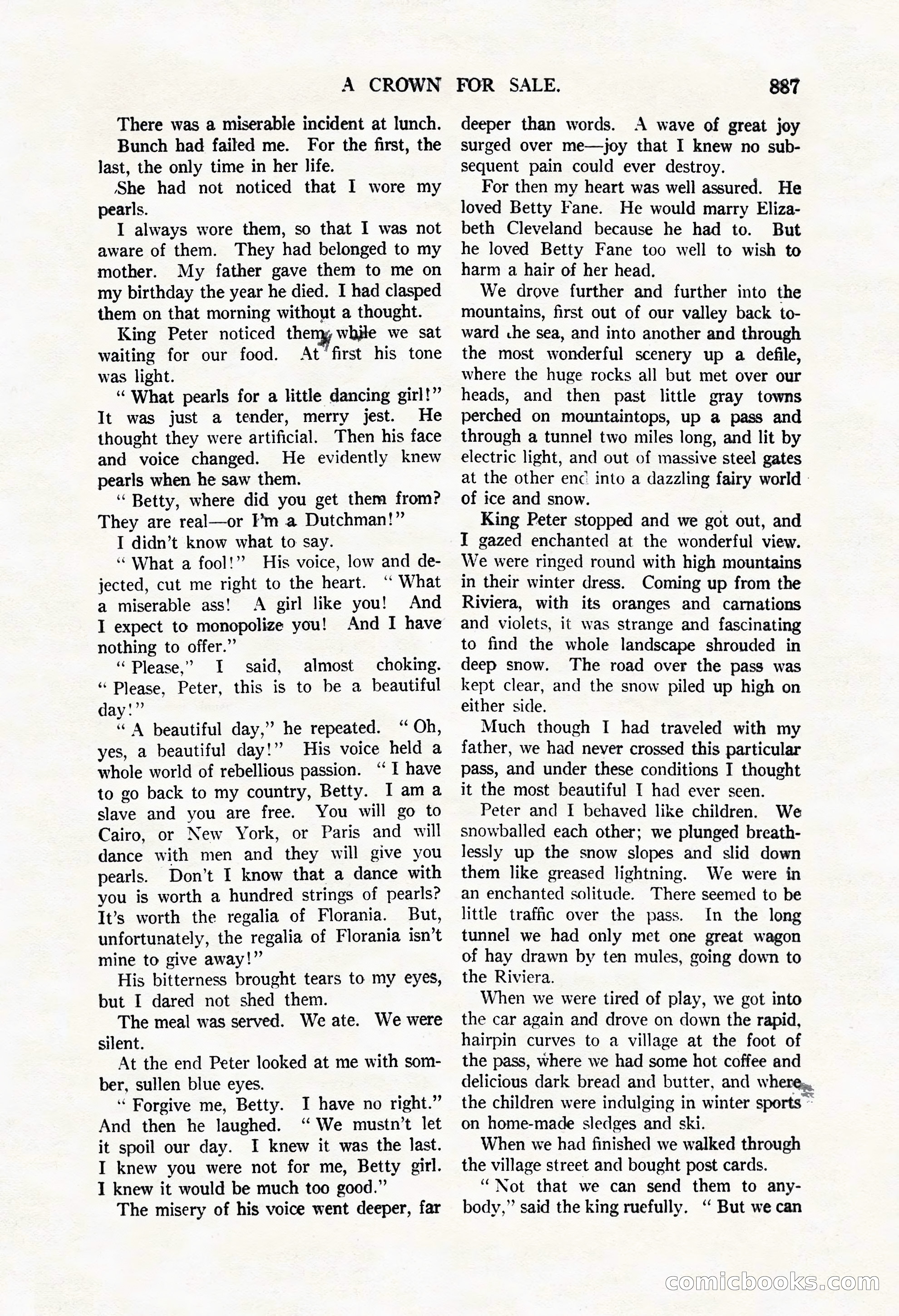
A restored page from Pulp Fiction, 1924. Page through the whole issue in the reader above.
📄 Transcribed text from this page (OCR, searchable)
Machine-transcribed from the original scan — historical spelling and the odd misread are preserved.
A CROWN There was a miserable incident at lunch. Bunch had failed me. For the first, the last, the only time in her life. She had not noticed that I wore my pearls. I always wore them, so that I was not aware of them. They had belonged to my mother. My father gave them to me on my birthday the year he died. I had clasped them on that morning without a thought. King Peter noticed theny while we sat waiting for our food. At first his tone was light. “ What pearls for a little dancing girl!” It was just a tender, merry jest. He thought they were artificial. Then his face and voice changed. He evidently knew pearls when he saw them. “Betty, where did you get them frome They are real—or I’m a Dutchman!” I didn’t know what to say. ‘What a fool!” His voice, low and de- jected, cut me right to the heart. ‘“ What a miserable ass! A girl like you! And I expect to monopolize you! And I have nothing to offer.” “Please,” I said, almost choking. ‘Please, Peter, this is to be a beautiful day!” “A beautiful day,” he repeated. “ Oh, yes, a beautiful day!” His voice held a whole world of rebellious passion. ‘‘ I have to go back to my country, Betty. I ama slave and you are free. You will go to Cairo, or New York, or Paris and will dance with men and they will give you pearls. Don’t I know that a dance with you is worth a hundred strings of pearls? It’s worth the regalia of Florania. But, unfortunately, the regalia of Florania isn’t mine to give away!” His bitterness brought tears to my eyés, but I dared not shed them. The meal was served. We ate. We were silent. At the end Peter looked at me with som- ber, sullen blue eyes. “ Forgive me, Betty. I have no right.” And then he laughed. ‘“ We mustn’t let it spoil our day. I knew it was the last. I knew you were not for me, Betty girl. I knew it would be much too good.” The misery of his voice went deeper, far FOR SALE. 887 deeper than words. A wave of great joy surged over me—joy that I knew no sub- sequent pain could ever destroy. For then my heart was well assured. He loved Betty Fane. He would marry Eliza- beth Cleveland because he had to. But he loved Betty Fane too well to wish to harm a hair of her head. We drove further and further into the mountains, first out of our valley back to- ward che sea, and into another and through the most wonderful scenery up a defile, where the huge rocks all but met over our heads, and then past little gray towns perched on mountaintops, up a pass and through a tunnel two miles long, and lit by electric light, and out of massive steel gates at the other enc into a dazzling fairy world » of ice and snow. King Peter stopped and we got out, and I gazed enchanted at the wonderful view. We were ringed round with high mountains in their winter dress. Coming up from the Riviera, with its oranges and carnations and violets, it was strange and fascinating to find the whole landscape shrouded in deep snow. The road over the pass was kept clear, and the snow piled up high on either side. Much though I had traveled with my father, we had never crossed this particular pass, and under these conditions I thought it the most beautiful I had ever seen. Peter and I behaved like children. We snowballed each other; we plunged breath- lessly up the snow slopes and slid down them like greased lightning. We were in an enchanted solitude. There seemed to be little traffic over the pass. In the long tunnel we had only met one great wagon of hay drawn by ten mules, going down to the Riviera. When we were tired of play, we got into the car again and drove on down the rapid, hairpin curves to a village at the foot of the pass, where we had some hot coffee and delicious dark bread and butter, and where, the children were indulging in winter sports © on home-made sledges and ski. When we had finished we walked through the village street and bought post cards. “Not that we can send them to any- body,” said the king ruefully. ‘“ But we can COMIGD OO! S (CO) nn