
Pulp Fiction, 1924 · page 56 of 186
Argosy All-Story Weekly, May 3, 1924 — page 56: what you’re looking at
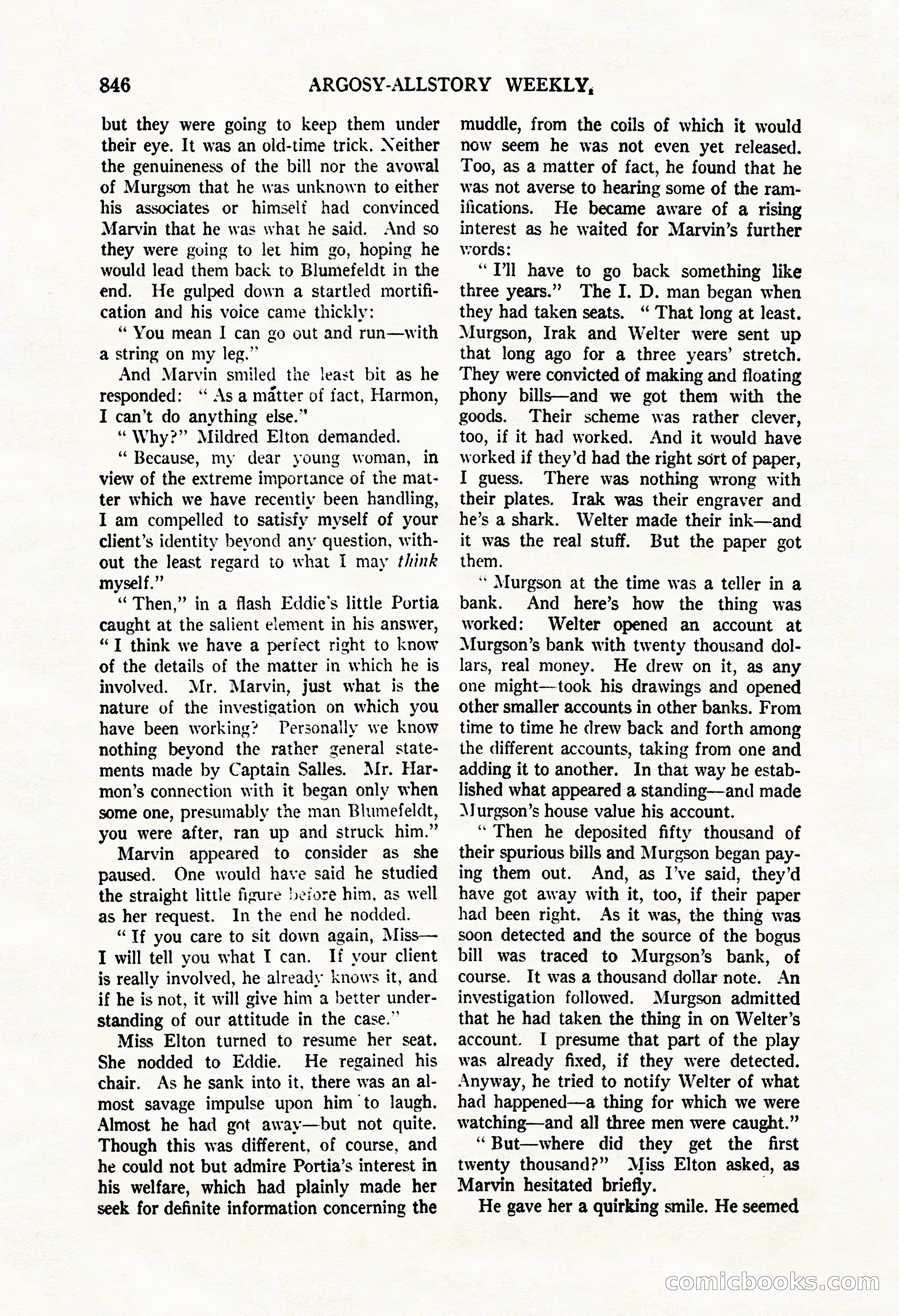
A restored page from Pulp Fiction, 1924. Page through the whole issue in the reader above.
📄 Transcribed text from this page (OCR, searchable)
Machine-transcribed from the original scan — historical spelling and the odd misread are preserved.
846 but they were going to keep them under their eye. It was an old-time trick. Neither the genuineness of the bill nor the avowal of Murgson that he was unknown to either his associates or himself had convinced Marvin that he was what he said. And so they were going to let him go, hoping he would lead them back to Blumefeldt in the end. He gulped down a startled mortifi- cation and his voice came thickly: “ You mean I can go out and run—with a string on my leg.”’ And Marvin smiled the least bit as he responded: ‘“ Asa matter of fact, Harmon, I can’t do anything else.” “Why?” Mildred Elton demanded. “Because, my dear young woman, in view of the extreme importance of the mat- ter which we have recentiv been handling, I am compelled to satisfy myself of your client’s identity bevond any question, with- out the least regard to what I may think myself.” “ Then,” in a flash Eddie's little Portia caught at the salient element in his answer, “T think we have a perfect right to know of the details of the matter in which he is involved. Mr. Marvin, just what is the nature of the investigation on which you have been working? Personally we know nothing beyond the rather general state- ments made by Captain Salles. Mfr. Har- mon’s connection with it began only when some one, presumably the man Blumefeldt, you were after, ran up and struck him.” Marvin appeared to consider as she paused. One would have said he studied the straight little figure beiore him, as well as her request. In the end he nodded. “Tf you care to sit down again, Miss— I will tell you what I can. If your client is really involved, he already knows it, and if he is not, it will give him a better under- standing of our attitude in the case.” Miss Elton turned to resume her seat. She nodded to Eddie. He regained his chair. As he sank into it, there was an al- most savage impulse upon him to laugh. Almost he had got away—but not quite. Though this was different, of course, and he could not but admire Portia’s interest in his welfare, which had plainly made her seek for definite information concerning the ARGOSY-ALLSTORY WEEKLY, muddle, from the coils of which it would now seem he was not even yet released. Too, as a matter of fact, he found that he was not averse to hearing some of the ram- ifications. He became aware of a rising interest as he waited for Marvin’s further words: ‘Tl have to go back something like three years.” The I. D. man began when they had taken seats. ‘“ That long at least. Murgson, Irak and Welter were sent up that long ago for a three years’ stretch. They were convicted of making and floating phony bills—and we got them with the goods. Their scheme was rather clever, too, if it had worked. And it would have worked if they’d had the right sort of paper, I guess. There was nothing wrong with their plates. Irak was their engraver and he’s a shark. Welter made their ink—and it was the real stuff. But the paper got them. ‘* Murgson at the time was a teller in a bank. And here’s how the thing was worked: Welter opened an account at Murgson’s bank with twenty thousand dol- lars, real money. He drew on it, as any one might—took his drawings and opened other smaller accounts in other banks. From time to time he drew back and forth among the different accounts, taking from one and adding it to another. In that way he estab- lished what appeared a standing—and made MJurgson’s house value his account. “Then he deposited fifty thousand of their spurious bills and Murgson began pay- ing them out. And, as I’ve said, they’d have got away with it, too, if their paper had been right. As it was, the thing was soon detected and the source of the bogus bill was traced to Murgson’s bank, of course. It was a thousand dollar note. An investigation followed. Murgson admitted that he had taken the thing in on Welter’s account. I presume that part of the play was already fixed, if they were detected. Anyway, he tried to notify Welter of what had happened—a thing for which we were watching—and all three men were caught.” ‘“But—where did they get the first twenty thousand?” Miss Elton asked, as Marvin hesitated briefly. He gave her a quirking smile. He seemed comniiclooo! (©