
Pulp Fiction, 1924 · page 53 of 186
Argosy All-Story Weekly, May 3, 1924 — page 53: what you’re looking at
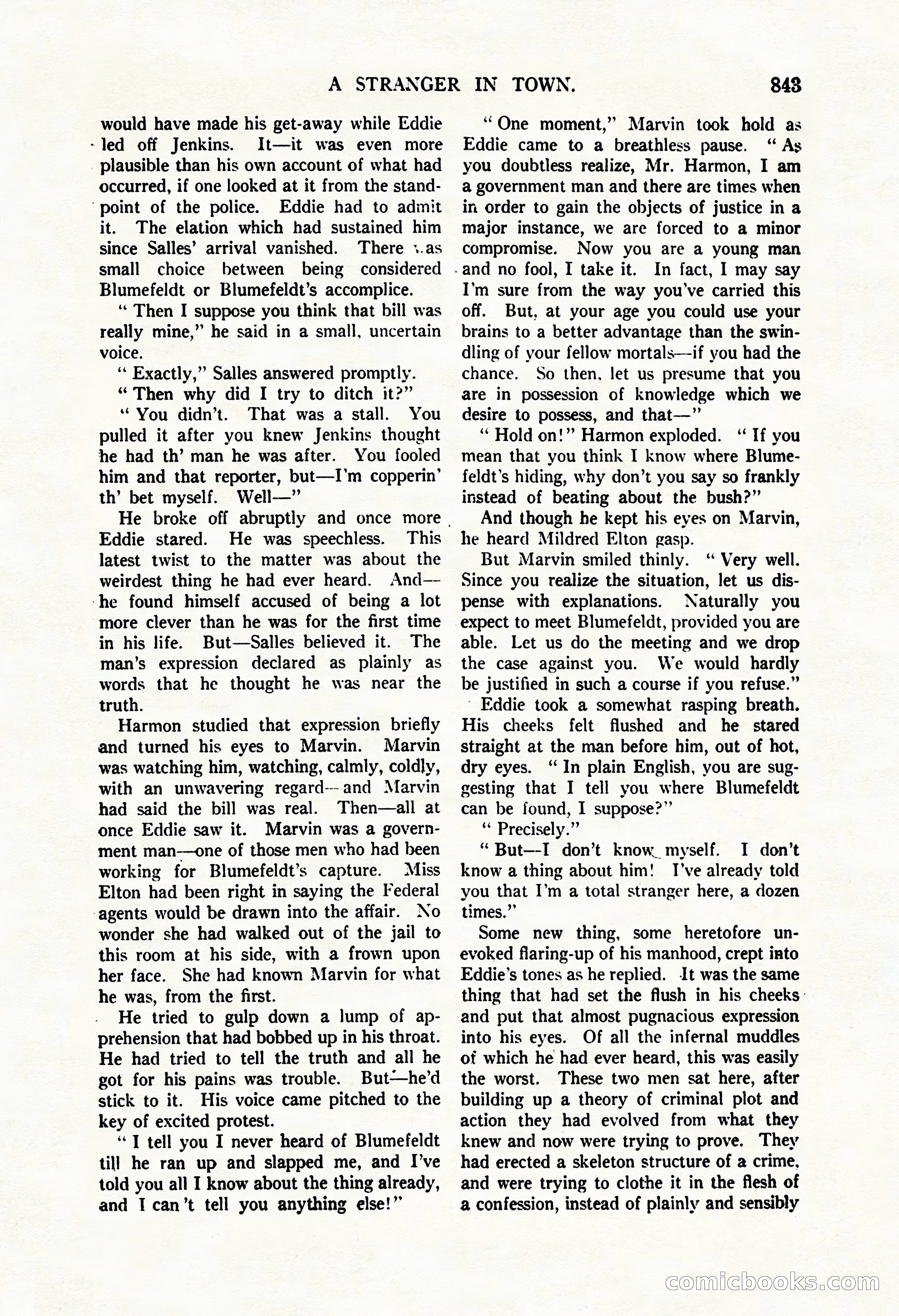
A restored page from Pulp Fiction, 1924. Page through the whole issue in the reader above.
📄 Transcribed text from this page (OCR, searchable)
Machine-transcribed from the original scan — historical spelling and the odd misread are preserved.
A STRANGER IN TOWN, would have made his get-away while Eddie -led off Jenkins. It—it was even more plausible than his own account of what had occurred, if one looked at it from the stand- ‘point of the police. Eddie had to admit it. The elation which had sustained him since Salles’ arrival vanished. There ».as small choice between being considered Blumefeldt or Blumefeldt’s accomplice. ‘‘ Then I suppose you think that bill was really mine,” he said in a small, uncertain voice. ‘* Exactly,” Salles answered promptly. “Then why did I try to ditch it?” “You didn’t. That was a stall. You pulled it after you knew Jenkins thought he had th’ man he was after. You fooled him and that reporter, but—I'm copperin’ th’ bet myself. Well—” He broke off abruptly and once more | Eddie stared. He was speechless. This latest twist to the matter was about the weirdest thing he had ever heard. And— ‘he found himself accused of being a lot more clever than he was for the first time in his life. But—Salles believed it. The man’s expression declared as plainly as words that he thought he was near the truth. Harmon studied that expression briefly and turned his eyes to Marvin. Marvin was watching him, watching, calmly, coldly, with an unwavering regard--and Marvin had said the bill was real. Then—all at once Eddie saw it. Marvin was a govern- ment man—one of those men who had been working for Blumefeldt’s capture. Miss Elton had been right in saying the Federal agents would be drawn into the affair. No wonder she had walked out of the jail to this room at his side, with a frown upon her face. She had known Marvin for what he was, from the first. He tried to gulp down a lump of ap- prehension that had bobbed up in his throat. He had tried to tell the truth and all he got for his pains was trouble. But—he’d stick to it. His voice came pitched to the key of excited protest. ‘“T tell you I never heard of Blumefeldt till he ran up and slapped me, and I’ve told you all I know about the thing already, and I can’t tell you anything else!” -and no fool, I take it. 848 ‘“Qne moment,” Marvin took hold as Eddie came to a breathless pause. “ As you doubtless realize, Mr. Harmon, I am a government man and there are times when in order to gain the objects of justice in a major instance, we are forced to a minor compromise. Now you are a young man In fact, I may say I’m sure from the way you've carried this off. But, at your age you could use your brains to a better advantage than the swin- dling of your fellow mortals—if you had the chance. So then, let us presume that you are in possession of knowledge which we desire to possess, and that—”’ ‘* Hold on!” Harmon exploded. ‘“ If you mean that you think I know where Blume- feldt’s hiding, why don’t you say so frankly instead of beating about the bush?” And though he kept his eyes on Marvin, he heard Mildred Elton gasp. But Marvin smiled thinly. ‘ Very well. Since you realize the situation, let us dis- pense with explanations. Naturally you expect to meet Blumefeldt, provided you are able. Let us do the meeting and we drop the case against you. We would hardly be justified in such a course if you refuse.” ' Eddie took a somewhat rasping breath. His cheeks felt flushed and he stared straight at the man before him, out of hot, dry eyes. “In plain English, you are sug- gesting that I tell you where Blumefeldt can be found, I suppose?”’ ‘* Precisely.” “ But—-I don’t know myself. I don’t know a thing about him! I've already told you that I’m a total stranger here, a dozen times.”’ Some new thing, some heretofore un- evoked flaring-up of his manhood, crept into Eddie’s tones as he replied. It was the same thing that had set the flush in his cheeks: and put that almost pugnacious expression into his eyes. Of all the infernal muddles of which he had ever heard, this was easily the worst. These two men sat here, after building up a theory of criminal plot and action they had evolved from what they knew and now were trying to prove. They had erected a skeleton structure of a crime, and were trying to clothe it in the flesh of a confession, instead of plainly and sensibly comniiclsoo! (©