
Pulp Fiction, 1924 · page 45 of 186
Argosy All-Story Weekly, May 3, 1924 — page 45: what you’re looking at
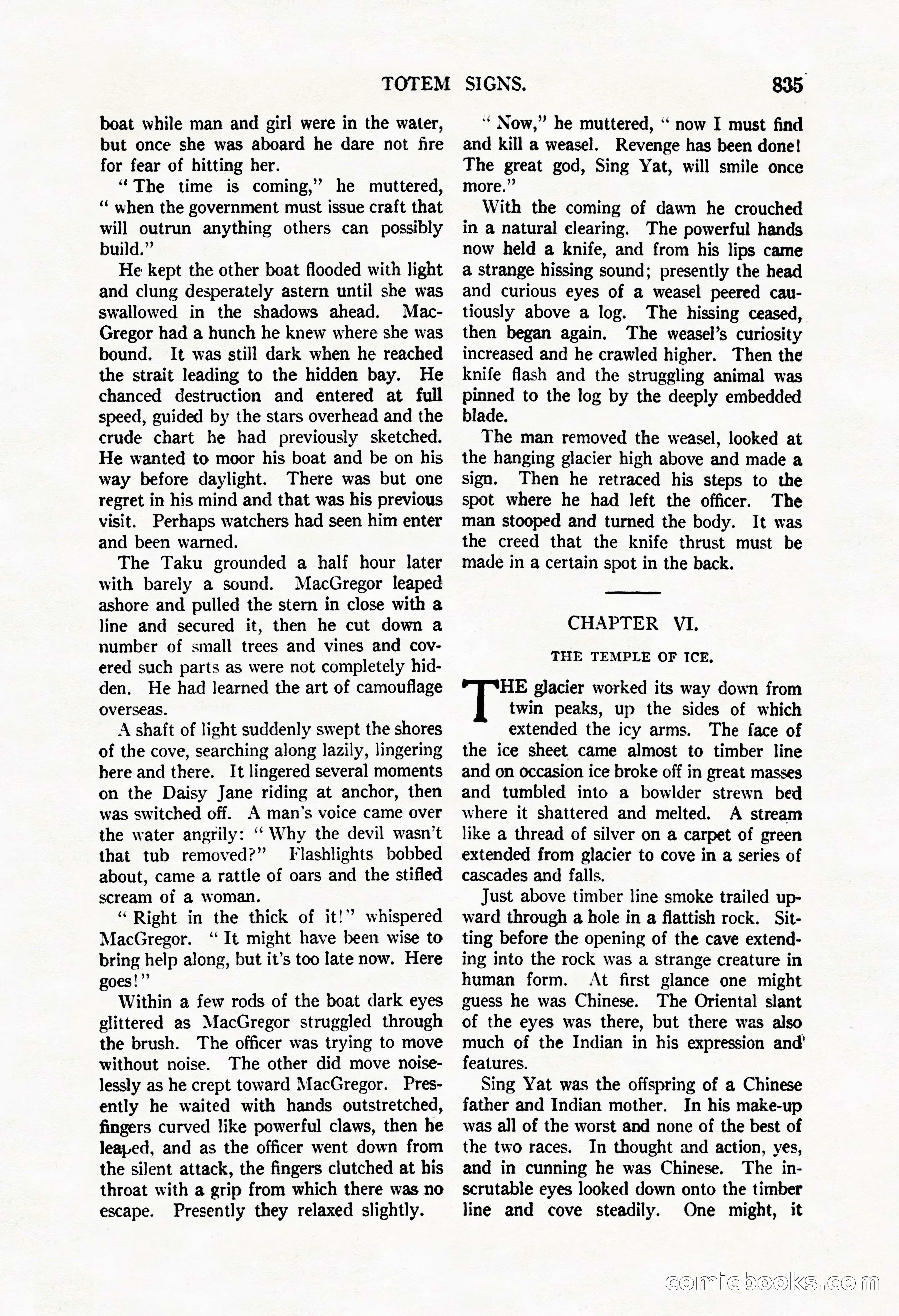
A restored page from Pulp Fiction, 1924. Page through the whole issue in the reader above.
📄 Transcribed text from this page (OCR, searchable)
Machine-transcribed from the original scan — historical spelling and the odd misread are preserved.
TOTEM boat while man and girl were in the water, but once she was aboard he dare not fire for fear of hitting her. “The time is coming,’ he muttered, ‘“‘ when the government must issue craft that will outrun anything others can possibly build.” He kept the other boat flooded with light and clung desperately astern until she was swallowed in the shadows ahead. Mac- Gregor had a hunch he knew where she was bound. It was still dark when he reached the strait leading to the hidden bay. He chanced destruction and entered at full speed, guided by the stars overhead and the crude chart he had previously sketched. He wanted to moor his boat and be on his way before daylight. There was but one regret in his mind and that was his previous visit. Perhaps watchers had seen him enter and been warned. The Taku grounded a half hour later with barely a sound. MacGregor leaped ashore and pulled the stern in close with a line and secured it, then he cut down a number of small trees and vines and cov- ered such parts as were not completely hid- den. He had learned the art of camouflage overseas. A shaft of light suddenly swept the shores of the cove, searching along lazily, lingering here and there. It lingered several moments on the Daisy Jane riding at anchor, then was switched off. A man’s voice came over the water angrily: ‘“‘ Why the devil wasn’t that tub removed?” Flashlights bobbed about, came a rattle of oars and the stifled scream of a woman. “ Right in the thick of it!” whispered MacGregor. “It might have been wise to bring help along, but it’s too late now. Here goes!’ Within a few rods of the boat dark eyes glittered as MacGregor struggled through the brush. The officer was trying to move without noise. The other did move noise- lessly as he crept toward MacGregor. Pres- ently he waited with hands outstretched, fingers curved like powerful claws, then he leaped, and as the officer went down from the silent attack, the fingers clutched at his throat with a grip from which there was no escape. Presently they relaxed slightly. SIGNS. ‘* Now,” he muttered, ‘“ now I must find and kill a weasel. Revenge has been done! The great god, Sing Yat, will smile once more.” With the coming of dawn he crouched in a natural clearing. The powerful hands now held a knife, and from his lips came a strange hissing sound; presently the head and curious eyes of a weasel peered cau- tiously above a log. The hissing ceased, then began again. The weasel’s curiosity increased and he crawled higher. Then the knife flash and the struggling animal was pinned to the log by the deeply embedded blade. The man removed the weasel, looked at the hanging glacier high above and made a sign. Then he retraced his steps to the spot where he had left the officer. The man stooped and turned the body. It was the creed that the knife thrust must be made in a certain spot in the back. CHAPTER VI. THE TEMPLE OF ICE, HE glacier worked its way down from twin peaks, up the sides of which extended the icy arms. The face of the ice sheet came almost to timber line and on occasion ice broke off in great masses and tumbled into a bowlder strewn bed where it shattered and melted. A stream like a thread of silver on a carpet of green extended from glacier to cove in a series of cascades and falls. Just above timber line smoke trailed up- ward through a hole in a flattish rock. Sit- ting before the opening of the cave extend- ing into the rock was a strange creature in human form. At first glance one might guess he was Chinese. The Oriental slant of the eyes was there, but there was also much of the Indian in his expression and’ features. Sing Yat was the offspring of a Chinese father and Indian mother. In his make-up was all of the worst and none of the best of the two races. In thought and action, yes, and in cunning he was Chinese. The in- scrutable eyes looked down onto the timber line and cove steadily. One might, it COMIGD OO! eng’ (©