
Pulp Fiction, 1924 · page 42 of 186
Argosy All-Story Weekly, May 3, 1924 — page 42: what you’re looking at
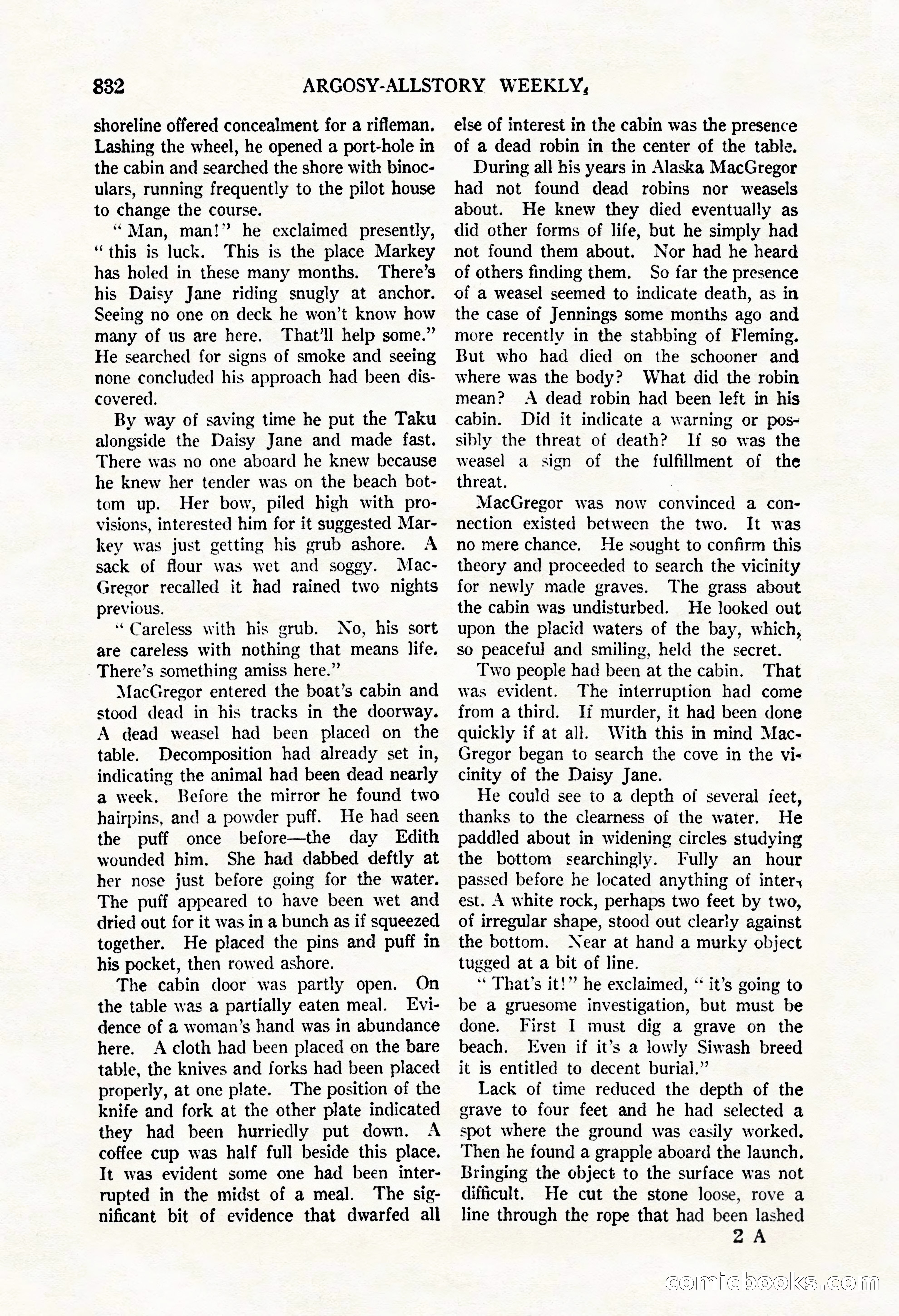
A restored page from Pulp Fiction, 1924. Page through the whole issue in the reader above.
📄 Transcribed text from this page (OCR, searchable)
Machine-transcribed from the original scan — historical spelling and the odd misread are preserved.
832 shoreline offered concealment for a rifleman. Lashing the wheel, he opened a port-hole in the cabin and searched the shore with binoc- ulars, running frequently to the pilot house to change the course. ‘“Man, man!” he exclaimed presently, “this is luck. This is the place Markey has holed in these many months. There’s his Daisy Jane riding snugly at anchor. Seeing no one on deck he won’t know how many of us are here. That’ll help some.” He searched for signs of smoke and seeing none concluded his approach had been dis- covered. By way of saving time he put the Taku alongside the Daisy Jane and made fast. There was no one aboard he knew because he knew her tender was on the beach bot- tom up. Her bow, piled high with pro- visions, interested him for it suggested Mar- key was just getting his grub ashore. A sack of flour was wet and soggy. Mac- Gregor recalled it had rained two nights previous. “Careless with his grub. No, his sort are careless with nothing that means life. There’s something amiss here.” MacGregor entered the boat’s cabin and stood dead in his tracks in the doorway. A dead weasel had been placed on the table. Decomposition had already set in, indicating the animal had been dead nearly a week. Before the mirror he found two hairpins, and a powder puff. He had seen the puff once before—the day Edith wounded him. She had dabbed deftly at her nose just before going for the water. The puff appeared to have been wet and dried out for it was in a bunch as if squeezed together. He placed the pins and puff in his pocket, then rowed ashore. The cabin door was partly open. On the table was a partially eaten meal. Evi- dence of a woman’s hand was in abundance here. A cloth had been placed on the bare table, the knives and forks had been placed properly, at one plate. The position of the knife and fork at the other plate indicated they had been hurriedly put down. A coffee cup was half full beside this place. It was evident some one had been inter- rupted in the midst of a meal. The sig- nificant bit of evidence that dwarfed all ARGOSY-ALLSTORY WEEKLY, else of interest in the cabin was the presence of a dead robin in the center of the table. During all his years in Alaska MacGregor had not found dead robins nor weasels about. He knew they died eventually as did other forms of life, but he simply had not found them about. Nor had he heard of others finding them. So far the presence of a weasel seemed to indicate death, as in the case of Jennings some months ago and more recently in the stabbing of Fleming. But who had died on the schooner and where was the body? What did the robin mean? <A dead robin had been left in his cabin. Did it indicate a warning or pos- sibly the threat of death? If so was the weasel a sign of the fulfillment of the threat. = MacGregor was now convinced a con- nection existed between the two. It was no mere chance. He sought to confirm this theory and proceeded to search the vicinity for newly made graves. The grass about the cabin was undisturbed. He looked out upon the placid waters of the bay, which, so peaceful and smiling, held the secret. Two people had been at the cabin. That was evident. The interruption had come from a third. If murder, it had been done quickly if at all. With this in mind Mac- Gregor began to search the cove in the vi- cinity of the Daisy Jane. He could see to a depth of several feet, thanks to the clearness of the water. He paddled about in widening circles studying the bottom searchingly. Fully an hour passed before he located anything of inter, est. A white rock, perhaps two feet by two, of irregular shape, stood out clearly against the bottom. Near at hand a murky object tugged at a bit of line. ‘* That’s it!” he exclaimed, “ it’s going to be a gruesome investigation, but must be done. First I must dig a grave on the beach. Even if it’s a lowly Siwash breed it is entitled to decent burial.” Lack of time reduced the depth of the grave to four feet and he had selected a spot where the ground was easily worked. Then he found a grapple aboard the launch. Bringing the object to the surface was not difficult. He cut the stone loose, rove a line through the rope that had been lashed ZA COMIC OO! S CO) nn