
Pulp Fiction, 1924 · page 17 of 186
Argosy All-Story Weekly, May 3, 1924 — page 17: what you’re looking at
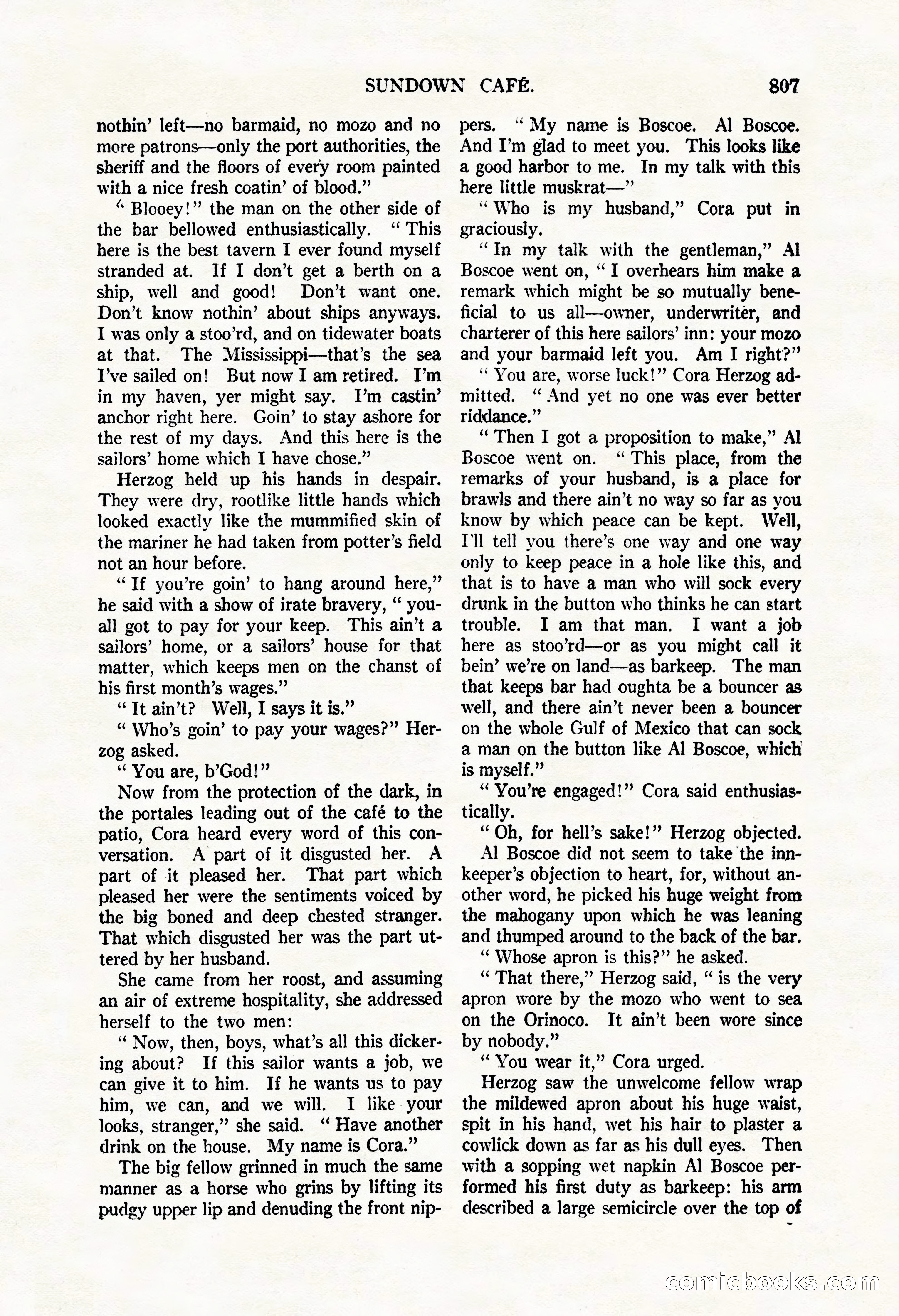
A restored page from Pulp Fiction, 1924. Page through the whole issue in the reader above.
📄 Transcribed text from this page (OCR, searchable)
Machine-transcribed from the original scan — historical spelling and the odd misread are preserved.
SUNDOWN CAFE. nothin’ left—no barmaid, no mozo and no more patrons—only the port authorities, the sheriff and the floors of every room painted with a nice fresh coatin’ of blood.” “ Blooey!”’ the man on the other side of the bar bellowed enthusiastically. ‘‘ This here is the best tavern I ever found myself stranded at. If I don’t get a berth on a ship, well and good! Don’t want one. Don’t know nothin’ about ships anyways. I was only a stoo’rd, and on tidewater boats at that. The Mississippi—that’s the sea I’ve sailed on! But now I am retired. I’m in my haven, yer might say. I’m castin’ anchor right here. Goin’ to stay ashore for the rest of my days. And this here is the sailors’ home which I have chose.” Herzog held up his hands in despair. They were dry, rootlike little hands which looked exactly like the mummified skin of the mariner he had taken from potter’s field not an hour before. “Tf you’re goin’ to hang around here,” he said with a show of irate bravery, “ you- all got to pay for your keep. This ain’t a sailors’ home, or a sailors’ house for that matter, which keeps men on the chanst of his first month’s wages.” “Tt ain’t? Well, I says it is.” “ Who’s goin’ to pay your wages?” Her- zog asked. “You are, b’God!” Now from the protection of the dark, in the portales leading out of the café to the patio, Cora heard every word of this con- versation. A part of it disgusted her. A part of it pleased her. That part which pleased her were the sentiments voiced by the big boned and deep chested stranger. That which disgusted her was the part ut- tered by her husband. She came from her roost, and assuming an air of extreme hospitality, she addressed herself to the two men: ‘““ Now, then, boys, what’s all this dicker- ing about? If this sailor wants a job, we can give it to him. If he wants us to pay him, we can, and we will. I like your looks, stranger,’”’ she said. ‘‘ Have another drink on the house. My name is Cora.” The big fellow grinned in much the same manner as a horse who grins by lifting its pudgy upper lip and denuding the front nip- 807 pers. “ My name is Boscoe. Al Boscoe. And I’m glad to meet you. This looks like a good harbor to me. In my talk with this here little muskrat—” ‘“Who is my husband,” Cora put in graciously. ‘In my talk with the gentleman,” Al Boscoe went on, ‘‘ I overhears him make a remark which might be so mutually bene- ficial to us all—owner, underwriter, and charterer of this here sailors’ inn: your mozo and your barmaid left you. Am I right?” ‘You are, worse luck!” Cora Herzog ad- mitted. ‘‘ And yet no one was ever better riddance.” ‘Then I got a proposition to make,” Al Boscoe went on. “ This place, from the remarks of your husband, is a place for brawls and there ain’t no way so far as you know by which peace can be kept. Well, Ill tell you there’s one way and one way only to keep peace in a hole like this, and that is to have a man who will sock every drunk in the button who thinks he can start trouble. I am that man. I want a job here as stoo’rd—or as you might call it bein’ we’re on land—as barkeep. The man that keeps bar had oughta be a bouncer as well, and there ain’t never been a bouncer on the whole Gulf of Mexico that can sock a man on the button like Al Boscoe, which is myself.” “’'You’re engaged!’’ Cora said enthusias- tically. “Oh, for hell’s sake!”’ Herzog objected. Al Boscoe did not seem to take the inn- keeper’s objection to heart, for, without an- other word, he picked his huge weight from the mahogany upon which he was leaning and thumped around to the back of the bar. ‘‘ Whose apron is this?” he asked. ‘That there,” Herzog said, “ is the very apron wore by the mozo who went to sea on the Orinoco. It ain’t been wore since by nobody.” “You wear it,” Cora urged. Herzog saw the unwelcome fellow wrap the mildewed apron about his huge waist, spit in his hand, wet his hair to plaster a cowlick down as far as his dull eyes. Then with a sopping wet napkin Al Boscoe per- formed his first duty as barkeep: his arm described a large semicircle over the top of comniiclsoo! S (©