
Pulp Fiction, 1924 · page 159 of 186
Argosy All-Story Weekly, May 3, 1924 — page 159: what you’re looking at
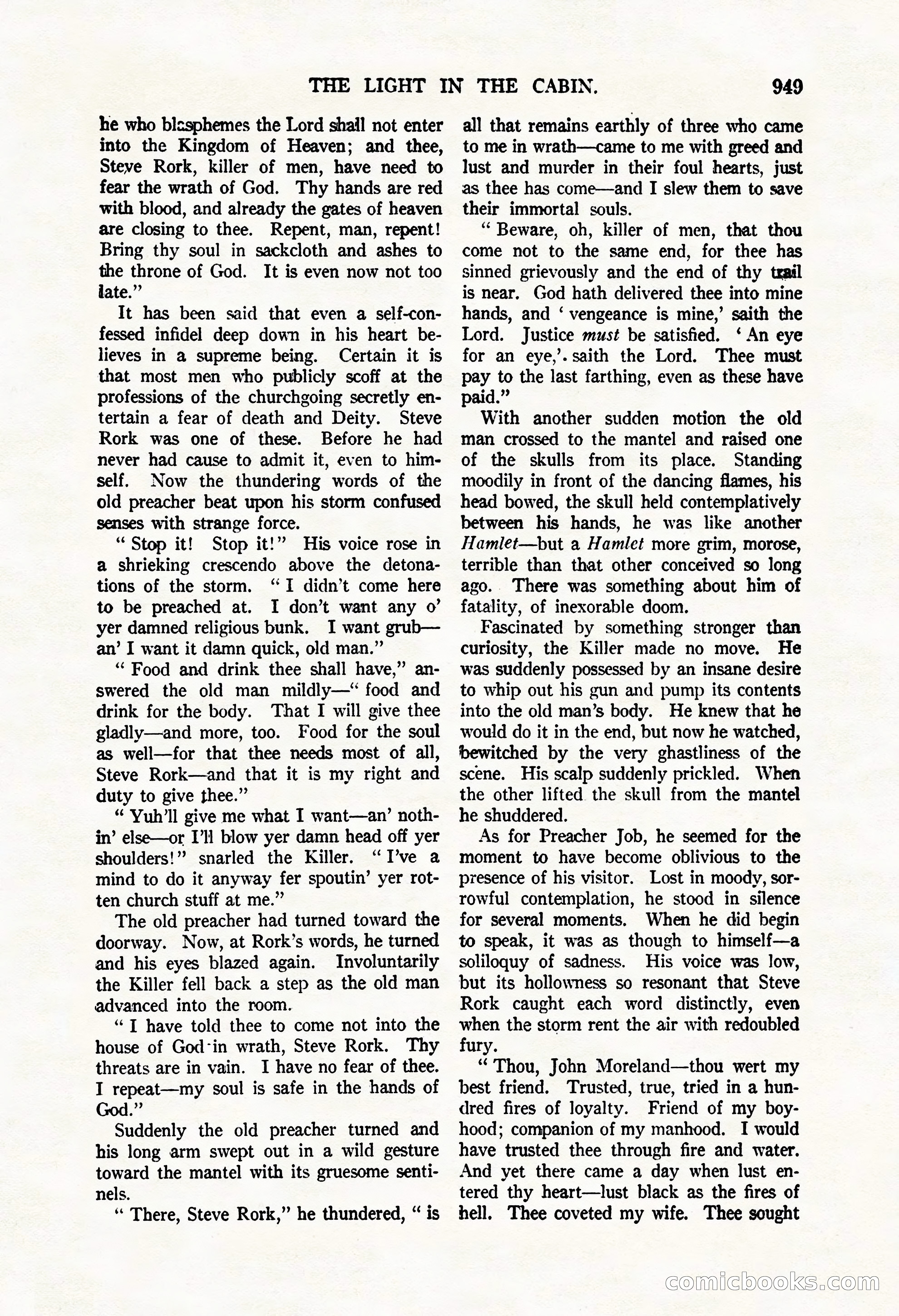
A restored page from Pulp Fiction, 1924. Page through the whole issue in the reader above.
📄 Transcribed text from this page (OCR, searchable)
Machine-transcribed from the original scan — historical spelling and the odd misread are preserved.
THE LIGHT IN THE CABIN. he who blasphemes the Lord shail not enter into the Kingdom of Heaven; and thee, Steve Rork, killer of men, have need to fear the wrath of God. Thy hands are red with blood, and already the gates of heaven are closing to thee. Repent, man, repent! Bring thy soul in sackcloth and ashes to the throne of God. It is even now not too late.” It has been said that even a self-con- fessed infidel deep down in his heart be- lieves in a supreme being. Certain it is that most men who publicly scoff at the professions of the churchgoing secretly en- tertain a fear of death and Deity. Steve Rork was one of these. Before he had never had cause to admit it, even to him- self. Now the thundering words of the old preacher beat upon his storm confused senses with strange force. ‘“* Stop it! Stop it!” His voice rose in a shrieking crescendo above the detona- tions of the storm. “I didn’t come here to be preached at. I don’t want any 0’ yer damned religious bunk. I want grub— an’ I want it damn quick, old man.” “Food and drink thee shall have,” an- swered the old man mildly—“ food and drink for the body. That I will give thee gladly—and more, too. Food for the soul as well—for that thee needs most of all, Steve Rork—and that it is my right and duty to give thee.” “ Yuh’ll give me what I want—an’ noth- in’ else—or I’l] blow yer damn head off yer shoulders!” snarled the Killer. “I’ve a mind to do it anyway fer spoutin’ yer rot- ten church stuff at me.” The old preacher had turned toward the doorway. Now, at Rork’s words, he turned and his eyes blazed again. Involuntarily the Killer fell back a step as the old man advanced into the room. “TI have told thee to come not into the house of God-in wrath, Steve Rork. Thy threats are in vain. I have no fear of thee. I repeat—my soul is safe in the hands of God.” Suddenly the old preacher turned and his long arm swept out in a wild gesture toward the mantel with its gruesome senti- nels. “ There, Steve Rork,” he thundered, “ is 949 all that remains earthly of three who came to me in wrath—came to me with greed and lust and murder in their foul hearts, just as thee has come—and I slew them to save their immortal souls. ‘“ Beware, oh, killer of men, that thou come not to the same end, for thee has sinned grievously and the end of thy trail is near. God hath delivered thee into mine hands, and ‘ vengeance is mine,’ saith the Lord. Justice must be satisfied. ‘ An eye for an eye,’. saith the Lord. Thee must pay to the last farthing, even as these have paid.” With another sudden motion the old man crossed to the mantel and raised one of the skulls from its place. Standing moodily in front of the dancing flames, his head bowed, the skull held contemplatively between his hands, he was like another Hamlet—but a Hamlet more grim, morose, terrible than that other conceived so long ago. There was something about him of fatality, of inexorable doom. Fascinated by something stronger than curiosity, the Killer made no move. He was suddenly possessed by an insane desire to whip out his gun and pump its contents into the old man’s body. He knew that he would do it in the end, but now he watched, bewitched by the very ghastliness of the scene. His scalp suddenly prickled. When the other lifted the skull from the mantel he shuddered. As for Preacher Job, he seemed for the moment to have become oblivious to the presence of his visitor. Lost in moody, sor- rowful contemplation, he stood in silence for several moments. When he did begin to speak, it was as though to himself—a soliloquy of sadness. His voice was low, but its hollowness so resonant that Steve Rork caught each word distinctly, even when the storm rent the air with redoubled fury. “Thou, John Moreland—thou wert my best friend. Trusted, true, tried in a hun- dred fires of loyalty. Friend of my boy- hood; companion of my manhood. I would have trusted thee through fire and water. And yet there came a day when lust en- tered thy heart—lust black as the fires of hell. Thee coveted my wife. Thee sought COMED oOo! S (©