
Pulp Fiction, 1924 · page 148 of 186
Argosy All-Story Weekly, May 3, 1924 — page 148: what you’re looking at
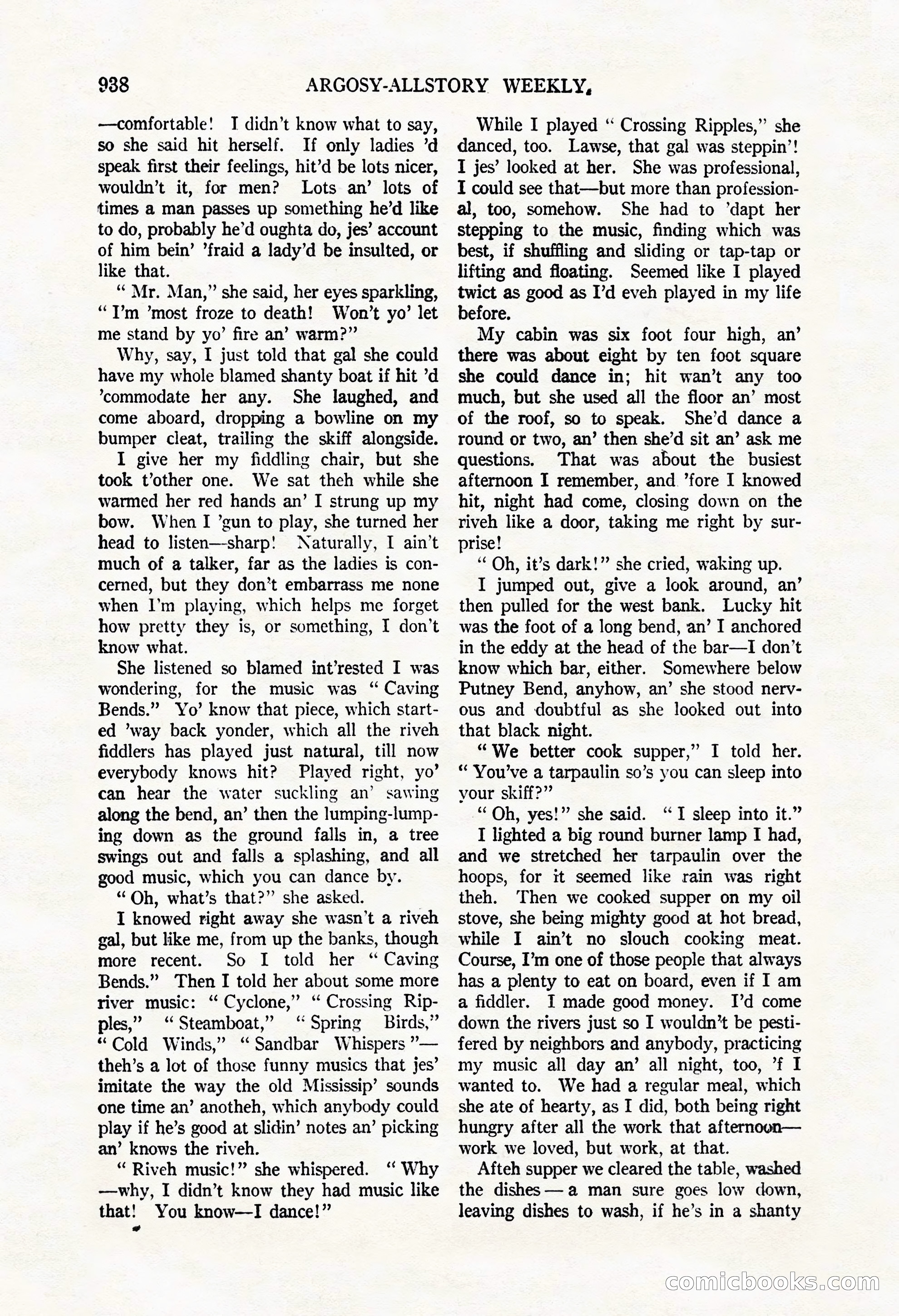
A restored page from Pulp Fiction, 1924. Page through the whole issue in the reader above.
📄 Transcribed text from this page (OCR, searchable)
Machine-transcribed from the original scan — historical spelling and the odd misread are preserved.
938 —comfortable! I didn’t know what to say, so she said hit herself. If only ladies ’d speak first their feelings, hit’d be lots nicer, wouldn’t it, for men? Lots an’ lots of times a man passes up something he’d like to do, probably he’d oughta do, jes’ account of him bein’ ’fraid a lady’d be insulted, or like that. ‘Mr. Man,” she said, her eyes sparkling, “I’m ’most froze to death! Won’t yo’ let me stand by yo’ fire an’ warm?” Why, say, I just told that gal she could have my whole blamed shanty boat if hit ’d ‘commodate her any. She laughed, and come aboard, dropping a bowline on my bumper cleat, trailing the skiff alongside. I give her my fiddling chair, but she took t’other one. We sat theh while she warmed her red hands an’ I strung up my bow. When I ’gun to play, she turned her head to listen—-sharp! Naturally, I ain’t much of a talker, far as the ladies is con- cerned, but they don’t embarrass me none when I’m playing, which helps me forget how pretty they is, or something, I don’t know what. She listened so blamed int’rested I was wondering, for the music was “ Caving Bends.” Yo’ know that piece, which start- ed ’way back yonder, which all the riveh fiddlers has played just natural, till now everybody knows hit? Played right, yo’ can hear the water suckling an’ sawing along the bend, an’ then the lumping-lump- ing down as the ground falls in, a tree swings out and falls a splashing, and all good music, which you can dance by. “Oh, what’s that?” she asked. | I knowed right away she wasn’t a riveh gal, but like me, from up the banks, though more recent. So I told her ‘“ Caving Bends.” Then I told her about some more river music: ‘“ Cyclone,” “ Crossing Rip- ples,” “Steamboat,” “Spring Birds,” “Cold Winds,” ‘Sandbar Whispers ”’— theh’s a lot of those funny musics that jes’ imitate the way the old Mississip’ sounds one time an’ anotheh, which anybody could play if he’s good at slidin’ notes an’ picking an’ knows the riveh. “ Riveh music!” she whispered. ‘‘ Why —why, I didn’t know they had music like that! You know—I dance!” ss ARGOSY-ALLSTORY WEEKLY, While I played ‘‘ Crossing Ripples,” she danced, too. Lawse, that gal was steppin’! I jes’ looked at her. She was professional, I could see that—but more than profession- al, too, somehow. She had to ‘dapt her stepping to the music, finding which was best, if shuffling and sliding or tap-tap or lifting and floating. Seemed like I played twict as good as I’d eveh played in my life before. My cabin was six foot four high, an’ there was about eight by ten foot square she could dance in; hit wan’t any too much, but she used all the floor an’ most of the roof, so to speak. She’d dance a round or two, an’ then she’d sit an’ ask me questions. That was about the busiest afternoon I remember, and ’fore I knowed hit, night had come, closing down on the riveh like a door, taking me right by sur- prise! ‘‘ Oh, it’s dark!” she cried, waking up. I jumped out, give a look around, an’ then pulled for the west bank. Lucky hit was the foot of a long bend, an’ I anchored in the eddy at the head of the bar—I don’t know which bar, either. Somewhere below Putney Bend, anyhow, an’ she stood nerv- ous and doubtful as she looked out into that black night. “We better cook supper,” I told her. * You’ve a tarpaulin so’s you can sleep into your skiff?” “‘ Oh, yes!” she said. “TI sleep into it.” I lighted a big round burner lamp I had, and we stretched her tarpaulin over the hoops, for it seemed like rain was right theh. ‘Then we cooked supper on my oil stove, she being mighty good at hot bread, while I ain’t no slouch cooking meat. Course, I’m one of those people that always has a plenty to eat on board, even if I am a fiddler. I made good money. I’d come down the rivers just so I wouldn’t be pesti- fered by neighbors and anybody, practicing my music all day an’ all night, too, f I wanted to. We had a regular meal, which she ate of hearty, as I did, both being right hungry after all the work that afternoon— work we loved, but work, at that. Afteh supper we cleared the table, washed the dishes — a man sure goes low down, leaving dishes to wash, if he’s in a shanty Conic oool S CO nn