
Pulp Fiction, 1924 · page 115 of 186
Argosy All-Story Weekly, May 3, 1924 — page 115: what you’re looking at
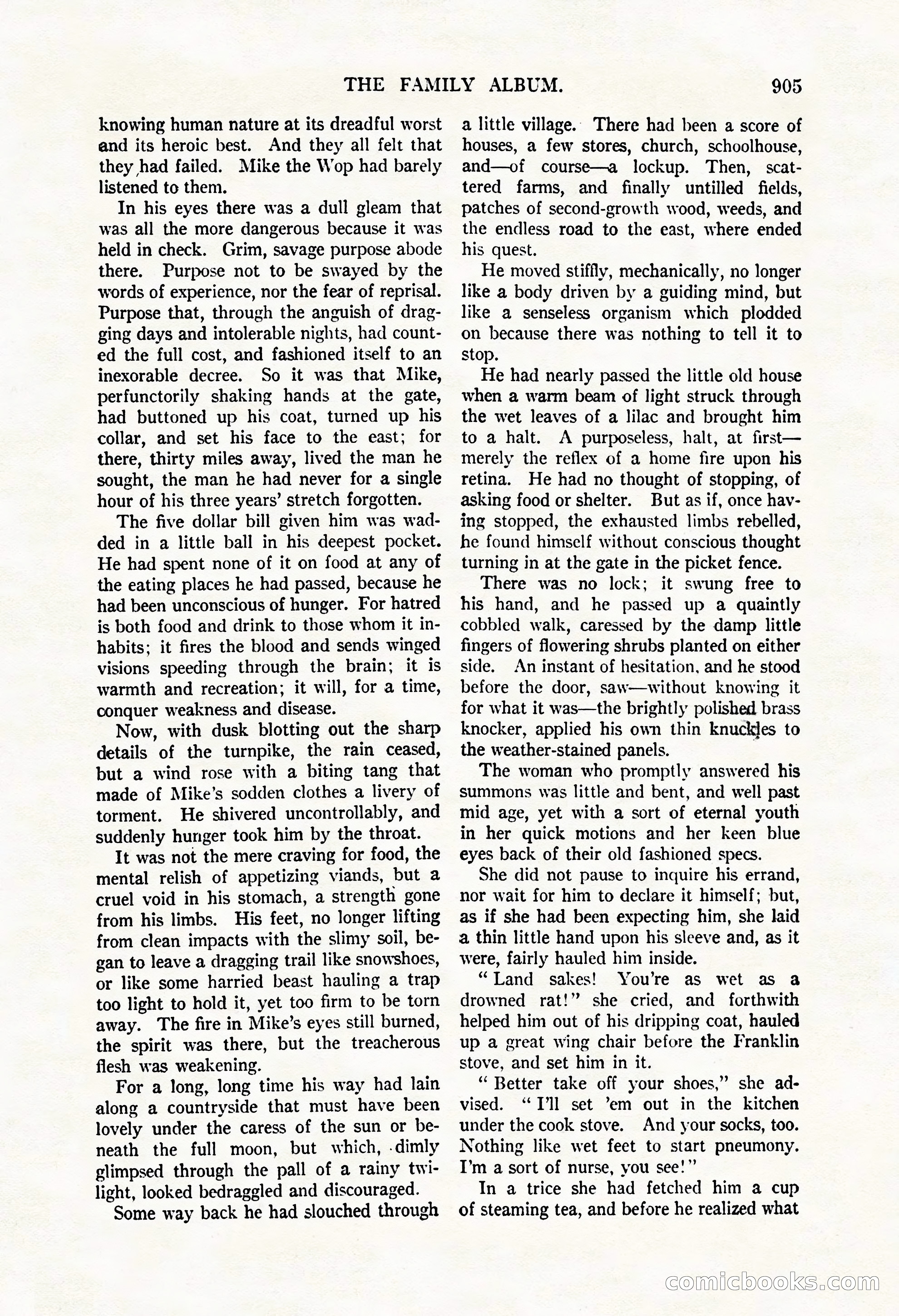
A restored page from Pulp Fiction, 1924. Page through the whole issue in the reader above.
📄 Transcribed text from this page (OCR, searchable)
Machine-transcribed from the original scan — historical spelling and the odd misread are preserved.
THE FAMILY ALBUM. knowing human nature at its dreadful worst and its heroic best. And they all felt that they had failed. Mike the Wop had barely listened to them. In his eyes there was a dull gleam that was all the more dangerous because it was held in check. Grim, savage purpose abode there. Purpose not to be swayed by the words of experience, nor the fear of reprisal. Purpose that, through the anguish of drag- ging days and intolerable nights, had count- ed the full cost, and fashioned itself to an inexorable decree. So it was that Mike, perfunctorily shaking hands at the gate, had buttoned up his coat, turned up his collar, and set his face to the east; for there, thirty miles away, lived the man he sought, the man he had never for a single hour of his three years’ stretch forgotten. The five dollar bill given him was wad- ded in a little ball in his deepest pocket. He had spent none of it on food at any of the eating places he had passed, because he had been unconscious of hunger. For hatred is both food and drink to those whom it in- habits: it fires the blood and sends winged visions speeding through the brain; it is warmth and recreation; it will, for a time, conquer weakness and disease. Now, with dusk blotting out the sharp details of the turnpike, the rain ceased, but a wind rose with a biting tang that made of Mike’s sodden clothes a livery of torment. He shivered uncontrollably, and suddenly hunger took him by the throat. It was not the mere craving for food, the mental relish of appetizing viands, but a cruel void in his stomach, a strength gone from his limbs. His feet, no longer lifting from clean impacts with the slimy soil, be- gan to leave a dragging trail like snowshoes, or like some harried beast hauling a trap too light to hold it, yet too firm to be torn away. The fire in Mike’s eyes still burned, the spirit was there, but the treacherous flesh was weakening. For a long, long time his way had lain along a countryside that must have been lovely under the caress of the sun or be- neath the full moon, but which, -dimly glimpsed through the pall of a rainy twi- light, looked bedraggled and discouraged. Some way back he had slouched through 905 a little village. There had been a score of houses, a few stores, church, schoolhouse, and—of course—a lockup. Then, scat- tered farms, and finally untilled fields, patches of second-growth wood, weeds, and the endless road to the east, where ended his quest. He moved stiffly, mechanically, no longer like a body driven by a guiding mind, but like a senseless organism which plodded on because there was nothing to tell it to stop. He had nearly passed the little old house when a warm beam of light struck through the wet leaves of a lilac and brought him to a halt. A purposeless, halt, at first— merely the reflex of a home fire upon his retina. He had no thought of stopping, of asking food or shelter. But as if, once hav- ing stopped, the exhausted limbs rebelled, he found himself without conscious thought turning in at the gate in the picket fence. There was no lock; it swung free to his hand, and he passed up a quaintly cobbled walk, caressed by the damp little fingers of flowering shrubs planted on either side. An instant of hesitation, and he stood before the door, saw—without knowing it for what it was—the brightly polished brass knocker, applied his own thin knuckles to the weather-stained panels. The woman who promptly answered his summons was little and bent, and well past mid age, yet with a sort of eternal youth in her quick motions and her keen blue eyes back of their old fashioned specs. She did not pause to inquire his errand, nor wait for him to declare it himself; but, as if she had been expecting him, she laid a thin little hand upon his sleeve and, as it were, fairly hauled him inside. “Land sakes! You’re as wet as a drowned rat!” she cried, and forthwith helped him out of his dripping coat, hauled up a great wing chair before the Franklin stove, and set him in it. “ Better take off your shoes,” she ad- vised. “I'll set ’em out in the kitchen under the cook stove. And your socks, too. Nothing like wet feet to start pneumony. I’m a sort of nurse, you see!” In a trice she had fetched him a cup of steaming tea, and before he realized what COMIC OOo! (©