
Pulp Fiction, 1924 · page 91 of 177
Argosy All-Story Weekly, March 15, 1924 — page 91: what you’re looking at
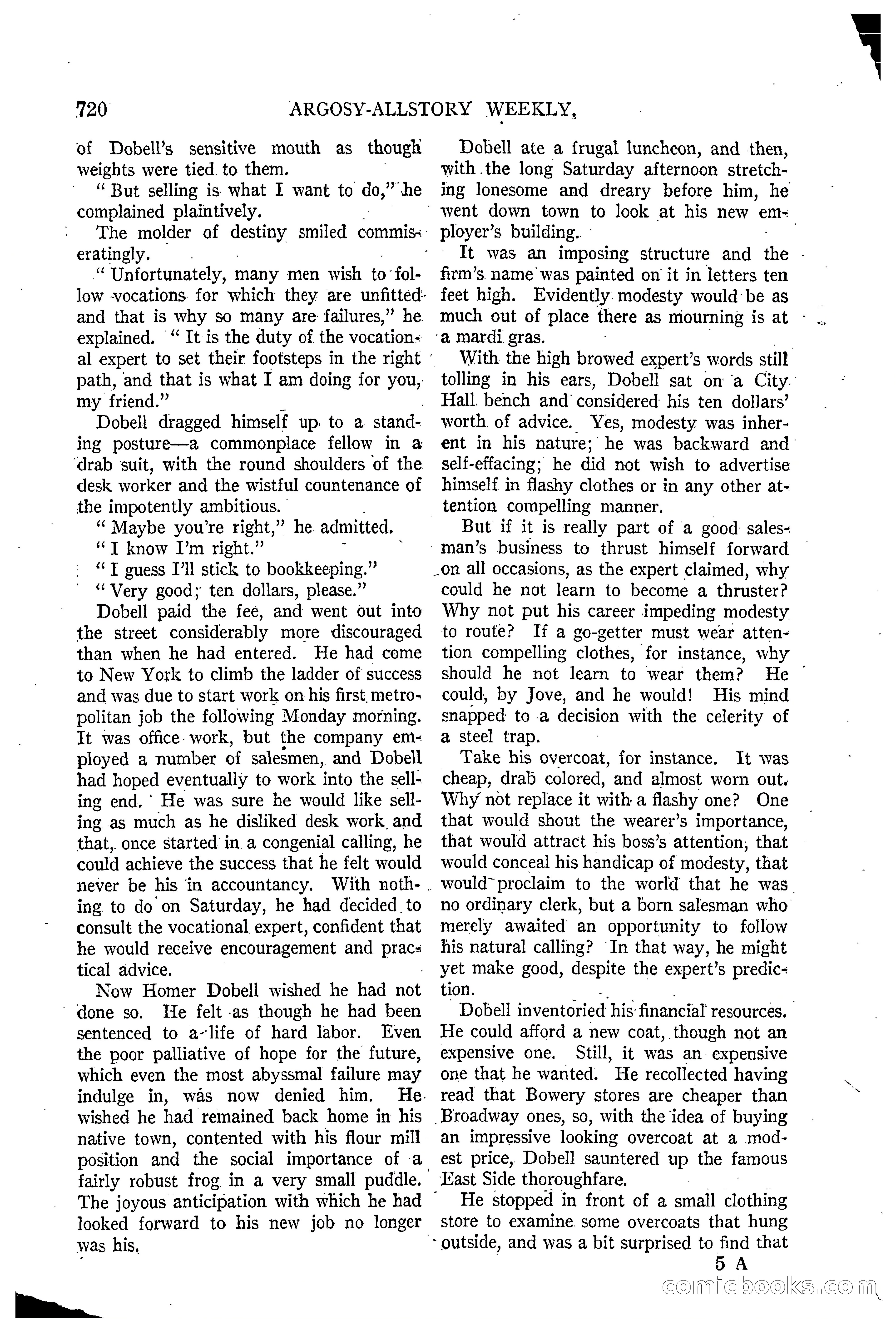
A restored page from Pulp Fiction, 1924. Page through the whole issue in the reader above.
📄 Transcribed text from this page (OCR, searchable)
Machine-transcribed from the original scan — historical spelling and the odd misread are preserved.
120 of Dobell’s sensitive mouth as though weights were tied to them. “ But selling is what I want to do," the complained plaintively. The molder of destiny smiled commis: eratingly. “ Unfortunately, many men wish to: fol- low -vocations. for which they: are unfitted: and that is why so many are failures,” he. explained. “ It-is the duty of the vocation- al expert to set their footsteps in the right ’ path, and that is what I am doing for you, my friend.” Dobell dragged himself up. to a stand- ing posture—a commonplace fellow in 4 ‘drab suit, with the round shoulders of the desk worker and the wistful countenance of the impotently ambitious. “Maybe you're right,” he. admitted. | “T know I’m right.” “T guess I'll stick to bookkeeping.” “Very good; ten dollars, please.” Dobell paid the fee, and went out into the street considerably more discouraged than when he had entered. He had come to New York to climb the ladder of success and was due to start work on his first, metro- politan job the following Monday morning. It was office. work, but the company eni- ployed a number of salesmen, and Dobell had hoped eventually to work into the sell- ing end.’ He was sure he would like sell- ing as much as he disliked desk work and that, once started in a congenial calling, he could achieve the success that he felt would never be his in accountancy. With noth- . ing to do on Saturday, he had decided to consult the vocational expert, confident that he would receive encouragement and prac- tical advice. Now Homer Dobell wished he had not ' done so. He felt -as though he had been sentenced to a-life of hard labor. Even the poor palliative of hope for the future, which even the most abyssmal failure may indulge in, was now denied him. wished he had remained back home in his native town, contented with his flour mill position and the social importance of a fairly robust frog in a very small puddle. The joyous anticipation with which he had — looked forward to his new job no longer was his, a He. ARGOSY-ALLSTORY WEEKLY, Dobell ate a frugal luncheon, and then, with the long Saturday afternoon stretch- ing lonesome and dreary before him, he ployer’s building.. went down town to look at his new a It was an imposing structure and the - firm’s. name was painted on it in letters ten feet high. Evidently. modesty would be as much out of place there as mourning is at - - ‘a mardi gras. | With the high browed expert’s words still tolling in his ears, Dobell sat on ‘a City. Hall. bench and’ considered: his ten dollars’ worth. of advice. Yes, modesty was inher- ent in his nature; he was backward and self-effacing; he did not wish to advertise himself in flashy clothes or in any other at- tention compelling manner. | But if it is really part of a good: sales- ~man’s business to thrust himself forward on all occasions, as the expert claimed, why could he not learn to become a thruster? Why not put his career impeding modesty to route? If a go-getter must wear atten- tion compelling clothes, for instance, why should he not learn to wear them? could, by Jove, and he would! His mind snapped: to -a decision with the celerity of a steel trap. _ Take his overcoat, for instance. It was cheap, drab colored, and almost worn out. Why not replace it with a flashy one? One that would shout the wearer’s. importance, that would attract his boss’s attention, that would conceal his handicap of modesty, that would” proclaim to the world that he was. no ordinary clerk, but a born salesman who merely awaited an opportunity to follow his natural calling? In that way, he might yet make good, despite the expert’s predic- tion. Dobell inventoried his: fnanciat resources. — He could afford a new coat, though not an expensive one. Still, it was an expensive one that he wanted. He recollected having read that Bowery stores are cheaper than Broadway ones, so, with the idea of buying an impressive looking overcoat at a mod- est price, Dobell sauntered up the famous East Side thoroughfare. . He stopped i in front of a small clothing store to examine some overcoats that hung ~ outside, and was a bit surprised to find that DA COMmiiclooe He —