
Pulp Fiction, 1924 · page 168 of 177
Argosy All-Story Weekly, March 15, 1924 — page 168: what you’re looking at
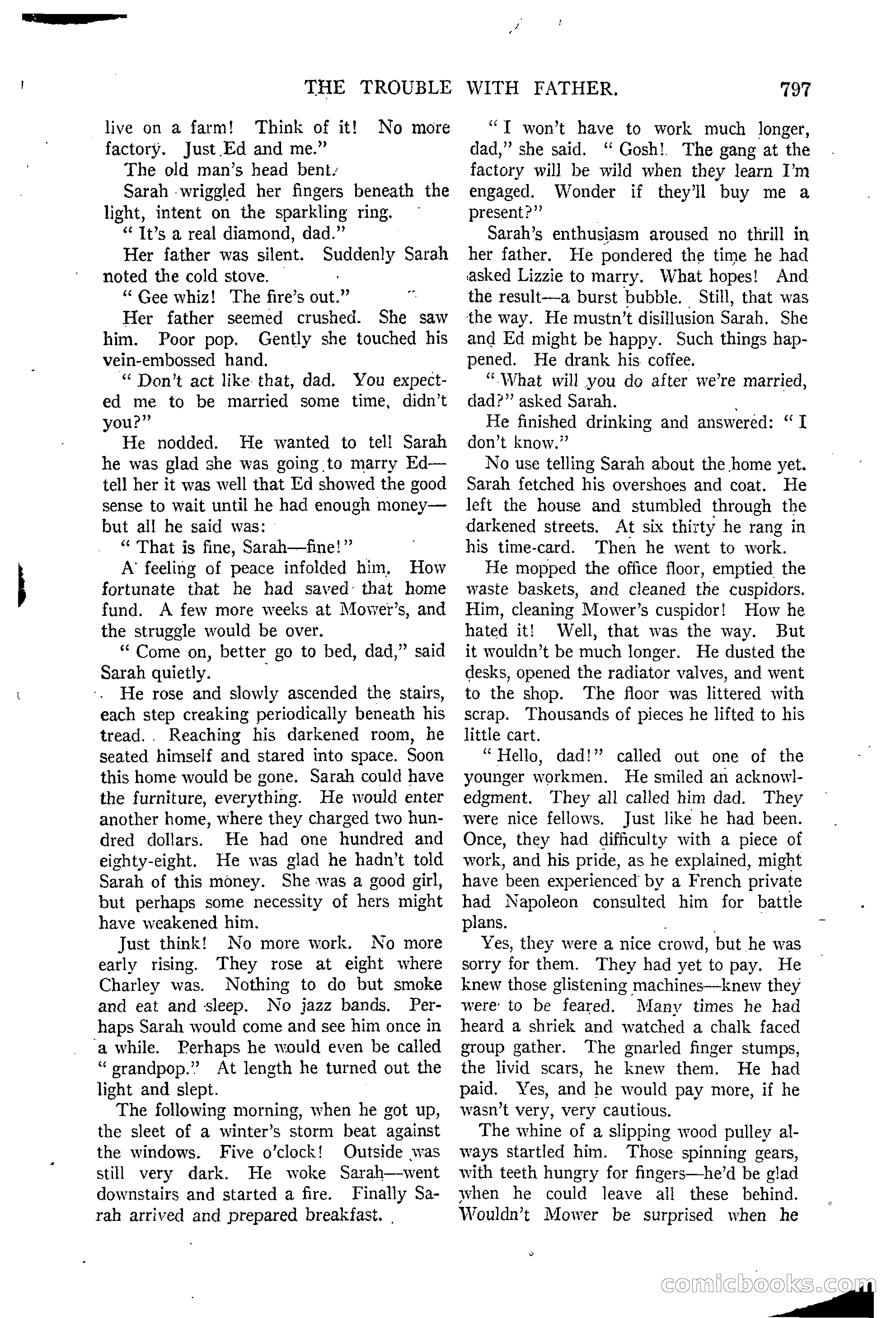
A restored page from Pulp Fiction, 1924. Page through the whole issue in the reader above.
📄 Transcribed text from this page (OCR, searchable)
Machine-transcribed from the original scan — historical spelling and the odd misread are preserved.
THE TROUBLE live on a farm! Think of it! No more factory. Just Ed and me.” The old man’s head bent. Sarah -wriggled her fingers beneath the light, intent on the sparkling ring. “It’s a real diamond, dad.” | Her father was silent. muadeniy Sarah noted the cold stove. ““ Gee whiz! The fire’s out.” Her father seemed crushed. She saw him. Poor pop. Gently she touched his vein-embossed hand. “ Don’t act like that, dad. You expect- ed me to be married some time, didn’t you?” He nodded. He wanted to tell Sarah he was glad she was going to marry Ed— tell her it was well that Ind showed the good sense to wait until he had enough money— but all he said was: » “ That is fine, Sarah—fine!” A’ feeling of peace infolded him, How fortunate that he had saved: that home fund. A few more weeks at Movwer’s, and the struggle would be over. “ Come on, better go to bed, dad,” said Sarah quietly. He rose and slowly ascended the stairs, each step creaking periodically beneath his tread.. Reaching his darkened room, he seated himself and stared into space. Soon this home would be gone. Sarah could have the furniture, everything. He would enter another home, where they charged two hun- dred dollars. He had one hundred and eighty-eight. He was glad he hadn’t told Sarah of this money. She was a good girl, but perhaps some necessity of hers might have weakened him. Just think! No more work. No more early rising. They rose at eight where Charley was. Nothing to do but smoke and eat and sleep. No jazz bands. Per- haps Sarah would come and see him once in ‘a while. Perhaps he would even be called “orandpop.” At length he turned out the light and slept. | The following morning, when he got up, the sleet of a winter’s storm beat against the windows. Five o’clock! Outside was still very dark. He woke Sarah—went downstairs and started a fire. Finally Sa- rah arrived and prepared breakfast. | WITH FATHER. 797 ‘“T won’t have to work much longer, dad,” she said. ‘‘ Gosh! The gang at the factory will be wild when they Jearn I’m engaged. Wonder if theyll buy me a present?” | Sarah’s enthusiasm aroused no thrill in her father. He pondered the time he had asked Lizzie to marry. What hopes! And the result—a burst bubble. Still, that was the way. He mustn’t disillusion Sarah, She and Ed might be happy. Such things hap- pened. He drank his coffee. “What will you do after we’re married, dad?” asked Sarah. He finished drinking and answered: “ I don’t know.” No use telling Sarah about the home yet. Sarah fetched his overshoes and coat. He left the house and stumbled through the darkened streets. At six thirty he rang in his time-card. Then he went to work. He mopped the office floor, emptied the waste baskets, and cleaned the cuspidors. Him, cleaning Mower’s cuspidor! How he hated it! Well, that was the way. But it wouldn’t be much longer. He dusted the desks, opened the radiator valves, and went to the shop. The floor was littered with scrap. Thousands of pieces he lifted to his little cart. “ Hello, dad!” called out one of the younger workmen. He smiled an acknowl- edgment. They all called him dad. They were nice fellows. Just like he had been. Once, they had difficulty with a piece of work, and his pride, as he explained, might have been experienced’ by a French private had Napoleon consulted him for battle plans. Yes, they were a nice crowd, but he was sorry for them. They had yet to pay. He knew those glistening machines—knew they were’ to be feared. Many times he had heard a shriek and watched a chalk faced group gather. The gnarled finger stumps, the livid scars, he knew them. He had paid. Yes, and he would pay more, if he wasn’t very, very cautious. The whine of a slipping wood pulley al- ways startled him. Those spinning gears, with teeth hungry for fingers—he’d be lad when he could leave all these behind. Wouldn’t Mower be surprised when he vo COMNNUC \OOKS ai