
Pulp Fiction, 1924 · page 140 of 177
Argosy All-Story Weekly, March 15, 1924 — page 140: what you’re looking at
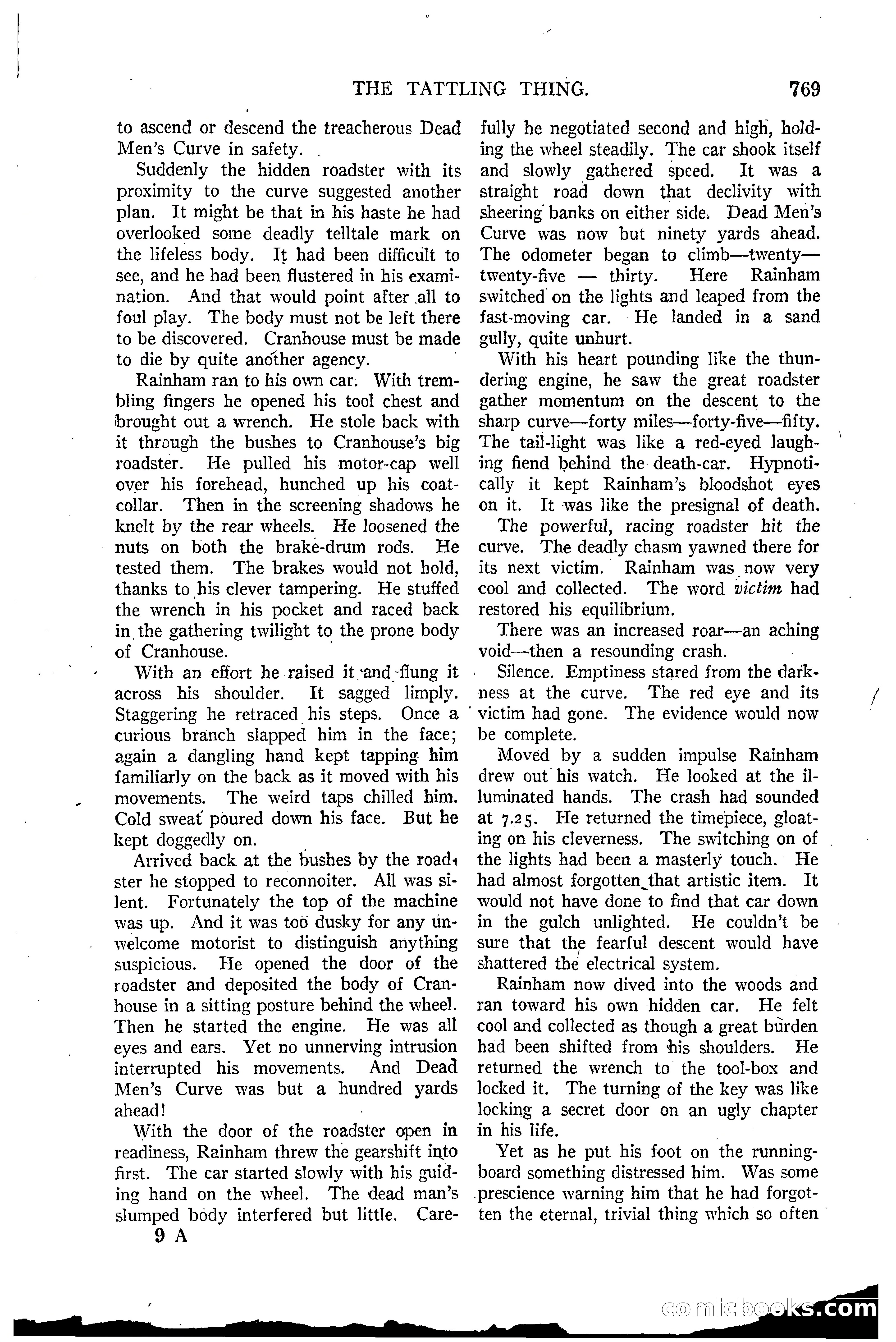
A restored page from Pulp Fiction, 1924. Page through the whole issue in the reader above.
📄 Transcribed text from this page (OCR, searchable)
Machine-transcribed from the original scan — historical spelling and the odd misread are preserved.
THE TATTLING THING. to ascend or descend the treacherous Dead Men’s Curve in safety. | Suddenly the hidden roadster with its proximity to the curve suggested another plan. It might be that in his haste he had overlooked some deadly telltale mark on the lifeless body. It had been difficult to see, and he had been flustered in his exami- nation. And that would point after all to foul play. The body must not be left there to be discovered. Cranhouse must be made to die by quite another agency. Rainham ran to his own car. With trem- bling fingers he opened his tool chest and brought out a wrench. He stole back with it through the bushes to Cranhouse’s big roadster. He pulled his motor-cap well over his forehead, hunched up his coat- collar. Then in the screening shadows he knelt by the rear wheels. He loosened the nuts on both the brake-drum rods. He tested them. The brakes would not hold, thanks to his clever tampering. He stuffed the wrench in his pocket and raced back in the gathering twilight to the prone body of Cranhouse. With an effort he raised it:and-flung it . across his shoulder. It sagged limply. Staggering he retraced his steps. Once a curious branch slapped him in the face; again a dangling hand kept tapping him familiarly on the back as it moved with his movements. The weird taps chilled him. Cold sweat poured down his face. But he kept doggedly on. Arrived back at the bushes by the road, ster he stopped to reconnoiter. All was si- lent. Fortunately the top of the machine was up. And it was too dusky for any un- welcome motorist to distinguish anything suspicious. He opened the door of the roadster and deposited the body of Cran- house in a sitting posture behind the wheel. Then he started the engine. He was all eyes and ears. Yet no unnerving intrusion interrupted his movements. And Dead Men’s Curve was but a hundred yards ahead! With the door of the roadster open in readiness, Rainham threw the gearshift into first. The car started slowly with his guid- ing hand on the wheel. The dead man’s slumped body interfered but little. Care- 9 A victim had gone. 469 fully he negotiated second and high, hold- ing the wheel steadily. The car shook itself and slowly gathered speed. It was a straight road down that declivity with sheering banks on either side. Dead Men’s Curve was now but ninety yards ahead. The odometer began to climb—twenty— twenty-five —- thirty. Here Rainham switched on the lights and leaped from the fast-moving car. He landed in a sand gully, quite unhurt. With his heart pounding like the thun- dering engine, he saw the great roadster gather momentum on the descent to the sharp curve—forty miles—forty-five—fity. The tail-light was like a red-eyed Jaugh- ing fiend behind the. death-car. Hypnoti- cally it kept Rainham’s bloodshot eyes on it. It was like the presignal of death. The powerful, racing roadster hit the curve. The deadly chasm yawned there for its next victim. Rainham was now very cool and collected. The word victim had restored his equilibrium. There was an increased roar—an aching void—then a resounding crash. Silence. Emptiness stared from the dark- ness at the curve. The red eye and its The evidence would now be complete. Moved by a sudden impulse Rainham drew out his watch. He looked at the il- luminated hands. The crash had sounded at 7.25. He returned the timepiece, gloat- ing on his cleverness. The switching on of | the lights had been a masterly touch. He had almost forgotten_that artistic item. It would not have done to find that car down in the gulch unlighted. He couldn’t be sure that the fearful descent would have shattered the electrical system. Rainham now dived into the woods and ran toward his own hidden car. He felt cool and collected as though a great burden had been shifted from ‘his shoulders. He returned the wrench to the tool-box and locked it. The turning of the key was like locking a secret door on an ugly chapter in his “life. Yet as he put his foot on the running- board something distressed him. Was some -prescience warning him that he had forgot- ten the eternal, trivial thing which so often