
Pulp Fiction, 1924 · page 102 of 177
Argosy All-Story Weekly, March 15, 1924 — page 102: what you’re looking at
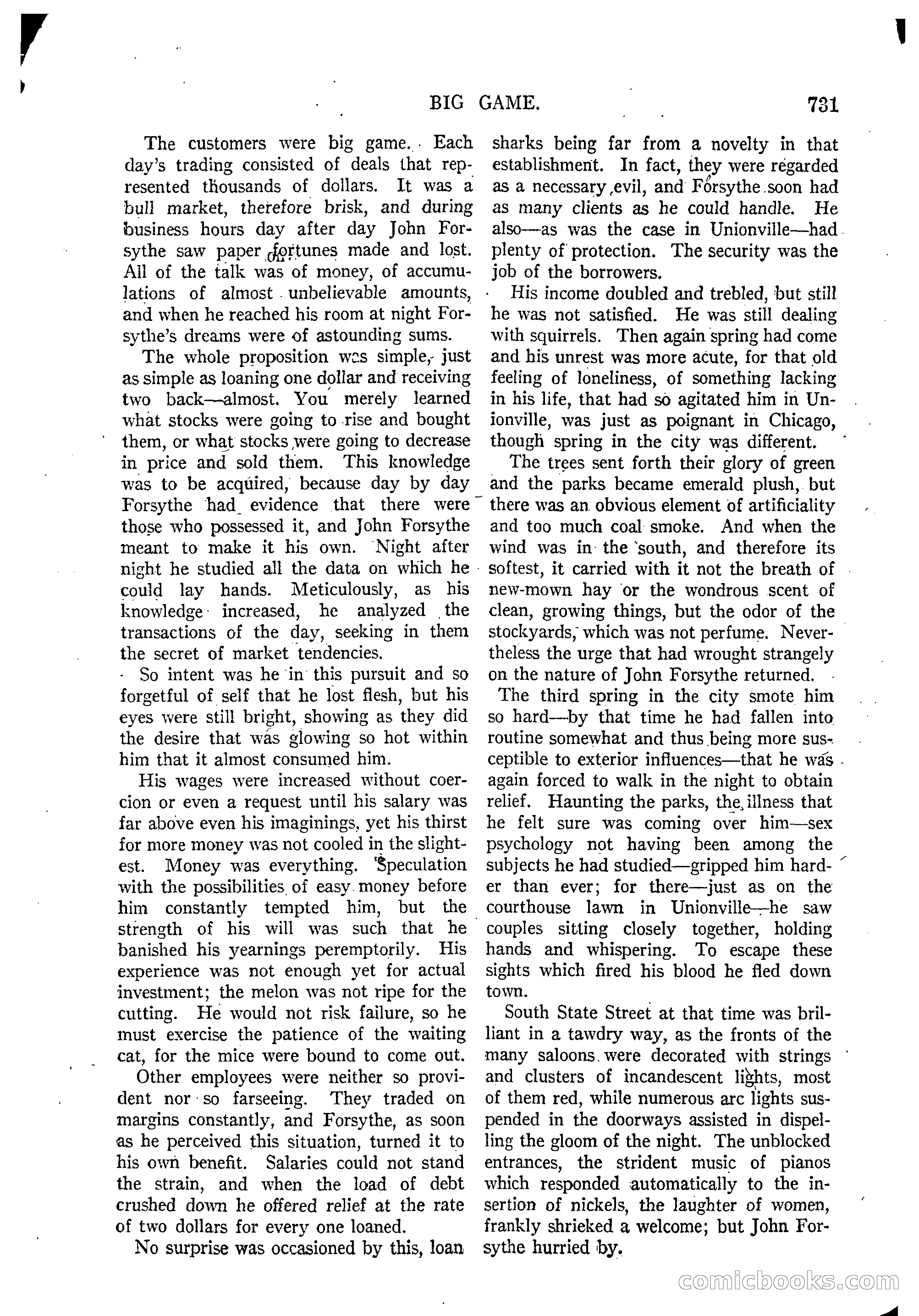
A restored page from Pulp Fiction, 1924. Page through the whole issue in the reader above.
📄 Transcribed text from this page (OCR, searchable)
Machine-transcribed from the original scan — historical spelling and the odd misread are preserved.
—_ BIG GAME. The customers were big game.. Each day’s trading consisted of deals that rep- resented thousands of dollars. It was a bull market, therefore brisk, and during business hours day after day John For- sythe saw paper fortunes made and lost. All of the talk was of money, of accumu- lations of almost . unbelievable amounts, and when he reached his room at night For- sythe’s dreams were of astounding sums. The whole proposition wes simple, just as simple as loaning one dollar and receiving two back—almost. You merely learned what stocks were going to rise and bought them, or what stocks were going to decrease in price and sold them. This knowledge was to be acqttired, because day by day Forsythe had_ evidence that there were ~ those who possessed it, and John Forsythe meant to make it his own. Night after night he studied all the data on which he - could lay hands. Meticulously, as his knowledge: increased, he analyzed _ the transactions of the day, seeking in them the secret of market tendencies. So intent was he in this pursuit and so forgetful of self that he lost flesh, but his eyes were still bright, showing as they did the desire that was glowing so hot within him that it almost consumed him. His wages were increased without coer- cion or even a request until his salary was far above even his imaginings, yet his thirst for more money was not cooled in the slight- est. Money was everything. ‘Speculation with the possibilities of easy. money before him constantly tempted him, but the — strength of his will was such that he banished his yearnings peremptorily. His experience was not enough yet for actual investment; the melon was not ripe for the cutting. He would not risk failure, so he must exercise the patience of the waiting cat, for the mice were bound to come out. Other employees were neither so provi- dent nor:so farseeing. They traded on margins constantly, and Forsythe, as soon as he perceived this situation, turned it to his own benefit. Salaries could not stand the strain, and when the load of debt crushed down he offered relief at the rate of two dollars for every one loaned. No surprise was occasioned by this, loan T3l sharks being far from @ novelty in that establishment. In fact, they were régarded as a necessary ,evil, and Forsythe .soon had as many clients as he could handle. He also—as was the case in Unionville—had. plenty of protection. The security was the job of the borrowers. His income doubled and trebled, but stil! he was not satisfied. He was still dealing with squirrels. Then again spring had come and his unrest was more acute, for that old feeling of loneliness, of something lacking in his life, that had so agitated him in Un- Jonville, was just as poignant in Chicago, — though spring in the city was different. The trees sent forth their glory of green and the parks became emerald plush,. but there was an obvious element of artificiality and too much coal:smoke. And when the wind was in: the ‘south, and therefore its softest, it carried with it not the breath of . new-mown hay or the wondrous scent of clean, growing things, but the odor of the stockyards, which was not perfume. Never- theless the urge that had wrought strangely on the nature of John Forsythe returned. The third spring in the city smote him so hard—by that time he had fallen into routine somewhat and thus being more sus- ceptible to exterior influences—that he was - again forced to walk in the night to obtain relief. Haunting the parks, the, illness that he felt sure was coming over him—sex psychology not having been among the subjects he had studied—gripped him hard- ~ er than ever; for there—just as on the courthouse lawn in Unionville—he saw couples sitting closely together, holding hands and whispering. To escape these sights which fired his blood he fled down town. South State Street at that time was bril- liant in a tawdry way, as the fronts of the many saloons. were decorated with strings and clusters of incandescent lights, most of them red, while numerous arc lights sus- pended in the doorways assisted in dispel- ling the gloom of the night. The unblocked entrances, the strident music of pianos which responded automatically to the in- sertion of nickels, the laughter of women, frankly shrieked a welcome; but John For- sythe hurried by. comicloookks