
Pulp Fiction, 1924 · page 87 of 166
Argosy All-Story Weekly, February 23, 1924 — page 87: what you’re looking at
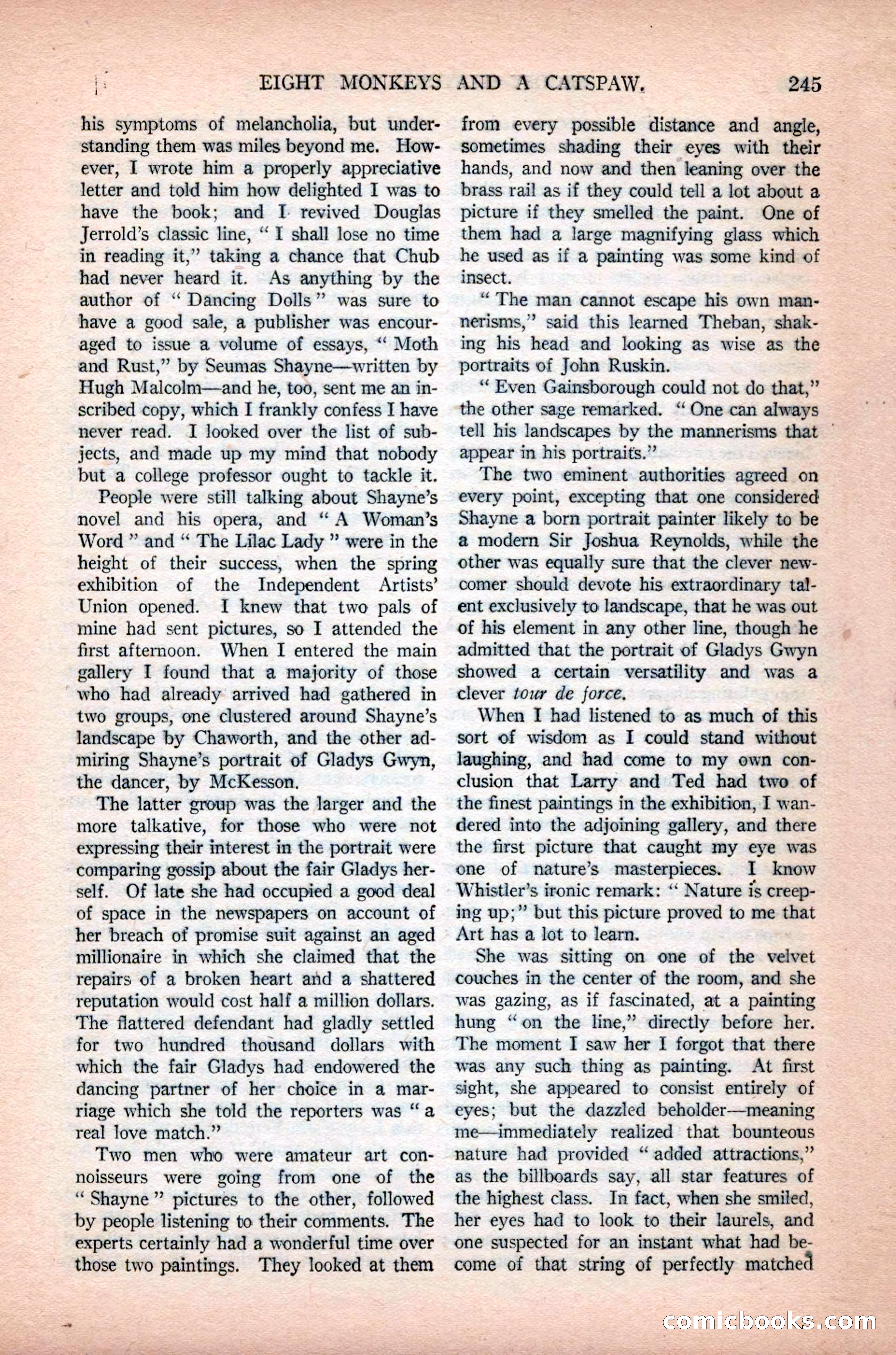
A restored page from Pulp Fiction, 1924. Page through the whole issue in the reader above.
📄 Transcribed text from this page (OCR, searchable)
Machine-transcribed from the original scan — historical spelling and the odd misread are preserved.
bs EIGHT MONKEYS his symptoms of melancholia, but under- standing them was miles beyond me. How- ever, [ wrote him a properly appreciative letter and told him how delighted I was to have the book; and I revived Douglas Jerrold’s classic line, “ I shall lose no time in reading it,” taking a chance that Chub had never heard it. As anything by the author of “ Dancing Dolls” was sure to have a good sale, a publisher was encour- aged to issue a volume of essays, “‘ Moth and Rust,” by Seumas Shayne—written by Hugh Malcolm—and he, too, sent me an in- scribed copy, which I frankly confess I have never read. I looked over the list of sub- jects, and made up my mind that nobody but a college professor ought to tackle it. People were still talking about Shayne’s novel and his opera, and “‘ A Woman’s Word ” and “ The Lilac Lady ” were in the height of their success, when the spring exhibition of the Independent Artists’ Union opened. I knew that two pals of mine had sent pictures, so I attended the first afternoon. When I entered the main gallery I found that a majority of those who had already arrived had gathered in two groups, one clustered around Shayne’s landscape by Chaworth, and the other ad- miring Shayne’s portrait of Gladys Gwyn, the dancer, by McKesson. The latter group was the larger and the more talkative, for those who were not expressing their interest in the portrait were comparing gossip about the fair Gladys her- self. Of late she had occupied a good deal of space in the newspapers on account of her breach of promise suit against an aged millionaire in which she claimed that the repairs of a broken heart and a shattered reputation would cost half a million dollars. The flattered defendant had gladly settled for two hundred thousand dollars with which the fair Gladys had endowered the dancing partner of her choice in a mar- riage which she told the reporters was “a real love match.” Two men who were amateur art con- noisseurs were going from one of the “Shayne ” pictures to the other, followed by people listening to their comments. The experts certainly had a wonderful time over those two paintings. They looked at them AND A CATSPAW. 245 from every possible distance and angle, sometimes shading their eyes with their hands, and now and then leaning over the brass rail as if they could tell a lot about a picture if they smelled the paint. One of them had a large magnifying glass which he used as if a painting was some kind of insect. “The man cannot escape his own man- nerisms,” said this learned Theban, shak- ing his head and looking as wise as the portraits of John Ruskin. “Even Gainsborough could not do that,” the other sage remarked. “One can always tell his landscapes by the mannerisms that ~ appear in his portraits.” The two eminent authorities agreed on every point, excepting that one considered Shayne a born portrait painter likely to be a modern Sir Joshua Reynolds, while the other was equally sure that the clever new- comer should devote his extraordinary tal- ent exclusively to landscape, that he was out of his element in any other line, though he admitted that the portrait of Gladys Gwyn showed a certain versatility and was a clever tour de force, When I had listened to as much of this sort of wisdom as I could stand without laughing, and had come to my own con- clusion that Larry and Ted had two of the finest paintings in the exhibition, I wan- dered into the adjoining gallery, and there the first picture that caught my eye was one of nature’s masterpieces. I know Whistler’s ironic remark: “‘ Nature is creep- ing up;” but this picture proved to me that Art has a lot to learn. She was sitting on one of the velvet couches in the center of the room, and she was gazing, as if fascinated, at a painting hung “on the line,” directly before her. The moment I saw her I forgot that there was any such thing as painting. At first | sight, she appeared to consist entirely of eyes; but the dazzled beholder—meaning me—immediately realized that bounteous nature had provided “ added attractions,” as the billboards say, all star features of the highest class. In fact, when she smiled, her eyes had to look to their laurels, and | one suspected for an instant what had be- come of that string of perfectly matched comicbooks (E(@)