
Pulp Fiction, 1924 · page 79 of 166
Argosy All-Story Weekly, February 23, 1924 — page 79: what you’re looking at
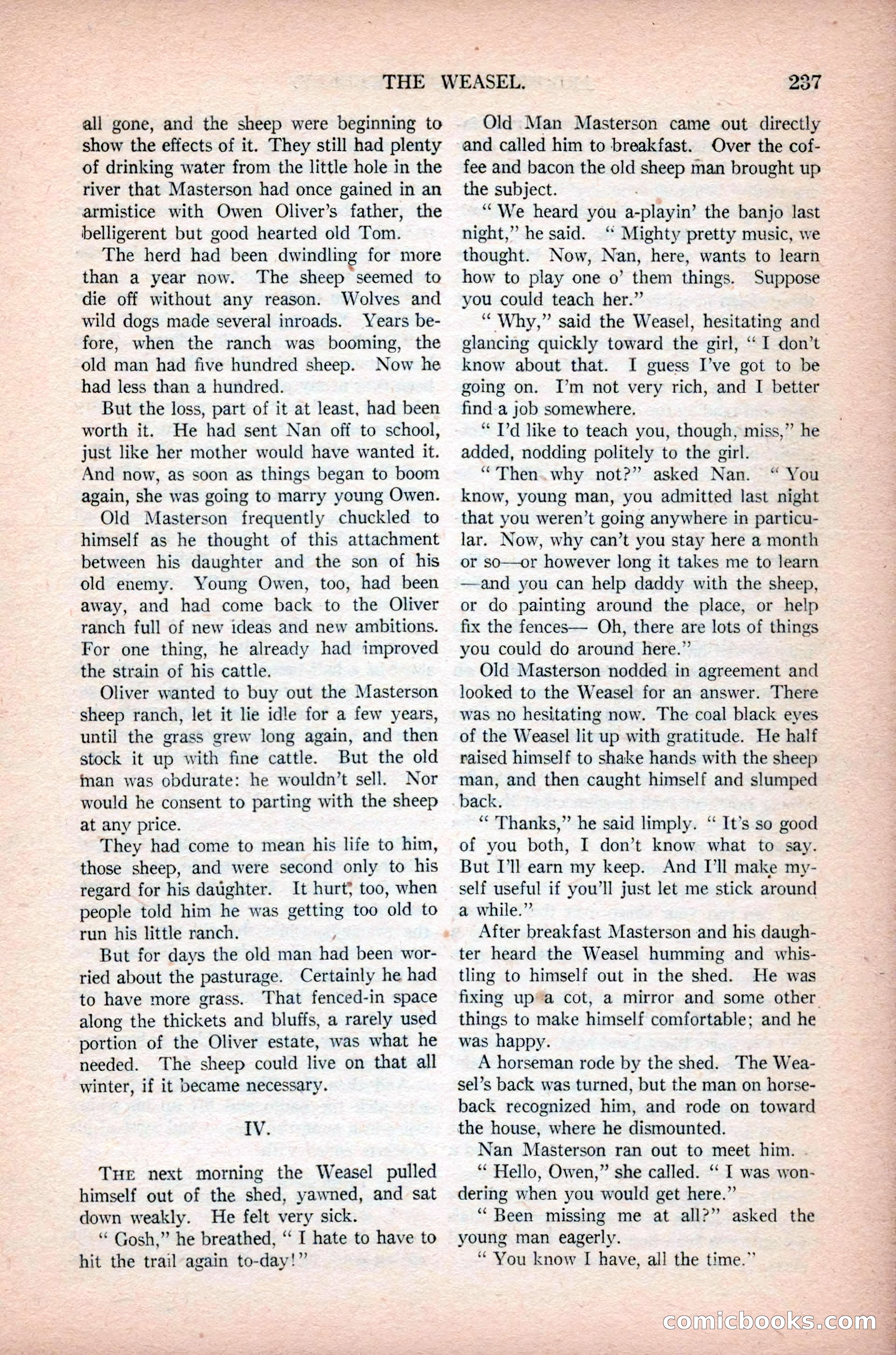
A restored page from Pulp Fiction, 1924. Page through the whole issue in the reader above.
📄 Transcribed text from this page (OCR, searchable)
Machine-transcribed from the original scan — historical spelling and the odd misread are preserved.
THE WEASEL. all gone, and the sheep were beginning to show the effects of it. They still had plenty of drinking water from the little hole in the river that Masterson had once gained in an armistice with Owen Oliver’s father, the belligerent but good hearted old Tom. The herd had been dwindling for more than a year now. The sheep seemed to die off without any reason. Wolves and wild dogs made several inroads. Years be- fore, when the ranch was booming, the old man had five hundred sheep. Now he had less than a hundred. But the loss, part of it at least, had been worth it. He had sent Nan off to school, just like her mother would have wanted it. And now, as soon as things began to boom again, she was going to marry young Owen. Old Masterson frequently chuckled to himself as he thought of this attachment between his daughter and the son of his old enemy. Young Owen, too, had been away, and had come back to the Oliver ranch full of new ideas and new ambitions. For one thing, he already had improved the strain of his cattle. Oliver wanted to buy out the Masterson sheep ranch, let it lie idle for a few years, until the grass grew long again, and then stock it up with fine cattle. But the old man was obdurate: he wouldn’t sell. Nor would he consent to parting with the sheep at any price. They had come to mean his life to him, those sheep, and were second only to his regard for his daughter. It hurt} too, when people told him he was getting too old to run his little ranch. But for days the old man a been wor- ried about the pasturage. Certainly he had to have more grass. That fenced-in space along the thickets and bluffs, a rarely used portion of the Oliver estate, was what he needed. The sheep could live on that all winter, if it became necessary. IV. Tuer next morning the Weasel pulled himself out of the shed, yawned, and sat down weakly. He felt very sick. ‘“ Gosh,” he breathed, “ I hate to have to hit the trail again to-day!” 257 Old Man Masterson came out directly and called him to breakfast. Over the cof- fee and bacon the old sheep man brought up the subject. “We heard you acplnyle? the banjo last night,” he said. ‘“ Mighty pretty music, we thought. Now, Nan, here, wants to learn how to play one o’ them things. Suppose you could teach her.” “Why,” said the Weasel, hesitating and glancing quickly toward the girl, ‘I don’t know about that. I guess I’ve got to be going on. I’m not very rich, and I better finda job somewhere. “Td like to teach you, though, miss,” he added, nodding politely to the girl. “Then. why not?” asked Nan. “ You know, young man, you admitted last night that you weren’t going anywhere in particu- lar. Now, why can’t you stay here a month or so—or however long it takes me to learn —and you can help daddy with the sheep, or do painting around the place, or help fix the fences— Oh, there are lots of things you could do around here.” Old Masterson nodded in agreement and looked to the Weasel for an answer. There was no hesitating now. The coal black eyes of the Weasel lit up with gratitude. He half raised himself to shake hands with the sheep man, and then caught himself and slumped back. “Thanks,” he said limply. “ It’s so good of you both, I don’t know what to say. But T'll earn my keep. And I’ll make my- self useful if you'll just let me stick around a while.” After breakfast Masterson and his daugh- ter heard the Weasel humming and whis- tling to himself out in the shed. He was fixing up’a cot, a mirror and some other things to make himself comfortable; and he was happy. A horseman rode by the shed. The Wea- Sel’s back was turned, but the man on horse- back recognized him, and rode on toward the house, where he dismounted. Nan Masterson ran out to meet him. . “ Hello, Owen,” she called. “ I was won- dering when you would get here.” “Been missing me at all?” asked the young man eagerly. ‘“ You know I have, all the time.” EOPMIG LOOKS (E@) wae UW hens ee ee