
Pulp Fiction, 1924 · page 61 of 166
Argosy All-Story Weekly, February 23, 1924 — page 61: what you’re looking at
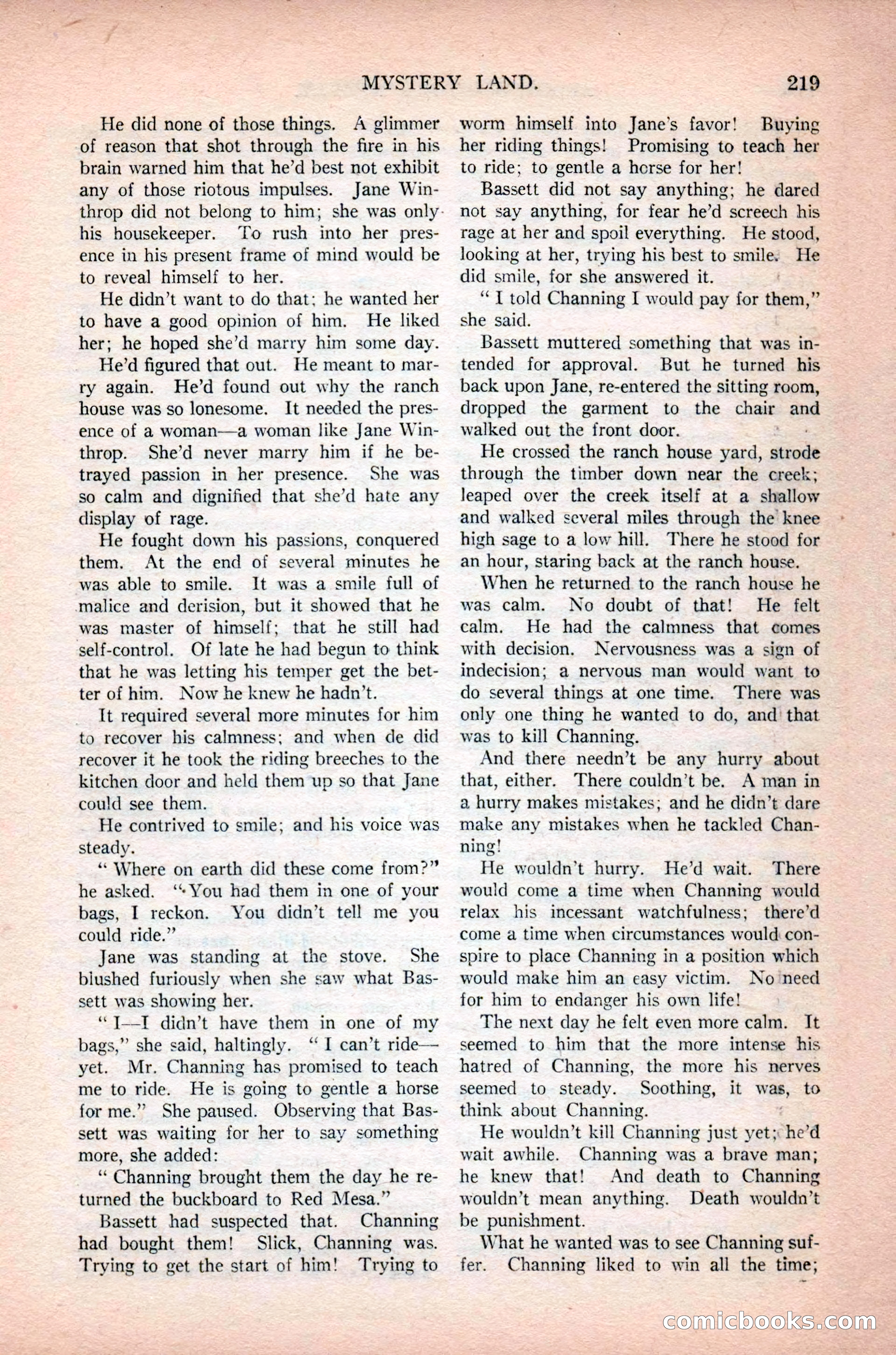
A restored page from Pulp Fiction, 1924. Page through the whole issue in the reader above.
📄 Transcribed text from this page (OCR, searchable)
Machine-transcribed from the original scan — historical spelling and the odd misread are preserved.
MYSTERY LAND. He did none of those things. A glimmer of reason that shot through the fire in his brain warned him that he’d best not exhibit any of those riotous impulses. Jane Win- throp did not belong to him; she was only: his housekeeper. To rush into her pres- ence in his present frame of mind would be to reveal himself to her. He didn’t want to do that: he wanted her to have a good opinion of him. He liked her; he hoped she’d marry him some day. He’d figured that out. He meant to mar- ry again. He’d found out why the ranch house was so lonesome. It needed the pres- ence of a woman—a woman like Jane Win- throp. She’d never marry him if he be- trayed passion in her presence. She was so calm and dignified that she’d hate any display of rage. He fought down his passions, conquered them. At the end of several minutes he was able to smile. It was a smile full of malice and derision, but it showed that he was master of himself; that he still had self-control. Of late he had begun to think that he was letting his temper get the bet- ter of him. Now he knew he hadn't. It required several more minutes for him to recover his calmness; and when de did recover it he took the riding breeches to the kitchen door and held them up so that Jane could see them. He contrived to smile; and his voice was steady. “Where on earth did these come from?” he asked. ‘*You had them in one of your bags, I reckon. You didn’t tell me you could ride.” Jane was standing at the stove. She blushed furiously when she saw what Bas- sett was showing her. ‘““T—-TI didn’t have them in one of my bags,” she said, haltingly. “ I can’t ride— yet. Mr. Channing has promised to teach me to ride. He is going to gentle a horse for me.” She paused. Observing that Bas- sett was waiting for her to say something more, she added: ‘Channing brought them the day he re- turned the buckboard to Red Mesa.” Bassett had suspected that. Channing had bought them! Slick, Channing was. Trying to get the start of him! Trying to 219 worm himself into Jane’s favor! Buying her riding things! Promising to teach her to ride; to gentle a horse for her! Bassett did not say anything; he dared not say anything, for fear he’d screech his rage at her and spoil everything. He stood, looking at her, trying his best to smile. He did smile, for she answered it. ‘1 told Channing I would pay for them,” she said. Bassett muttered something that was in- tended for approval. But he turned his back upon Jane, re-entered the sitting room, dropped the garment to the Chait: and walked out the front door. He crossed the ranch house yard, stiode through the timber down near the creek; leaped over the creek itself at a shallow and walked several miles through the knee high sage to a low hill. There he stood for an hour, staring back at the ranch house. When he returned to the ranch house he was calm. No doubt of that! He felt calm. He had the calmness that comes with decision. Nervousness was a sign of indecision; a nervous man would want to do several things at one time. There was only one thing he wanted to do, and’ that was to kill Channing. And there needn’t be any hurry about that, either. There couldn’t be. A man in a hurry makes mistakes; and he didn’t dare make any mistakes when he tackled Chan- ning! He wouldn’t hurry. He’d wait. There would come a time when Channing would relax his incessant watchfulness; there’d come a time when circumstances would con- spire to place Channing in a position which would make him an easy victim. No/need for him to endanger his own life! The next day he felt even more calm. It seemed to him that the more intense his hatred of Channing, the more his nerves seemed to steady. Soothing, it was, to think about Channing. He wouldn’t kill Channing just yet; he'd wait awhile. Channing was a brave man; he knew that! And death to Channing wouldn’t mean anything. Death wouldn’t be punishment. What he wanted was to see Channing suf- fer. Channing liked to win all the time; (€(0) DOO ANU cS (E(0)