
Pulp Fiction, 1924 · page 51 of 166
Argosy All-Story Weekly, February 23, 1924 — page 51: what you’re looking at
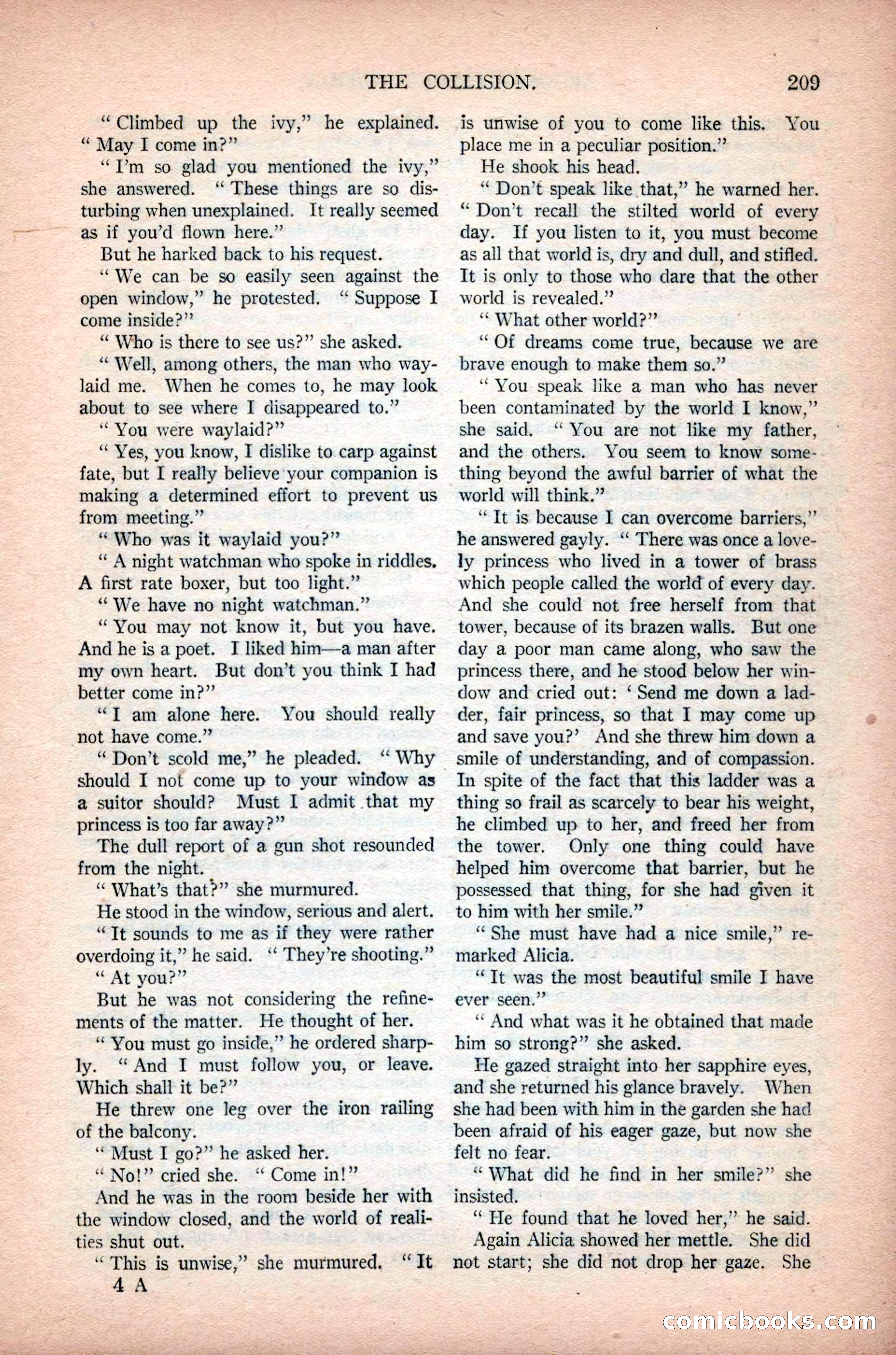
A restored page from Pulp Fiction, 1924. Page through the whole issue in the reader above.
📄 Transcribed text from this page (OCR, searchable)
Machine-transcribed from the original scan — historical spelling and the odd misread are preserved.
THE COLLISION. 209 “Climbed up the ivy,” he explained. “ May I come in?” ‘““T’m so glad you mentioned the ivy,” she answered. ‘“‘ These things are so dis- turbing when unexplained. It really seemed as if you’d flown here.” But he harked back to his request. ‘““We can be so easily seen against the open window,” he protested. ‘“ Suppose I come inside?” “‘ Who is there to see us?” she asked. ““ Well, among others, the man who way- laid me. When he comes to, he may look about to see where I disappeared to.” “You were waylaid?” “Yes, you know, I dislike to carp against fate, but I really believe your companion is making a determined effort to prevent us from meeting.” “Who was it waylaid you?” “ A night watchman who spoke in riddles, A first rate boxer, but too light.” ‘We have no night watchman.” “You may not know it, but you have. And he is a poet. I liked him—a man after my own heart. But don’t you think I had better come in?” ‘“‘T am alone here. You should really not have come.” “Don’t scold me,” he pleaded. “‘ Why should I not come up to your window as a suitor should? Must I admit that my princess is too far away?” The dull report of a gun shot resounded from the night. “ What’s that?” she murmured. He stood in the window, serious and alert. “Tt sounds to me as if they were rather overdoing it,” he said. ‘‘ They’re shooting.” ““ At you?” But he was not considering the refine- ments of the matter. He thought of her. “ You must go inside,”’ he ordered sharp- ly. “And I must follow you, or leave. Which shall it be?” He threw one leg over the iron railing of the balcony. “Must I go?” he asked her. “No!” cried she. “ Come in!” And he was in the room beside her with the window closed, and the world of reali- ties shut out. “This is unwise,” she murmured. “ It 4A is unwise of you to come like this. You place me in a peculiar position.” He shook his head. “ Don’t speak like that,” he warned her. “ Don’t recall the stilted world of every day. If you listen to it, you must become as all that world is, dry and dull, and stifled. It is only to those who dare that the other world is revealed.” ‘What other world?” “Of dreams come true, because we are brave enough to make them so.” ‘You speak like a man who has never been contaminated by the world I know,” she said. ‘ You are not like my father, and the others. You seem to know some- thing beyond the awful barrier of what the world will think.” ‘Tt is because I can overcome barriers,”’ he answered gayly. ‘“‘ There was once a love- ly princess who lived in a tower of brass which people called the world of every day. And she could not free herself from that tower, because of its brazen walls. But one day a poor man came along, who saw the princess there, and he stood below her win- dow and cried out: ‘Send me down a lad- der, fair princess, so that I may come up and save you?’ And she threw him down a smile of understanding, and of compassion. In spite of the fact that this ladder was a thing so frail as scarcely to bear his weight, he climbed up to her, and freed her from the tower. Only one thing could have helped him overcome that barrier, but he possessed that thing, for she had given it to him with her smile.” “She must have had a nice smile,” re- marked Alicia. “Tt was the most beautiful smile I have ever seen.” ‘““ And what was it he obtained that made him so strong?” she asked. He gazed straight into her sapphire eyes, and she returned his glance bravely. When she had been with him in the garden she had been afraid of his eager gaze, but now she felt no fear. “What did he find in her smile?” she insisted. ‘He found that he loved her,” he said. Again Alicia showed her mettle. She did not start; she did not drop her gaze. She Gomicbooks