
Pulp Fiction, 1924 · page 45 of 166
Argosy All-Story Weekly, February 23, 1924 — page 45: what you’re looking at
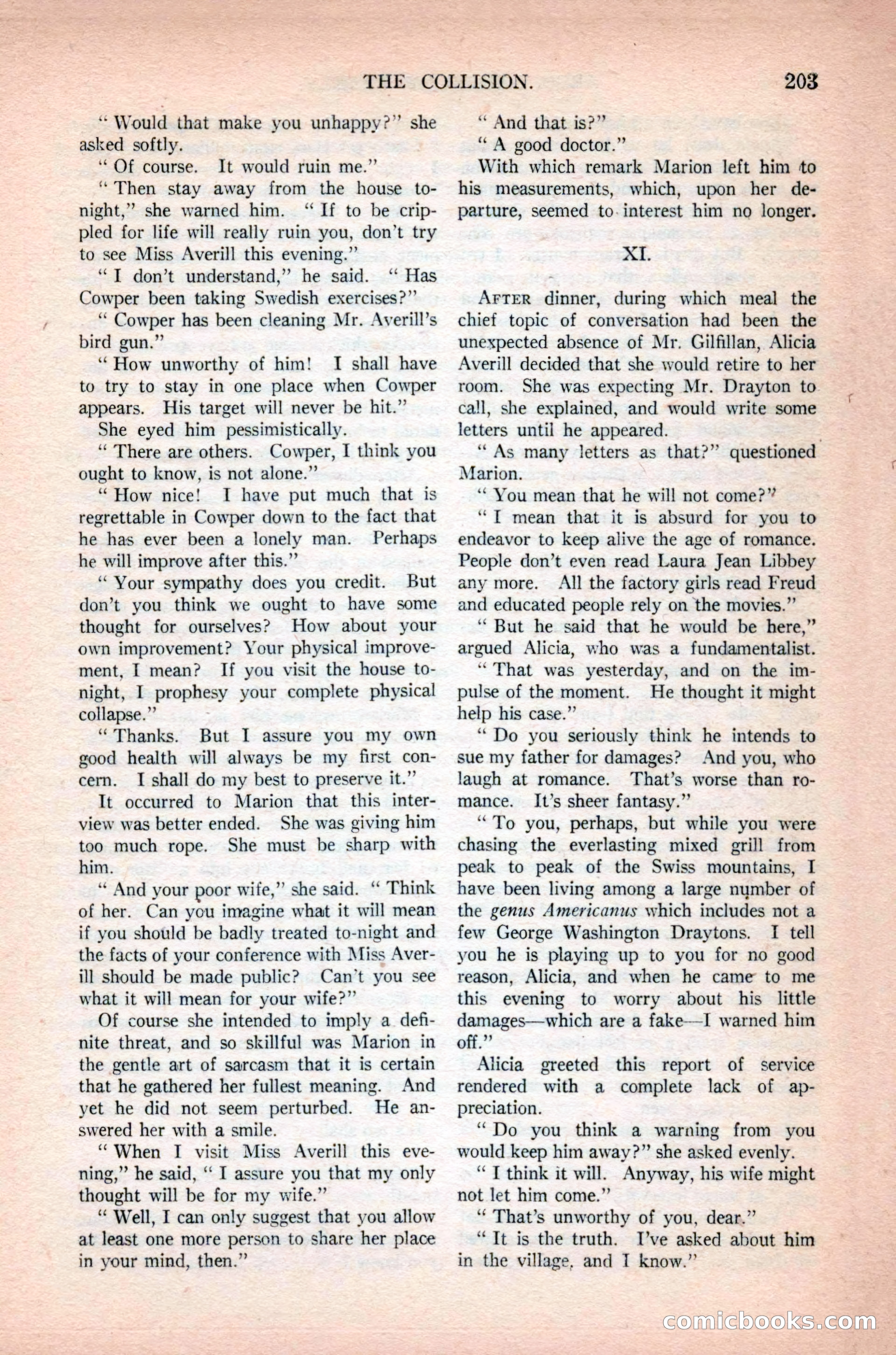
A restored page from Pulp Fiction, 1924. Page through the whole issue in the reader above.
📄 Transcribed text from this page (OCR, searchable)
Machine-transcribed from the original scan — historical spelling and the odd misread are preserved.
THE COLLISION. “ Would that make you unhappy?” she asked softly. ‘Of course. It would ruin me.”’ “Then stay away from the house to- night,” she warned him. ‘“ If to be crip- pled for life will really ruin you, don’t try to see Miss Averill this evening.” “TI don’t understand,” he said. ‘“ Has Cowper been taking Swedish exercises?” ‘““ Cowper has been cleaning Mr. Averill’s bird gun.” ‘““How unworthy of him! I shall have to try to stay in one place when Cowper appears. His target will never be hit.” She eyed him pessimistically. ‘There are others. Cowper, I think you ought to know, is not alone.” “How nice! I have put much that is regrettable in Cowper down to the fact that he has ever been a lonely man. Perhaps he will improve after this.” ‘Your sympathy does you credit. But don’t you think we ought to have some thought for ourselves? How about your own improvement? Your physical improve- ment, I mean? If you visit the house to- night, I prophesy your complete physical collapse.”’ “Thanks. But I assure you my own good health will always be my first con- cern. I shall do my best to preserve it.”’ It occurred to Marion that this inter- view was better ended. She was giving him too much rope. She must be sharp with him. “ And your poor wife,” she said. “ Think of her. Can you imagine what it will mean if you should be badly treated to-night and the facts of your conference with Miss Aver- ill should be made public? Can’t you see what it will mean for your wife?” Of course she intended to imply a defi- nite threat, and so skillful was Marion in the gentle art of sarcasm that it is certain that he gathered her fullest meaning. And yet he did not seem perturbed. He an- swered her with a smile. ““ When I visit Miss Averill this eve- ning,” he said, “‘ I assure you that my only thought will be for my wife.” ‘Well, I can only suggest that you allow at least one more person to share her place in your mind, then.” 203 ‘“ And that is?” ‘A good doctor.” With which remark Marion left him to his measurements, which, upon her de- parture, seemed to. interest him no longer. Al. AFTER dinner, during which meal the chief topic of conversation had been the unexpected absence of Mr. Gilfillan, Alicia Averill decided that she would retire to her room. She was expecting Mr. Drayton to call, she explained, and would write some letters until he appeared. “As many letters as that?” questioned Marion. ‘You mean that he will not come?” “[ mean that it is absurd for you to endeavor to keep alive the age of romance. People don’t even read Laura Jean Libbey any more. All the factory girls read Freud and educated people rely on the movies.” ‘But he said that he would be here,” argued Alicia, who was a fundamentalist. ‘That was yesterday, and on the im- pulse of the moment. He thought it might help his case.”’ “Do you seriously think he intends to sue my father for damages? And you, who laugh at romance. That’s worse than ro- mance. It’s sheer fantasy.” “To you, perhaps, but while you were chasing the everlasting mixed grill from peak to peak of the Swiss mountains, I have been living among a large number of the genus Americanus which includes not a few George Washington Draytons. [ tell you he is playing up to you for no good reason, Alicia, and when he came to me this evening to worry about his little damages—which are a fake—I warned him off.”’ 7 Alicia greeted this report of service rendered with a complete lack of ap- preciation. “Do you think a warning from you would keep him away?” she asked evenly. “ T think it will. Anyway, his wife might not let him come.” ‘“ That’s unworthy of you, dear.” “Tt is the truth. I’ve asked about him in the village, and I know.” CORICLOOOLK< (E@)