
Pulp Fiction, 1924 · page 29 of 166
Argosy All-Story Weekly, February 23, 1924 — page 29: what you’re looking at
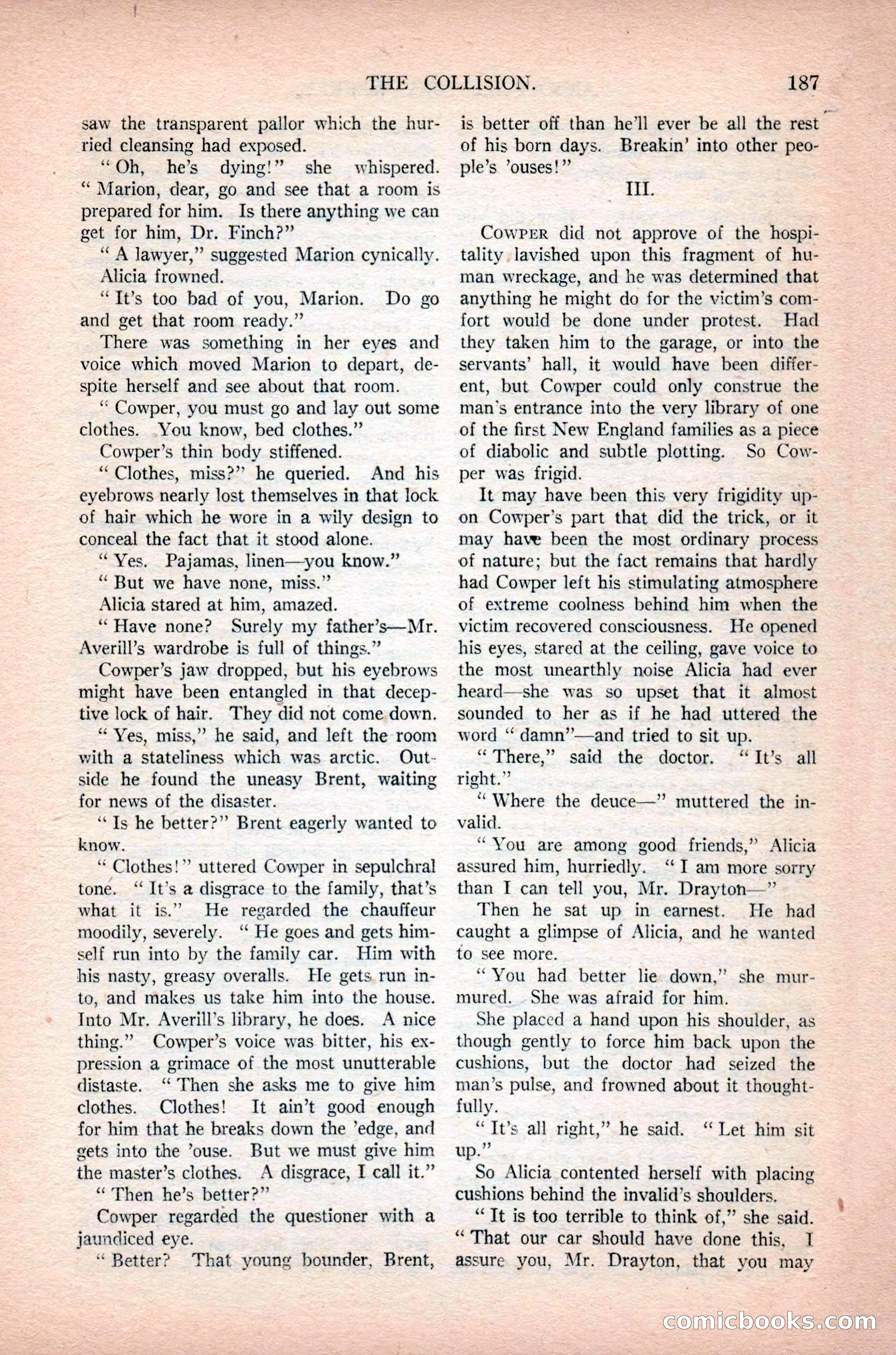
A restored page from Pulp Fiction, 1924. Page through the whole issue in the reader above.
📄 Transcribed text from this page (OCR, searchable)
Machine-transcribed from the original scan — historical spelling and the odd misread are preserved.
THE COLLISION. saw the transparent pallor which the hur- ried cleansing had exposed. “Oh, he’s dying!” she whispered. ““ Marion, dear, go and see that a room is prepared for him. Is there anything we can get for him, Dr. Finch?” ‘“A lawyer,” suggested Marion cynically. Alicia frowned. “It’s too bad of you, Marion. and get that room ready.” There was something in her eyes and voice which moved Marion to depart, de- spite herself and see about that room. ‘““ Cowper, you must go and lay out some clothes. .You know, bed clothes.” Cowper’s thin body stiffened. “Clothes, miss?”’ he queried. And his eyebrows nearly lost themselves in that lock of hair which he wore in a wily design to conceal the fact that it stood alone. “Yes. Pajamas, linen—you know.” “But we have none, miss.” Alicia stared at him, amazed. ‘““Have none? Surely my father’s—Mr. Averill’s wardrobe is full of things.” Cowper’s jaw dropped, but his eyebrows might have been entangled in that decep- tive lock of hair. They did not come down. “ Yes, miss,” he said, and left the room with a stateliness which was arctic. Out- side he found the uneasy Brent, waiting for news of the disaster. ‘Is he better?” Brent eagerly wanted to know. “ Clothes!” uttered Cowper in sepulchral tone. “It’s a disgrace to the family, that’s what it is.” He regarded the chauffeur moodily, severely. ‘‘ He goes and gets him- self run into by the family car. Him with his nasty, greasy overalls. He gets run in- to, and makes us take him into the house. Into Mr. Averill’s library, he does. A nice thing.”” Cowper’s voice was bitter, his ex- pression a grimace of the most unutterable distaste. ‘‘ Then she asks me to give him clothes. Clothes! It ain’t good enough for him that he breaks down the ’edge, and vets into the ’ouse. But we must give him the master’s clothes. A disgrace, I call it.” “Then he’s better?” Cowper regarded the questioner with a jaundiced eye. “ Better? That young bounder, Brent, Do go 187 is better off than he’ll ever be all the rest _ of his born days. Breakin’ into other peo- ple’s ’ouses!”’ IIL. CowPer did not approve of the hospi- tality lavished upon this fragment of hu- man wreckage, and he was determined that anything he might do for the victim’s com- fort would be done under protest. Had they taken him to the garage, or into the servants’ hall, it would have been differ- ent, but Cowper could only construe the man’s entrance into the very library of one of the first New England families as a piece of diabolic and subtle plotting. So Cow- per was frigid. It may have been this very frigidity up- on Cowper’s part that did the trick, or it may have been the most ordinary process of nature; but the fact remains that hardly had Cowper left his stimulating atmosphere of extreme coolness behind him when the victim recovered consciousness. He opened his eyes, stared at the ceiling, gave voice to the most unearthly noise Alicia had ever heard—-she was so upset that it almost sounded to her as if he had uttered the word ‘“‘ damn’’—and tried to sit up. “There,” said the doctor. “It’s all right.” ‘Where the deuce—” muttered the in- valid. “You are among good friends,” Alicia assured him, hurriedly. “I am more sorry than I can tell you, Mr. Drayton—” Then he sat up in earnest. He had caught a glimpse of Alicia, and he wanted to see more. “You had better lie down,” she mur- mured. She was afraid for him. She placed a hand upon his shoulder, as though gently to force him back upon the cushions, but the doctor had seized the man’s pulse, and frowned about it thought- fully. “Tt’s all right,” he said. 3 ‘Let him sit up So Alicia contented herself with placing cushions behind the invalid’s shoulders. “Tt is too terrible to think of,” she said. “That our car should have done this, I assure you, Mr. Drayton, that you may Gomichbooks (EO)