
Pulp Fiction, 1924 · page 25 of 166
Argosy All-Story Weekly, February 23, 1924 — page 25: what you’re looking at
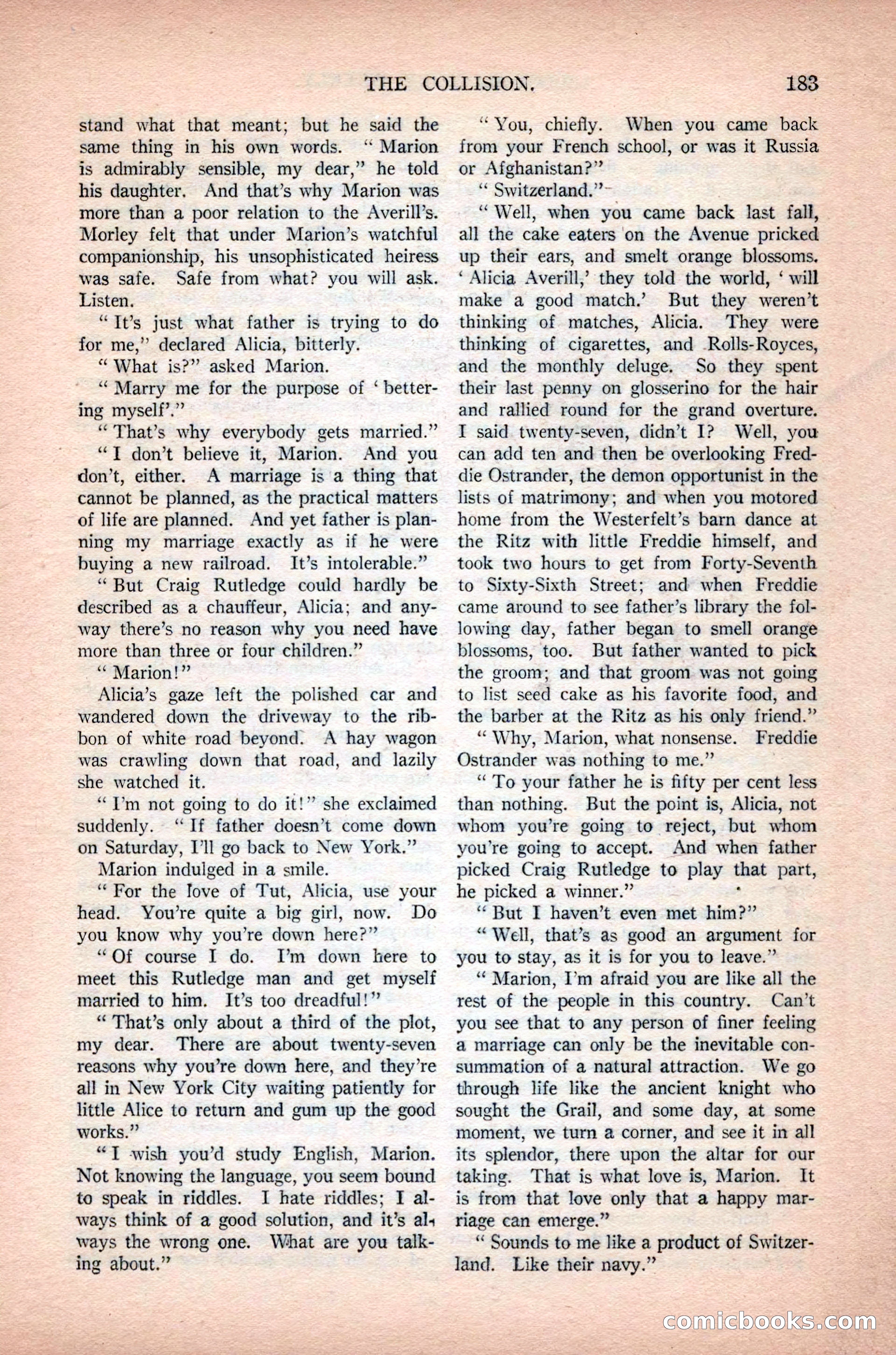
A restored page from Pulp Fiction, 1924. Page through the whole issue in the reader above.
📄 Transcribed text from this page (OCR, searchable)
Machine-transcribed from the original scan — historical spelling and the odd misread are preserved.
THE COLLISION. stand what that meant; but he said the same thing in his own words. “ Marion is admirably sensible, my dear,” he told his daughter. And that’s why Marion was more than a poor relation to the Averill’s. Morley felt that under Marion’s watchful companionship, his unsophisticated heiress was safe. Safe from what? you will ask. Listen. “Tt’s just what father is trying to do for me,” declared Alicia, bitterly. “What is?” asked Marion. ‘“‘ Marry me for the purpose of ‘ better- ing myself’.” “That’s why everybody gets married.” “Tt don’t believe it, Marion. And you don’t, either. A marriage is a thing that cannot be planned, as the practical matters of life are planned. And yet father is plan- ning my marriage exactly as if he were buying a new railroad. It’s intolerable.” “But Craig Rutledge could hardly be described as a chauffeur, Alicia; and any- way there’s no reason why you need have more than three or four children.” ‘* Marion!” Alicia’s gaze left the polished car and wandered down the driveway to the rib- bon of white road beyond. A hay wagon was crawling down that road, and lazily she watched it. “Tm not going to do it!” she exclaimed suddenly. “If father doesn’t come down on Saturday, I'll go back to New York.” Marion indulged in a smile. “For the Iove of Tut, Alicia, use your head. You’re quite a big girl, now. Do you know why you’re down here?” “Of course I do. I’m down here to meet this Rutledge man and get myself married to him. It’s too dreadful!” “ That’s only about a third of the plot, my dear. There are about twenty-seven reasons why you’re down here, and they’re all in New York City waiting patiently for little Alice to return and gum up the good works.” “T -wish you’d study English, Marion. Not knowing the language, you seem bound to speak in riddles. I hate riddles; I al- ways think of a good solution, and it’s al, ways the wrong one. What are you talk- ing about.” 183 “You, chiefly. When you came back from your French school, or was it Russia or Afghanistan?” ‘ Switzerland.”~ “Well, when you came back last fall, all the cake eaters on the Avenue pricked up their ears, and smelt orange blossoms. ‘ Alicia Averill,’ they told the world, ‘ will make a good match.’ But they weren’t thinking of matches, Alicia. They were thinking of cigarettes, and Rolls-Royces, and the monthly deluge. So they spent their last penny on glosserino for the hair and rallied round for the grand overture. I said twenty-seven, didn’t 1? Well, you can add ten and then be overlooking Fred- die Ostrander, the demon opportunist in the lists of matrimony; and when you motored home from the Westerfelt’s barn dance at the Ritz with little Freddie himself, and took two hours to get from Forty-Seventh to Sixty-Sixth Street; and when Freddie came around to see father’s library the fol- lowing day, father began to smell orange blossoms, too. But father wanted to pick the groom; and that groom was not going to list seed cake as his favorite food, and the barber at the Ritz as his only friend.” “Why, Marion, what nonsense. Freddie Ostrander was nothing to me.” : “To your father he is fifty per cent less than nothing. But the point is, Alicia, not whom you’re going to reject, but whom you're going to accept. And when father picked Craig Rutledge to play that part, he picked a winner.’ “But I haven’t even met him?” “Well, that’s as good an argument for you to stay, as it is for you to leave.” ‘““ Marion, I’m afraid you are like all the rest of the people in this country. Can’t you see that to any person of finer feeling a marriage can only be the inevitable con- summation of a natural attraction. We go through life like the ancient knight who sought the Grail, and some day, at some moment, we turn a corner, and see it in all its splendor, there upon the altar for our taking. That is what love is, Marion. It is from that love only that a happy mar- riage can emerge.” “ Sounds to me like a product of Switzer- land. Like their navy.” (e(0) DOOKS