
Pulp Fiction, 1924 · page 19 of 166
Argosy All-Story Weekly, February 23, 1924 — page 19: what you’re looking at
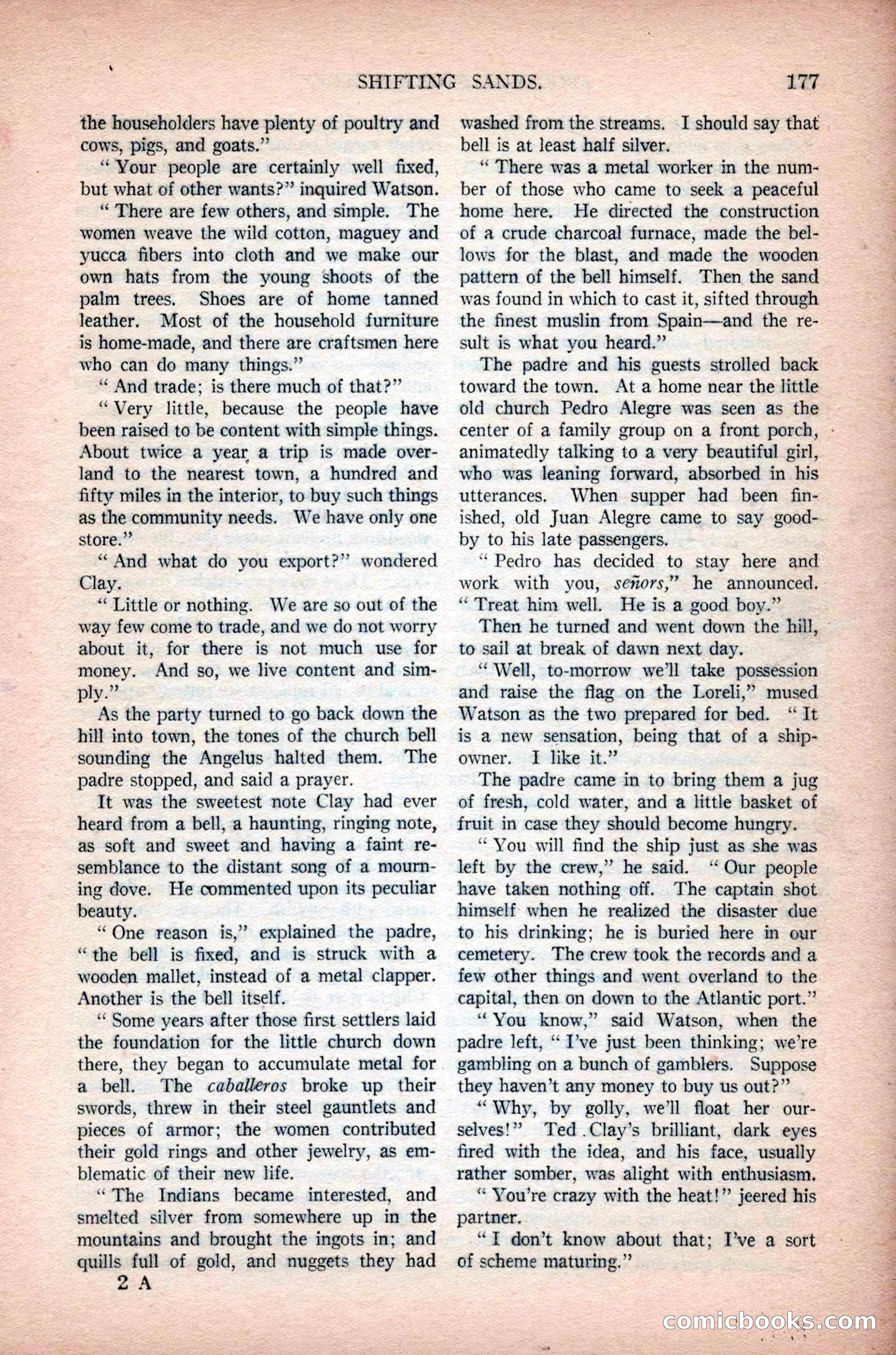
A restored page from Pulp Fiction, 1924. Page through the whole issue in the reader above.
📄 Transcribed text from this page (OCR, searchable)
Machine-transcribed from the original scan — historical spelling and the odd misread are preserved.
SHIFTING SANDS. the householders have plenty of poultry and cows, pigs, and goats.” “Your people are certainly well fixed, but what of other wants?” inquired Watson. “There are few others, and simple. The women weave the wild cotton, maguey and yucca fibers into cloth and we make our own hats from the young shoots of the palm trees. Shoes are of home tanned leather. Most of the household furniture is home-made, and there are craftsmen here who can do many things.” “ And trade; is there much of that?” “Very little, because the people have been raised to be content with simple things. About twice a year a trip is made over- land to the nearest town, a hundred and fifty miles in the interior, to buy such things as the community needs. We have only one store.” “And what do you export?” wondered Clay. “ Little or nothing. We are so out of the way few come to trade, and we do not worry about it, for there is not much use for money. And so, we live content and sim- ply.” As the party turned to go back down the hill into town, the tones of the church bell sounding the Angelus halted them. The padre stopped, and said a prayer. It was the sweetest note Clay had ever heard from a bell, a haunting, ringing note, as soft and sweet and having a faint re- semblance to the distant song of a mourn- ing dove. He commented upon its peculiar beauty. “One reason is,” explained the padre, “the bell is fixed, and is struck with a wooden mallet, instead of a metal clapper. Another is the bell itself. ‘‘ Some years after those first settlers laid the foundation for the little church down there, they began to accumulate metal for a bell. The caballeros broke up their swords, threw in their steel gauntlets and pieces of armor; the women contributed their gold rings and other jewelry, as em- blematic of their new life. “The Indians became interested, and smelted silver from somewhere up in the mountains and brought the ingots in; and quills full of gold, and nuggets they had - 177 washed from the streams. I should say that bell is at least half silver. “There was a metal worker in the num- ber of those who came to seek a peaceful home here. He directed the construction of a crude charcoal furnace, made the bel- lows for the blast, and made the wooden pattern of the bell himself. Then the sand was found in which to cast it, sifted through — the finest muslin from Spain—and the re- sult is what you heard.” The padre and his guests strolled back toward the town. At a home near the little old church Pedro Alegre was seen as the center of a family group on a front porch, - animatedly talking to a very beautiful girl, who was leaning forward, absorbed in his utterances. When supper had been fin- ished, old Juan Alegre came to say good- by to his late passengers. ‘Pedro has decided to stay here and work with you, sevors,” he announced. “Treat him well. He is a good boy.” Then he turned and went down the hill, to sail at break of dawn next day. “Well, to-morrow we'll take possession and raise the flag on the Loreli,” mused Watson as the two prepared for bed. “It is a new sensation, being that of a ship- owner. I hike it.” The padre came in to bring them a jug of fresh, cold water, and a little basket of fruit in case they should become hungry. “You will find the ship just as she was left by the crew,” he said. ‘ Our people have taken nothing off. The captain shot himself when he realized the disaster due to his drinking; he is buried here in our cemetery. The crew took the records and a few other things and went overland to the capital, then on down to the Atlantic port.” “You know,” said Watson, when the padre left, “‘ I’ve just been thinking; we’re gambling on a bunch of gamblers. Suppose they haven’t any money to buy us out?” “Why, by golly, we'll float her our- selves!” Ted .Clay’s brilliant, dark eyes fired with the idea, and his face, usually rather somber, was alight with enthusiasm. “You’re crazy with the heat!” jeered his partner. “TI don’t know about that; I’ve a sort of scheme maturing.” comicbooks com