
Pulp Fiction, 1924 · page 141 of 166
Argosy All-Story Weekly, February 23, 1924 — page 141: what you’re looking at
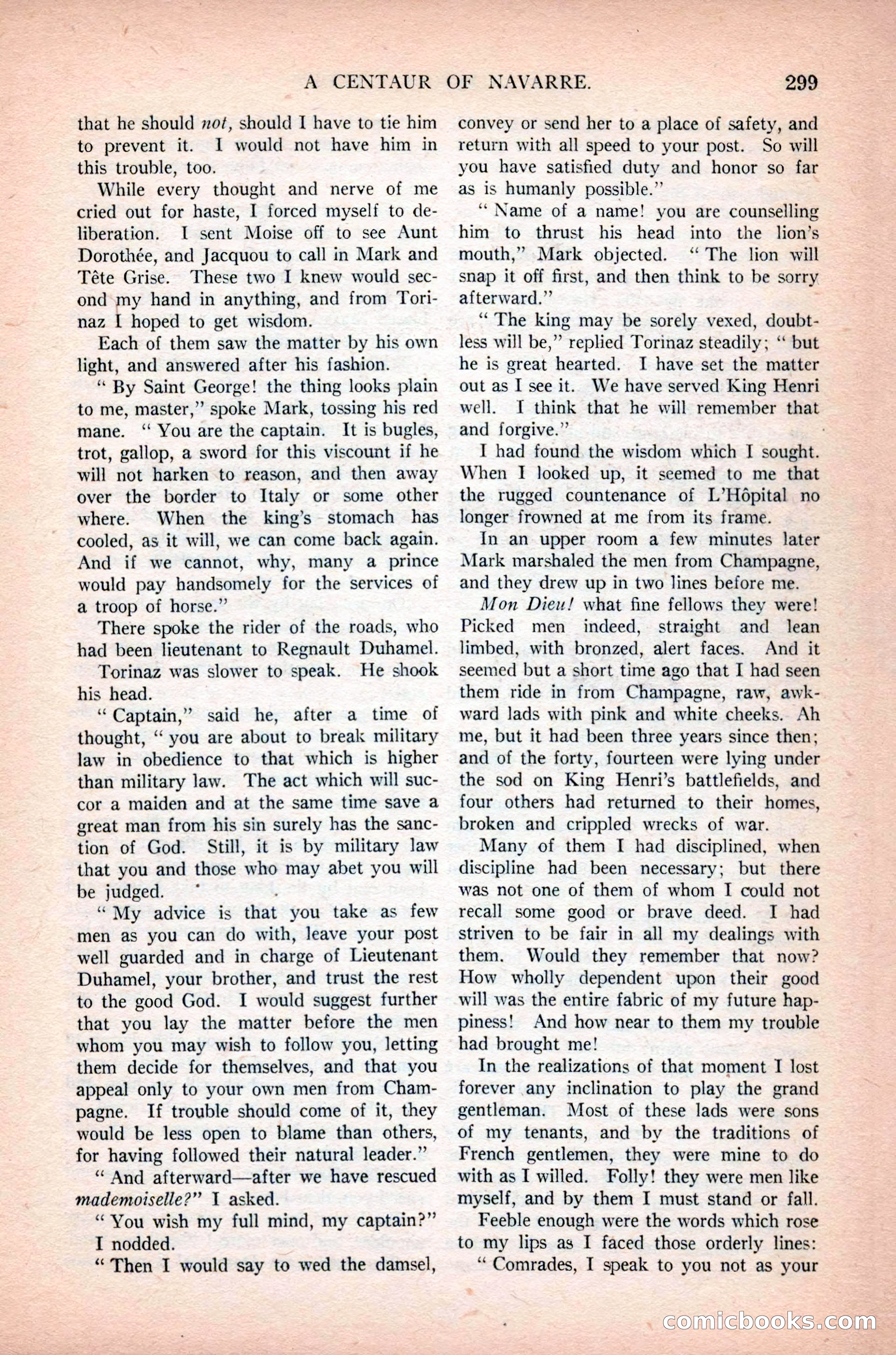
A restored page from Pulp Fiction, 1924. Page through the whole issue in the reader above.
📄 Transcribed text from this page (OCR, searchable)
Machine-transcribed from the original scan — historical spelling and the odd misread are preserved.
A CENTAUR OF that he should of, should I have to tie him to prevent it. I would not have him in this trouble, too. While every thought and nerve of me cried out for haste, I forced myself to de- liberation. I sent Moise off to see Aunt Dorothée, and Jacquou to call in Mark and Téte Grise. These two I knew would sec- ond my hand in anything, and from Tori- naz {| hoped to get wisdom. Each of them saw the matter by his own light, and answered after his fashion. ‘“ By Saint George! the thing looks plain to me, master,” spoke Mark, tossing his red mane. ‘‘ You are the captain. It is bugles, trot, gallop, a sword for this viscount if he will not harken to reason, and then away over the border to Italy or some other where. When the king’s stomach has cooled, as it will, we can come back again. And if we cannot, why, many a prince would pay handsomely for the services of a troop of horse.” There spoke the rider of the roads, who had been lieutenant to Regnault Duhamel. Torinaz was slower to speak. He shook his head. “Captain,” said he, after a time of thought, “ you are about to break military law in obedience to that which is higher than military law. The act which will suc- cor a maiden and at the same time save a great man from his sin surely has the sanc- tion of God. Still, it is by military law that you and those who may abet you will be judged. ~ “My advice is that you take as few men as you can do with, leave your post well guarded and in charge of Lieutenant Duhamel, your brother, and trust the rest to the good God. I would suggest further that you lay the matter before the men whom you may wish to follow you, letting them decide for themselves, and that you appeal only to your own men from Cham- pagne. If trouble should come of it, they would be less open to blame than others, for having followed their natural leader.” “ And afterward—after we have rescued mademoiselle?” 1 asked. “You wish my full mind, my captain?” I nodded. “Then I would say to wed the damsel, NAVARRE. 299 convey or send her to a place of safety, and return with all speed to your post. So will you have satisfied duty and honor so far as is humanly possible.” ‘Name of a name! you are counselling him to thrust his head into the lion’s mouth,” Mark objected. ‘‘ The lion will snap it off first, and then think to be sorry afterward.” “The king may be sorely vexed, doubt- less will be,” replied Torinaz steadily; ‘‘ but he is great hearted. I have set the matter out as I see it. We have served King Henri well. I think that he will remember that and forgive.” I had found the wisdom which I sought. When I looked up, it seemed to me that the rugged countenance of L’Hopital no longer frowned at me from its frame. In an upper room a few minutes later Mark marshaled the men from Champagne, and they drew up in two lines before me. Mon Dieu! what fine fellows they were! Picked men _ indeed, straight and lean limbed, with bronzed, alert faces. And it seemed but a short time ago that I had seen them ride in from Champagne, raw, awk- ward lads with pink and white cheeks. Ah me, but it had been three years since then; and of the forty, fourteen were lying under the sod on King Henri’s battlefields, and four others had returned to their homes, broken and crippled wrecks of war. Many of them I had disciplined, when discipline had been necessary; but there was not one of them of whom I could not recall some good or brave deed. I had striven to be fair in all my dealings with them. Would they remember that now? How wholly dependent upon their good will was the entire fabric of my future hap- piness! And how near to them my trouble had brought me! In the realizations of that moment I lost forever any inclination to play the grand gentleman. Most of these lads were sons of my tenants, and by the traditions of French gentlemen, they were mine to do with as I willed. Folly! they were men like myself, and by them I must stand or fall. Feeble enough were the words which rose to my lips as I faced those orderly lines: “Comrades, I speak to you not as your (E00) DOO ANG S (E@)