
Pulp Fiction, 1924 · page 137 of 166
Argosy All-Story Weekly, February 23, 1924 — page 137: what you’re looking at
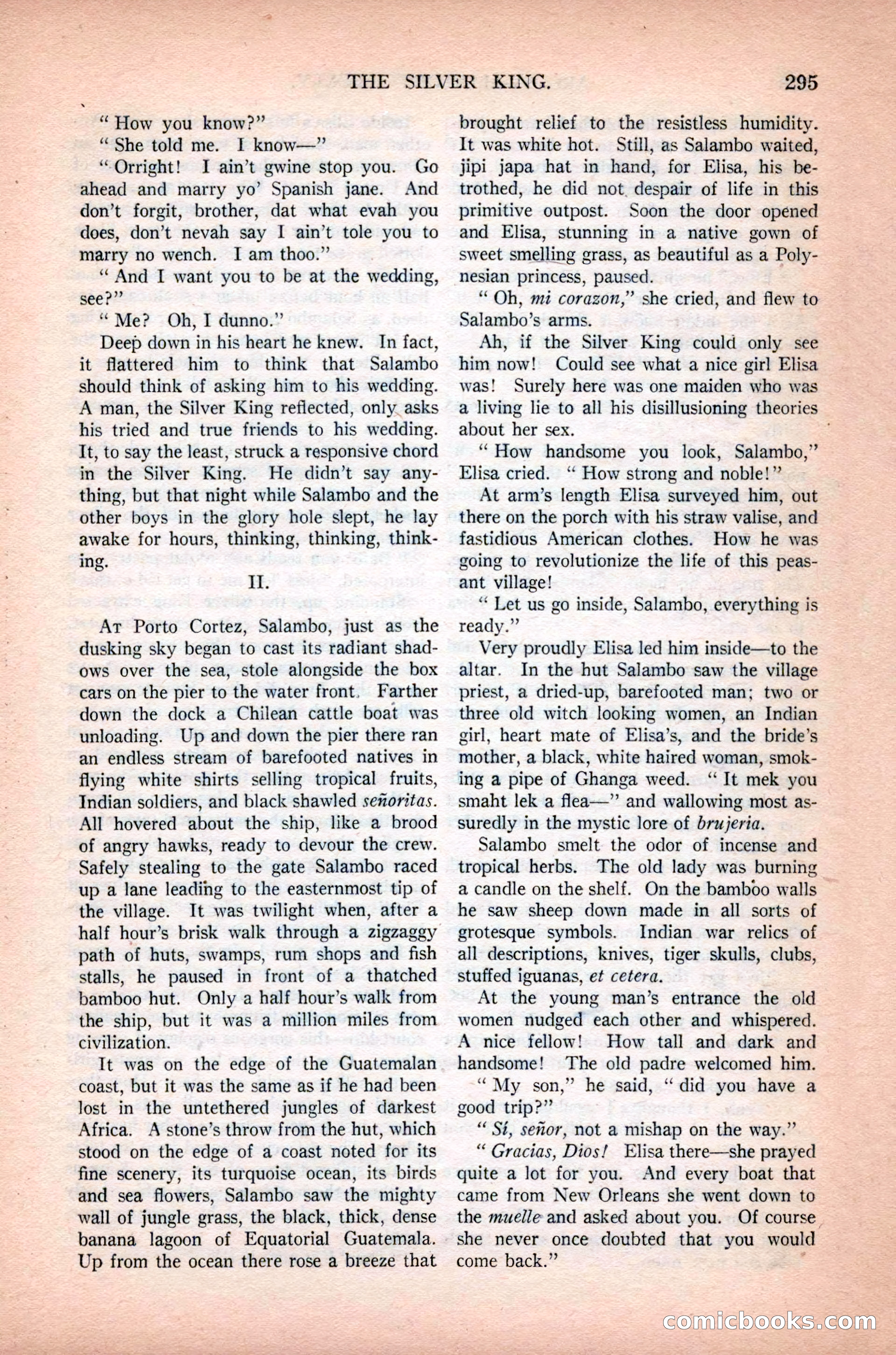
A restored page from Pulp Fiction, 1924. Page through the whole issue in the reader above.
📄 Transcribed text from this page (OCR, searchable)
Machine-transcribed from the original scan — historical spelling and the odd misread are preserved.
THE SILVER KING. “ How you know?” “She told me. I know—” “Orright! I ain’t gwine stop you. Go ahead and marry yo’ Spanish jane. And don’t forgit, brother, dat what evah you does, don’t nevah say I ain’t tole you to marry no wench. I am thoo.” ‘““And I want you to be at the wedding, see?” ‘Me? Oh, I dunno.” Deep down in his heart he knew. In fact, it flattered him to think that Salambo should think of asking him to his wedding. A man, the Silver King refiected, only asks his tried and true friends to his wedding. It, to say the least, struck a responsive chord in the Silver King. He didn’t say any- thing, but that night while Salambo and the other boys in the glory hole slept, he lay awake for hours, thinking, thinking, think- ing. Il. Ar Porto Cortez, Salambo, just as the dusking sky began to cast its radiant shad- ows over the sea, stole alongside the box cars on the pier to the water front. Farther down the dock a Chilean cattle boat was unloading. Up and down the pier there ran an endless stream of barefooted natives in flying white shirts selling tropical fruits, Indian soldiers, and black shawled senoritas. All hovered about the ship, like a brood of angry hawks, ready to devour the crew. Safely stealing to the gate Salambo raced up a lane leading to the easternmost tip of the village. It was twilight when, after a half hour’s brisk walk through a zigzaggy path of huts, swamps, rum shops and fish stalls, he paused in front of a thatched bamboo hut. Only a half hour’s walk from the ship, but it was a million miles from civilization. It was on the edge of the Guatemalan coast, but it was the same as if he had been lost in the untethered jungles of darkest Africa. A stone’s throw from the hut, which stood on the edge of a coast noted for its fine scenery, its turquoise ocean, its birds and sea flowers, Salambo saw the mighty wall of jungle grass, the black, thick, dense banana lagoon of Equatorial Guatemala. Up from the ocean there rose a breeze that 295 brought relief to the resistless humidity. It was white hot. Still, as Salambo waited, jipi japa hat in hand, for Elisa, his be- trothed, he did not. despair of life in this primitive outpost. Soon the door opened and Elisa, stunning in a native gown of sweet smelling grass, as beautiful as a Poly- nesian princess, paused. “Oh, mi corazon,” she cried, and flew to Salambo’s arms. Ah, if the Silver King could only see him now! Could see what a nice girl Elisa was! Surely here was one maiden who was a living lie to all his disillusioning theories about her sex. “How handsome you look, Salambo,” Elisa cried. ‘“ How strong and noble!” At arm’s length Elisa surveyed him, out there on the porch with his straw valise, and fastidious American clothes. How he was going to revolutionize the life of this peas- ant village! ‘“ Let us go inside, Salambo, everything is ready.” Very proudly Elisa led him inside—to the altar. In the hut Salambo saw the village priest, a dried-up, barefooted man; two or three old witch looking women, an Indian girl, heart mate of Elisa’s, and the bride’s mother, a black, white haired woman, smok- ing a pipe of Ghanga weed. ‘It mek you smaht lek a flea—”’ and wallowing most as- suredly in the mystic lore of brujeria. Salambo smelt the odor of incense and tropical herbs. The old lady was burning a candle on the shelf. On the bamboo walls he saw sheep down made in all sorts of grotesque symbols. Indian war relics of all descriptions, knives, tiger skulls, clubs, stuffed iguanas, et cetera. At the young man’s entrance the old women nudged each other and whispered. A nice fellow! How tall and dark and handsome! The old padre welcomed him. “My son,” he said, “did you have a good trip?” “ Si, senor, not a mishap on the way.” “ Gracias, Dios! Elisa there—she prayed quite a lot for you. And every boat that came from New Orleans she went down to the muelie and asked about you. Of course. she never once doubted that you would come back.” : Gomichbooks Eon