
Pulp Fiction, 1924 · page 134 of 166
Argosy All-Story Weekly, February 23, 1924 — page 134: what you’re looking at
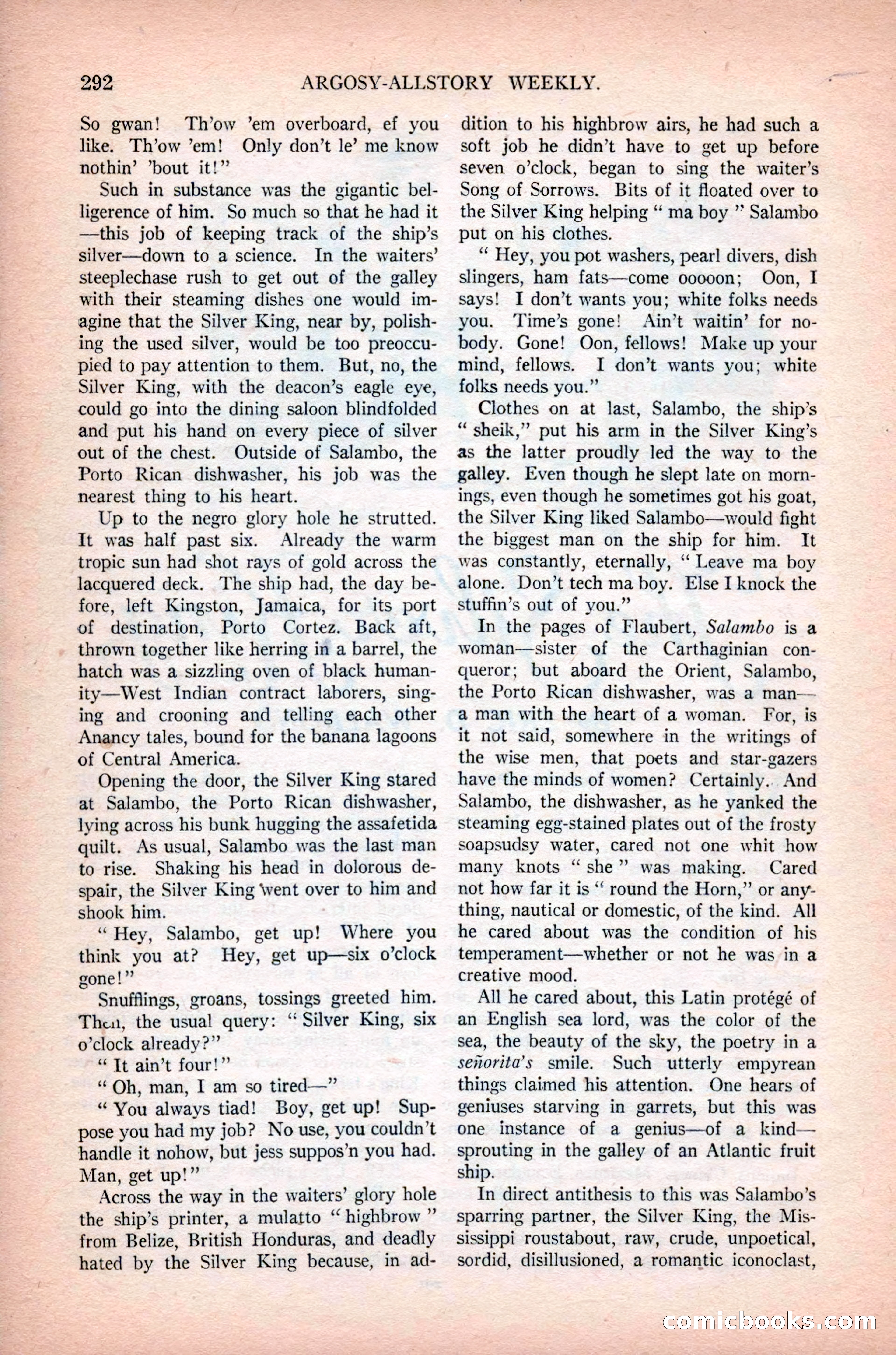
A restored page from Pulp Fiction, 1924. Page through the whole issue in the reader above.
📄 Transcribed text from this page (OCR, searchable)
Machine-transcribed from the original scan — historical spelling and the odd misread are preserved.
292 So gwan! Th’ow ’em overboard, ef you like. Th’ow ’em! Only don’t le’ me know nothin’ "bout it!” Such in substance was the gigantic bel- ligerence of him. So much so that he had it —this job of keeping track of the ship’s silver—down to a science. In the waiters’ steeplechase rush to get out of the galley with their steaming dishes one would im- agine that the Silver King, near by, polish- ing the used silver, would be too preoccu- pied to pay attention to them. But, no, the Silver King, with the deacon’s eagle eye, could go into the dining saloon blindfolded and put his hand on every piece of silver out of the chest. Outside of Salambo, the Porto Rican dishwasher, his job was the nearest thing to his heart. Up to the negro glory hole he strutted. It was half past six. Already the warm tropic sun had shot rays of gold across the lacquered deck. The ship had, the day be- fore, left Kingston, Jamaica, for its port of destination, Porto Cortez. Back aft, thrown together like herring in a barrel, the hatch was a sizzling oven of black human- ity—West Indian contract laborers, sing- ing and crooning and telling each other Anancy tales, bound for the banana lagoons of Central America. Opening the door, the Silver King stared at Salambo, the Porto Rican dishwasher, lying across his bunk hugging the assafetida quilt. As usual, Salambo was the last man to rise. Shaking his head in dolorous de- spair, the Silver King went over to him and shook him. “Hey, Salambo, get up! Where you think you at? Hey, get up—six o’clock gone!” Snufflings, groans, tossings greeted him. The, the usual query: “Silver King, six o’clock already?” “ Tt ain’t four!” “Oh, man, I am so tired—” “ You always tiad! Boy, get up! Sup- pose you had my job? No use, you couldn’t handle it nohow, but jess suppos’n you had. Man, get up!” Across the way in the waiters’ glory hole the ship’s printer, a mulatto “highbrow ” from Belize, British Honduras, and deadly hated by the Silver King because, in ad- ARGOSY-ALLSTORY WEEKLY. dition to his highbrow airs, he had such a soft job he didn’t have to get up before seven o’clock, began to sing the waiter’s Song of Sorrows. Bits of it floated over to the Silver King helping “ ma boy ” Salambo put on his clothes. ‘“ Hey, you pot washers, pear! divers, dish slingers, ham fats—come ooooon; Oon, I says! I don’t wants you; white folks needs you. Time’s gone! Ain’t waitin’ for no- body. Gone! Oon, fellows! Make up your mind, fellows. I don’t wants you; white folks needs you.” Clothes on at last, Salambo, the ship’s “ sheik,” put his arm in the Silver King’s as the latter proudly led the way to the galley. Even though he slept late on morn- ings, even though he sometimes got his goat, the Silver King liked Salambo—would fight the biggest man on the ship for him. It was constantly, eternally, ‘“‘ Leave ma boy alone. Don’t tech ma boy. Else I knock the stuffin’s out of you.” In the pages of Flaubert, Salambo is a woman—sister of the Carthaginian con- queror; but aboard the Orient, Salambo, the Porto Rican dishwasher, was a man— a man with the heart of a woman. For, is it not said, somewhere in the writings of the wise men, that poets and star-gazers have the minds of women? Certainly. And Salambo, the dishwasher, as he yanked the steaming egg-stained plates out of the frosty soapsudsy water, cared not one whit how many knots “she” was making. Cared not how far it is “‘ round the Horn,” or any- thing, nautical or domestic, of the kind. All he cared about was the condition of his temperament—whether or not he was in a creative mood. All he cared about, this Latin protégé of an English sea lord, was the color of the sea, the beauty of the sky, the poetry in a senorita’s smile. Such utterly empyrean things claimed his attention. One hears of geniuses starving in garrets, but this was one instance of a genius—of a kind— sprouting in the galley of an Atlantic fruit ship. In direct antithesis to this was Salambo’s sparring partner, the Silver King, the Mis- Sissippi roustabout, raw, crude, unpoetical, sordid, disillusioned, a romantic iconoclast, CORNICE OOKS (F@)