
Pulp Fiction, 1924 · page 113 of 166
Argosy All-Story Weekly, February 23, 1924 — page 113: what you’re looking at
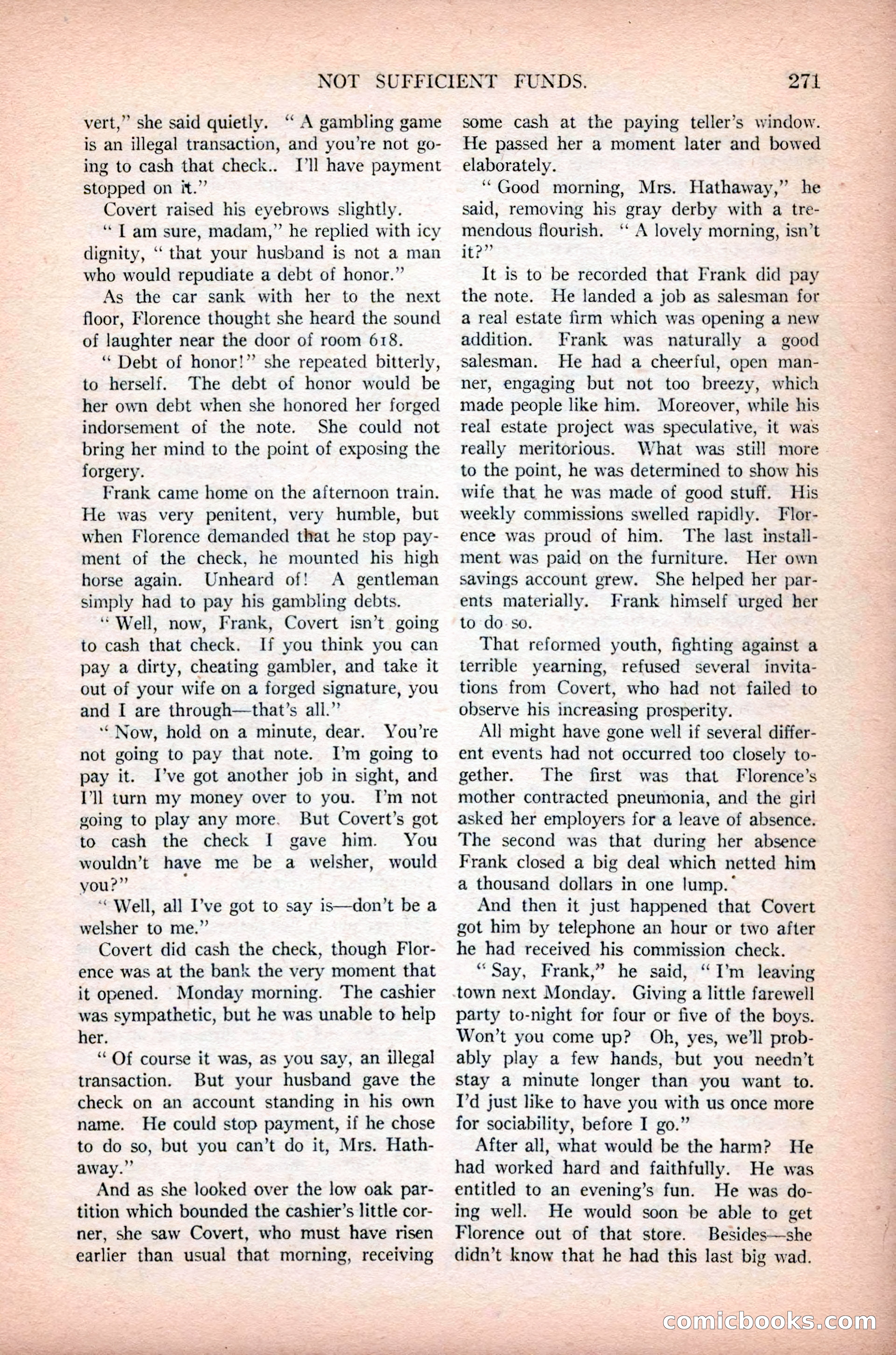
A restored page from Pulp Fiction, 1924. Page through the whole issue in the reader above.
📄 Transcribed text from this page (OCR, searchable)
Machine-transcribed from the original scan — historical spelling and the odd misread are preserved.
NOT SUFFICIENT FUNDS. vert,” she said quietly. ‘“ A gambling game is an illegal transaction, and you're not go- ing to cash that check.. I'll have payment stopped on it.”’ Covert raised his eyebrows slightly. ‘Tam sure, madam,” he replied with icy dignity, ‘“‘ that your husband is not a man who would repudiate a debt of honor.” As the car sank with her to the next floor, Florence thought she heard the sound of laughter near the door of room 618. ‘Debt of honor!” she repeated bitterly, to herself. The debt of honor would be her own debt when she honored her forged indorsement of the note. She could not bring her mind to the point of exposing the forgery. Frank came home on the afternoon train. He was very penitent, very humble, but when Florence demanded that he stop pay- ment of the check, he mounted his high horse again. Unheard of! A gentleman simply had to pay his gambling debts. ‘Well, now, Frank, Covert isn’t going to cash that check. If you think you can pay a dirty, cheating gambler, and take it out of your wife on a forged signature, you and I are through—that’s all.” ‘“ Now, hold on a minute, dear. You're not going to pay that note. I’m going to pay it. I’ve got another job in sight, and I'll turn my money over to you. I’m not going to play any more. But Covert’s got to cash the check I gave him. You wouldn’t have me be a welsher, would you?”’ ‘Well, all I’ve got to say is—don’t be a welsher to me.” Covert did cash the check, though Flor- ence was at the bank the very moment that it opened. Monday morning. The cashier was sympathetic, but he was unable to help her. ‘Of course it was, as you say, an illegal transaction. But your husband gave the check on an account standing in his own name. He could stop payment, if he chose to do so, but you can’t do it, Mrs. Hath- away.” And as she looked over the low oak par- tition which bounded the cashier’s little cor- ner, she saw Covert, who must have risen earlier than usual that morning, receiving 271 some cash at the paying teller’s window. He passed her a moment later and bowed elaborately. ‘Good morning, Mrs. Hathaway,” he said, removing his gray derby with a tre- mendous flourish. ‘‘ A lovely morning, isn’t it?” It is to be recorded that Frank did pay the note. He landed a job as salesman for a real estate firm which was opening a new addition. Frank was naturally a good salesman. He had a cheerful, open man- ner, engaging but not too breezy, which made people like him. Moreover, while his real estate project was speculative, it was really meritorious. What was still more to the point, he was determined to show his wife that he was made of good stuff. His weekly commissions swelled rapidly. Flor- ence was proud of him. The last install- ment was paid on the furniture. Her own savings account grew. She helped her par- ents materially. Frank himself urged her to do so. That reformed youth, fighting against a terrible yearning, refused several invita- tions from Covert, who had not failed to observe his increasing prosperity. All might have gone well if several differ- ent events had not occurred too closely to- gether. The first was that Florence’s mother contracted pneumonia, and the girl asked her employers for a leave of absence. The second was that during her absence Frank closed a big deal which netted him a thousand dollars in one lump.° And then it just happened that Covert got him by telephone an hour or two after he had received his commission check. “Say, Frank,” he said, “I’m leaving town next Monday. Giving a little farewell party to-night for four or five of the boys. Won’t you come up? Oh, yes, we'll prob- ably play a few hands, but you needn’t stay a minute longer than you want to. I’d just like to have you with us once more for sociability, before I go.” After all, what would be the harm? He had worked hard and faithfully. He was entitled to an evening’s fun. He was do- ing well. He would soon be able to get Florence out of that store. Besides—she didn’t know that he had this last big wad. COMIC OOO K<S (E@)